Transcript (captions)
Hi, it's Simon. Claude Opus 5 has just turned up. It's practically half the price of Fable and is already better at knowledge work. This makes Claude co-work and using Claude for everyday workers and users like me twice as good and twice the value. So, I thought I'd run a little test in front of you while we talk about what Claude has announced.
Here's what you need to know. Now, first of all, Opus 5 is the new default model for Max plans using Claude co-work and there's a good reason for that. It will manage complex tasks at half the price of Fable and often do a better job. What is way more important here is that Pro plan users get included access to Opus 5. Fable was on top of that.
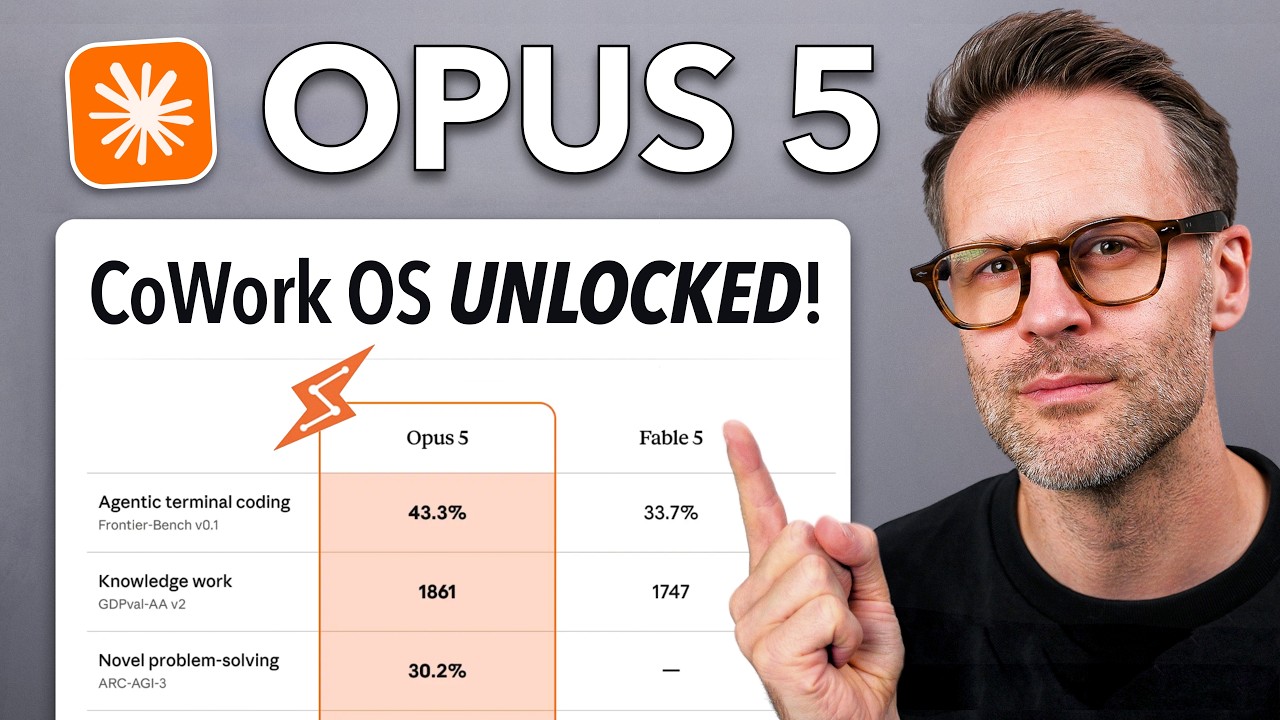
You had to pay on top to use it. That makes something like using a system like my co-work OS system, which can be a little bit more token heavy, way more affordable, but way more powerful. If you jump into the benchmarks, you'll see here that it it behaves slightly differently. It's kind of jumping ahead of Fable on a huge amount of things in terms of agentic search, multi-disciplinary reasoning, computer use. It's really, really solid.
In fact, the only few things that it's behind Fable are things like health, legal, agentic coding only just. But, the big headline is that it's outperforming Fable and other frontier models on the benchmarks Anthropic has shared for both knowledge work, business processes, and problem-solving. And that is why it's such a significant update for most knowledge work and regular users. Because, if we jump down to the performance and the costs, what you'll see here are like the score and then the cost per attempt. And we're seeing like a much higher score, but it's kind of aligned with the old Opus 4.8.
And you can see that Fable starts like halfway up the charts. So, what we're seeing is Fable is more expensive to be slightly less effective in some instances. So, this is kind of a really nice balance of being able to use this and look, there you go. Opus 5 outperforms every other model at any given cost surpassing Fable's 5's best result at just over a third of the cost. Just look at this automation benchmark for like automated workflows using AI that Zapier put publish and looking at this leaderboard Claude Opus absolutely cleans up.
Look at this, 26.2% score and the cost per task of an average of 1.27. You then have to go down to Fable down here to see it at almost twice the price and 10% less effective essentially. That is a serious upgrade. So, I'm going to give it this prompt to review my agenticbusinessmethod.com website and create me a motion graphic animation that celebrates my Casa method which is a process for transforming your business to be ready to use AI that it can add to the landing page. So, I'm going to copy this prompt.
I'm going to send it off to Opus 5 high and then I'm going to start a new one and do it again but also get it to do it with Fable 5. So, those two are now running. [music] We'll let them run and in the meantime, here's the headlines you need to know about Opus 5 and why Anthropic may have released it [music] this week with the very recent news and release of the latest Chinese models in Kimi K3, I think it's called a Kimi K. They are just getting so much closer. Not that long ago, people were talking about how they were 1 to 2 years behind the Chinese open source models.
Then with Fable, they were like, okay, they're about 8 months behind. Now it's really minuscule and the cost and adoption of those other models like Kimi are worth taking seriously now, particularly if you're over here in Europe. And since they're doing them on open source, so you get all the weights, basically, it means that you can get the system, and if you want, run it for yourself and not have to be behind a gate of whether or not the US government lets us use it in the UK. Really interesting. Opus 5 is designed to bring you super close to the intelligence of Fable, but at half the price.
It can work for hours on a task, recovering from errors and rooting around blockers instead of stopping. This is just not something you could do on Opus 4.8. Fable did it, but it cost a fortune. Better quality control in its processes. It also checks on its own work as it goes.
So, if you're using it in something like Claude Code, it's going to be able to catch issues much earlier than the previous models did. And in the short time I've been trying it, I can see its judgment is better. It more regularly asks clarifying questions before guessing. It pushes back on flawed instructions, and it considers the implication of the work before it jumps in and does it. In fact, here's a great example.
Where should this motion graphic live? Was what Fable asked, and Opus is saying, "Where will it be used? That decides the canvas." We're going to go for that. That's a good one. Okay, so these are the results.
I'm not going to tell you which one is which because it's really fascinating. So, first of all, we've got this rather nice infographic in the style of my brand deck, uh which is in Claude design. Only one of the models found it and used it, which is very interesting. I then This is a a different model, which followed a brand deck on my co-worker Wes's setup. So, within these folders here, it followed the uh the design language guide up here.
And then this is the third, which honestly is by far my favorite and and kind of remarkable. I mean, look at this detail. It's totally fantastic. It's doing a really good job. So, I'm sure you'd be interested to know which one has done which.
Well, Fable, first of all, when it ran its commands, could not find the brand deck guide, and I asked it for a 16 by 9 version, and it didn't give me one. I then re-asked it for it, and it did in the end do it. And here it is. The first version of running Opus 5 asked qualif- qualifying questions, but it did manage to, where Fable didn't, find the Design Sync with Claude Design down here. And it also kind of messed up.
It delivered a kind of also a vertical version, but eventually got there and created this very impressive presentation. So, that was pretty good. So, then I got Opus 5 to not go and read those things and read the same guidelines that Fable did, and we got a much more involved questioning. So, it asked me two qualifying questions, which I think is really good, and it resulted in much, much better results. And I'll be honest, the two are doing the same thing.
If anything, I would say that Opus is a better design. But, that's not really the point here, because actually Fable's design is going to have cost me almost twice what Opus cost. Now, Opus did take, admittedly, a little bit longer. It probably added another 3 minutes onto the continuous task, but the result outlining my cat's the framework, I'm putting this on the website. This is absolutely remarkable.
And a nice little pointer to show you just what's possible from a single prompt with Claude now and its built-in design system, where it can built build motion graphic animations. So, we'll get this over on my agenticbusinessmethod.com, and while we're there, make sure you go and check it out and join the waitlist, which will allow you to sign up to be amongst the first to hear about a number of things, our Notion business OS, but also a cohort where we will help non-technical business founders, entrepreneurs, creators to adopt agentic AI without being technical. I'll show you how to move from scattered information to consolidated architect systematized and agentic workflows in your business. Pretty cool. So, uh yeah, go and check this out.
I think you'll probably see that animation on the website soon uh and we'll hopefully see you in the mailing list. Now, I've just finished filming a video that shows you [music] exactly how to run Claude co-work synced across multiple devices. Meaning you can have a fully custom co-work OS setup [music] that you can take anywhere and use across multiple computers. That is coming out at the end of this week. So, make sure you subscribe to Systems Made Better to see more on that.
And if not, go and check out my recent videos on how I'm using Notion and Claude together alongside my [music] co-work OS system to get set up with these things quicker and easier than you think. And you should watch this video next to get started with Claude or this one for how to >> [music] >> move your Claude setup to a multi-device sync. Amazing. See you there and thanks for watching. Bye.