Transcript (captions)
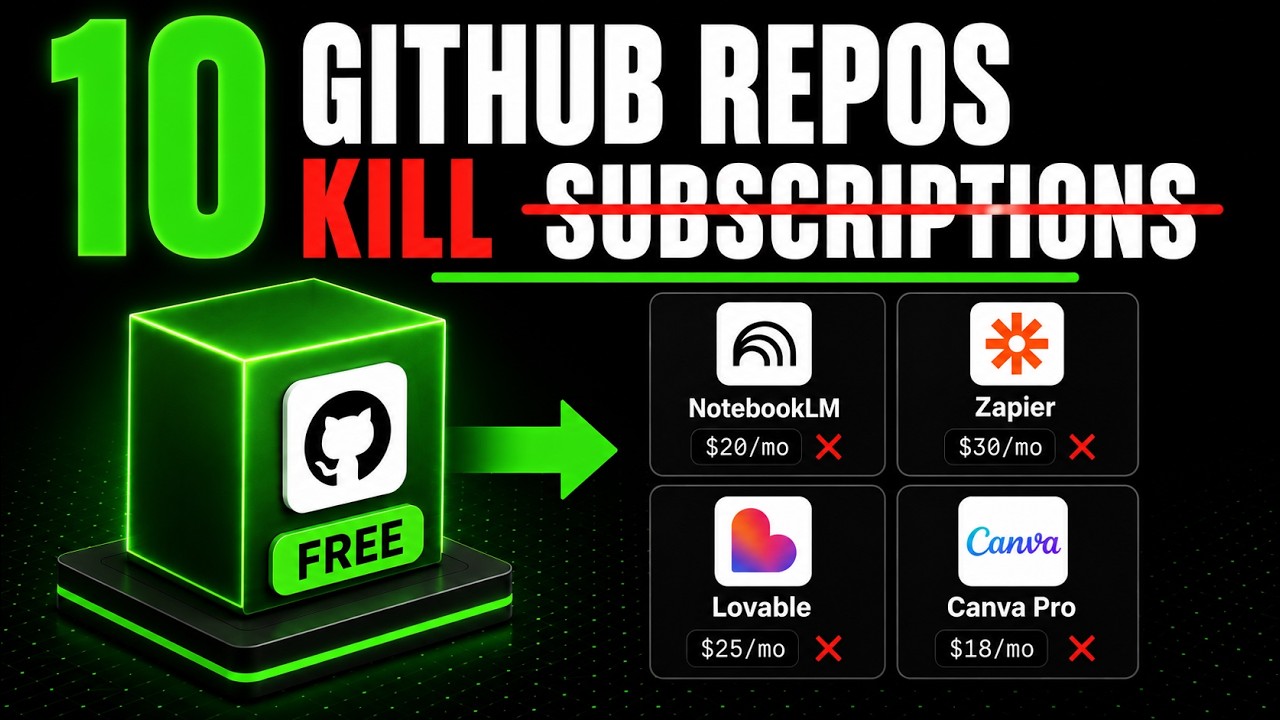
11 subscriptions, $219 a month, charged before you open a file. That is the AI stack a lot of developers are renting right now, and it renews without being asked. Notebook LM 20, Perplexity 20, Superhum 30, Zapier 30, Grammarly 12, Lovable 25, 11 Labs 22, Canva 18, Otter 17, OpusClip 15, $2,600 a year. At $285 a card, that is a used RTX 3060 every 6 weeks. 10 open source projects take that number to zero, and eight of the 10 were pushed to GitHub this week.
Seven carry between 12 and 36,000 stars, so they are past the weekend project stage. The other three are under 3 months old, which is why they are missing from every other list. So, the bill stays in the corner of the screen from here on, and it only moves in one direction. One of these 10 I would not hand to a paying client yet. I will name it and say what breaks.
First target is the $20 Google charges for Notebook LM inside its AI pro tier. Open notebook is that product as a container you run yourself. 36,400 stars pushed two days ago. Point it at PDFs, links or audio and you chat with your own sources. It runs on Docker with Surreal DB behind it.
MIT licensed and it will talk to 18 different model providers, OpenAI, Anthropic, Alama, Deepseek, whatever you already pay for or already run locally. Google gives you Google. It also makes the podcast the feature that sold the whole tier except it stages one to four speakers instead of two. $20 comes off, but it only knows the documents you hand it and most questions start before the documents exist. SurfSense starts there instead.
Same notebook idea except the corpus is the live web, Reddit, YouTube, Instagram, Tik Tok, Indeed search with your own Slack, Notion, and GitHub index beside it. 15,800 stars in a push today on a repo that has been running since July of 2024. Notebook LM Perplexity and Glean folded into one box you host. So the $20 for Perplexity Pro goes with it. 40 off the bill and neither tool has cost anything but disk.
Both of those need something already written down. The thing you actually need was said out loud in a meeting and then it was gone. Otter and Fireflies sell that memory back at $17 and $18 a month. The price of that is where the recording lives. Meily records on your own machine MIT licensed Windows, Mac OS and Linux live transcription through parakeet or whisper which the project advertises at four times faster than real time.
The minutes come from a model you pick locally or claude groout any open AI compatible endpoint speaker diorization is the paid pro tier not the free build the readme says. So, even where the repo blurb does not 28,400 stars and search YouTube for the name, the results run dry after a few clips. For a legal, medical or client call, nothing leaving the machine is the whole argument. $57 gone. So far, the trade has been easy.
The next four are the expensive lines, and each one asks for something back. Superhum is $30 a month, the biggest single charge here, and it sells one thing, an inbox that sorts itself. Inbox zero does that sorting in the open. Rules written in plain English, replies pre-drafted in your own phrasing, bulk unsubscribe, cold email blocking, meeting briefs, a Slack or Telegram hook, and analytics naming the senders eating your week. 11,900 stars pushed today.
The cost is real. Docker, Node 24, PNPM, and an OOTH app of your own before a single message gets triaged. You are trading $30 a month for an evening. That evening is the pattern for everything left and active pieces is where it pays back fastest. Zapier bills $30 a month at the entry tier and meters you by task because the meter is the product.
Active pieces is the automation platform sitting in N shadow. 23,600 stars push today MIT licensed community edition 200 plus integrations and its readme puts 280 of them on MCP. 60% of those integrations were contributed by users. And the project describes its own deployment as self-hosted and network gapped. So the same flows run plus agents reaching your tools through MCP on hardware where the task counter does not exist.
Zapier comes off and half the bill is gone. Which is the place to ask the question that actually decides this. Which of these charges would you miss if it stopped billing tonight? Most people name the biggest one. The line that survives longest is usually the cheapest.
$12 sits under the threshold where anyone rereads a statement and Grammarly has been sitting there in every text box you own for years. Harper replaces it offline. Written in Rust by Automatic, the WordPress company. 14,200 stars. Linting a document in milliseconds on under a 50th of language tools memory.
Language server in VS Code. Neoim, Helix, Emacs and Zed, Web Assembly in the browser, and English only. The reflex that kept Grammarly on the card is the same one keeping lovable there at 25. Diad builds apps from a prompt on your own machine with your own model key. 21,000 stars pushed yesterday.
The code lands in a folder you own instead of a platform you rent, which matters the first time you move the project. Seven tools down, $154 off, and every one of them has years of issues behind it. The last three do not, and that is exactly the point of them. Audio CPP is 6 weeks old. One C++ engine on GGML, the same lineage as llama.cpp.
Running 44 families of audio model behind a single binary. Text to speech with Quing 3TS and Vibe voice. Voice cloning with fish audio and chatterbox. Speech to text with Quing 3 ASR. Music with Astep and stable audio 3.
CUDA rock mulcan metal or plain CPU plus a grad web UI. Its own release notes put the TTS paths at 1.8 to eight times faster than the Python references and Supertonic 3 at 10 hours of audio in 3 minutes on a 5090. The same notes are blunt about the limit. GGUF is a container, not a universal adapter. So backend coverage is model by model.
1,200 stars because it shipped in June. 11 Labs is 22 a month and Sunno is 10. This one binary takes out both, which is $32 killed by a project that did not exist in May. That is the trade the last three tools are offering. Design is the other charge that survives on Habit.
Canva Pro is 18 a month and most of what leaves it is a deck, a poster or a card. HTML anything is an agentic editor that writes those as one file of HTML. Feed it markdown, CSV, Excel, JSON or SQL. and a local agent produces the layout across nine surfaces, magazine, deck, resume, poster, social card, prototype, data report from 75 composable skills. Apache 2 8,100 stars in 3 months and it needs no API key because it reuses the agent you are already logged into.
Claude Code, Codeex, Gemini CLI, Cursor, Copilot, nine of them autodetected on your path. One click sends the result to X, WeChat, or Zub, or straight down as HTML or PNG. That leaves the $15 line most creators pay without looking. Opus Clip cuts long video into vertical clips and ranks them by predicted performance. Autoshorts is a Rust desktop app built on Tari that does the same job.
media in 9 by6 candidates out ranked with everything kept in a local equalite file under 700 stars seven weeks old and is the one I would not hand to a paying client yet. It transcribes through deepgram and analyses with deepseek or claude by default. The offline path exists and its own documentation says local models are not recommended for the ranking. So the verdict for anyone with a machine already running, Harper, active pieces, and meily are the three that stick because they replace a habit instead of a workflow. And habits are what a subscription actually bills for.
Self-hosting is not free either. Electricity, disc, and the Saturday the first install eats. Against $2,600 a year, that Saturday is the cheapest hour on the list. So, which one of yours goes