Enjoying this issue?
Get tomorrow's AI & engineering digest in your inbox — hand-picked, summarized, and always spam-free.
TLDR
Reactor argues that real-time interactive video generation, which it calls world models, will fundamentally change content creation and consumption by making video programmable like software. The company provides an API platform with four model types — Helios (interactive video from ByteDance), LinkBot (world model from Alibaba), LongLive2 (multi-shot film from Nvidia), and SoundStreaming (video-to-video from Nvidia) — but the technology is still in early stages, with unsolved problems in evaluation, memory, and frame rate. The key insight is that real-time video generation requires different infrastructure than batch generation, particularly around streaming, live session memory, and global low-latency routing.
Key points
Reactor defines world models as real-time interactive video generation, contrasting them with passive video generation models like Sora or Veo that produce fixed, unchangeable recordings.
The talk draws historical parallels: GPS made maps real-time and enabled Uber; digital viewfinders made video production interactive and enabled Instagram/TikTok. The claim is that real-time video will similarly unlock new applications.
Reactor categorizes real-time video models into three types: (1) infinite, interactive real-time video generation (like a real-time Veo/Sora), (2) world models like Google's Genie 3 that allow character control, and (3) live interactive avatars for customer support, sales, etc.
Reactor's platform exposes four model types via API: Helios (ByteDance, interactive video), LinkBot (Alibaba, world model), LongLive2 (Nvidia, multi-shot film), and SoundStreaming (Nvidia, video-to-video editing).
New applications being built on Reactor include interactive live streams where viewers vote on what happens next, medical simulation training, cooking simulation, and real-time video editing via prompting or clicking.
The talk claims that real-time video generation requires different infrastructure than batch inference, specifically mentioning streaming of pixels from server to client, maintaining context memory across live sessions, and global compute deployment to achieve sub-100ms latency worldwide.
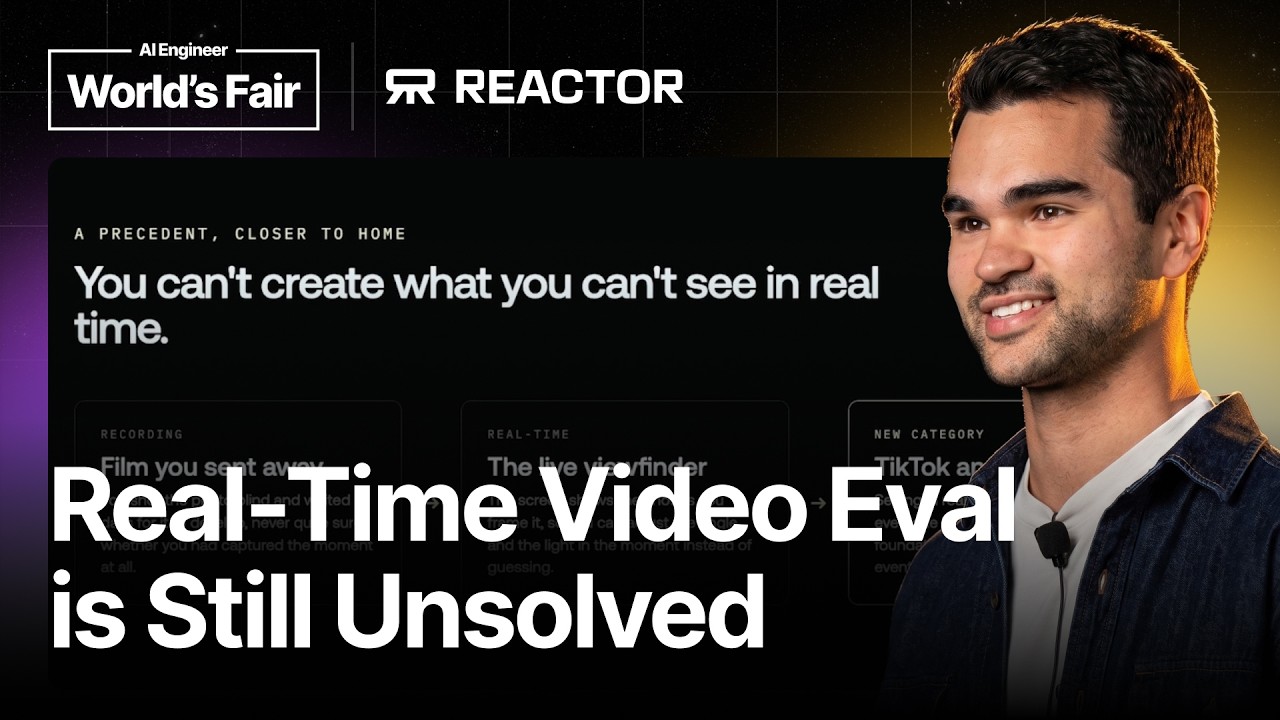
Evaluation of real-time models is described as an unsolved problem, with the presenter stating that current methods rely on human judgment and that even DeepMind has not solved it. Reactor has a research team working on it.
Current frame rate is 16 FPS; achieving 30 FPS requires multi-GPU optimization, quantization, and model weight optimization according to the presenter.
The company is at Series A and is building the platform as infrastructure, leaving deterministic rule sets and other features to the community to build on top.
Tools mentioned
Techniques
- Real-time video generation with streaming pixels from server to client
- Multi-GPU inference and quantization for achieving higher frame rates
- Global compute routing for sub-100ms latency worldwide
- Context memory management across live sessions for consistency
Stop scrolling. Start reading smarter.
Receive the day's most important AI & engineering updates in one concise email. No spam.
Transcript (captions)
[music] >> Hi everyone. Welcome to the talk. First of all, thank you all for making the time. I know it's the last talk of the day probably or I think the last one is
at 3:45 but yeah, thank you all for your time. I know you're all probably very busy. >> [snorts] >> Today I'm going to be talking about
something that is a little bit slightly futuristic though not for San Francisco and that's world models. I know here it's written real time interactive video but the way we think
about world models is really in the real time interactive video and I'll explain why. And in today's world I think world models is a little bit of a marketing
term that people think about it from a Gaussian splatting standpoint others from video but the way we define world models is really real time interactive video and I
have strong evidence or like beliefs that this will actually change everything in how we produce and consume content. Oops.
What happened? Sorry. Sorry about that. Cool. >> [clears throat]
>> So if you think about video, video has always been something passive. Before people used to produce videos and movies and then we would watch it. And in today's world we have these
models the VO3, the C dance 2 and what they do is you prompt them, you get back a file, you watch and good luck. It's a slot machine. You cannot change it. You cannot do anything about it.
So there's a question that we like to think about in our company is what happens when video becomes programmable like software. And what happens when pixels can be
generated in real time? Once this happens it actually changes completely how we think about consuming content and even producing content and I'll be talking about how in history
we've seen that real time has always been the future and the kind of applications that it unfolded and how you can get started today. Quick Quick background here. Um so, my
name is Ahmed. I'm the head of go-to-market at Reactor. My background is in computer vision and machine learning. Um and I state machine learning because this is the time where
we used to actually train our models. Um I built and shipped games on iOS uh on iOS and Android for fun. Um I was a founder um and uh today I'm the head of go-to-market at Reactor.
And who we are quickly is we're a series A company building the platform for these real-time world models. So, so far the main most of them have been still models, but we are building
the infrastructure and the developer platform to make them usable so that anyone can integrate these real-time interactive video, and we can democratize access to this technology.
I'll start with a problem. We can today generate pretty much anything, but we just can't change it, right? A generated video, as I mentioned earlier, is still a recording. You get it back, you can't
do anything about it. And real time changes what the medium is. It doesn't just make it faster. And I'm going to talk about two examples that actually show us what real time has
unlocked in the past. Before, in the 1950s and even before, we used to look at a map to know where we are. Someone produces a map, you look at
where you are, and that's it. You cannot do anything about it. Then GPS came. GPS made it real time. Suddenly, I can know where where I am at the instant that I can, you know, track
it. Now, you'd think GPS has just made it a bit faster to know where I am, but actually Uber would not exist if we did not have
the GPS. Another example, which is even a bit more powerful, I'd say. Before we used to do to use the film to produce content, right? We had a film,
someone shoots something, they can't see what they're shooting, they go somewhere, they produce that film, and then you can see it. And then it became digital.
You can start seeing what you're shooting. If today you pick up your iPhone and you start recording a video, then you can see what's going on and that's why we can
produce high-quality content. It's because you are able to see what's going on in the screen and adapt accordingly. That gave rise to Instagram and TikTok. Instagram and TikTok would not exist if
we could not produce high-quality content and the only reason why we're able to produce high-quality content among many reasons is because we can see in
real time what's happening. It's not a slot machine. We can actually just edit and see and that's what unlocks all of these new use cases.
So, when video becomes programmable, you can address it, you can condition it, you can change it. I can show you on the screen whatever I want to show you on the screen and it
becomes programmable a little bit like software or like anything that is programmable in the world. And in in the market today, we are seeing three
kinds of models that do this. Some of them you will be familiar with, others you will not be familiar with. The first one is these are Vio, think about Vio or Sora, but real-time and
interactive. Meaning that first of all, they're infinite. So, they don't stop after 5, 10, or 30 seconds. They actually continue forever.
They're interactive, meaning you can change what's happening on the screen. And they're in real time. So, you don't need to wait to see what's going on. And assuming this works, so this is an
example of a of a video that I passed an image with a dog and this was all generated in real time. And at some point, I'm going to prompt a cat shows up and you will see that a cat showed up
in the in the video. This would not be possible in the existing batch regular video generation models because you would get back the video and you cannot do anything about it. I could have added
anything. I could have gone on to create an entire story with it. I could have said the cat the dog starts running, starts jumping, a dragon shows up. It goes to, I don't know, to the World Cup.
All of this would have happened in front of you. These type These types of models like unlock a few things. First of all, control.
So, if you think about generative media today, the big problem that content creators all have is I don't have the control I need. Like, yes, it's great to use CDNS to review 03 to generate
videos, but I just don't have the control. And this is always the thing that any filmmaker or movie producer or any content creator will tell you. And so, real-time actually ends the slot
machine type of mentality and actually gives you the the control that you need. And a big thing I like to say is instant feedback is the ultimate level of control, and you we will never be
able to have this level of control if we don't have real-time. The second thing it unlocks, which, you know, among other things, which is a field I'm not particularly fond of, but
I think it's going to be big, is advertising. If I can know what you looked for a minute ago, why can't I insert the logo of whatever you've been looking for? Why
can't I produce an ad in real-time in front of you? We don't need to produce pre-produce anything. Now, granted, this is going to take some time because, you know, brands afraid of AI, afraid of you
know, if their logo has one pixel that is white instead of dark. But it will happen eventually. And so, and I think at the moment that happens, we will not be to need to produce any
ads anymore. Everything will be happening in front of you in real-time. The second type of model is the one that probably you're most familiar with. It's the Genie 3 like from Google.
These are models where you can pass an image and a text typically, and you can control a character. They're fun. The first thing that you
think about when you think about this is games, right? It's a character, it's a world, you can generate anything. But actually, it actually goes way far way beyond
games. It creates entire new interactive experiences where combined with the first types of models that I talked about, we've already been seeing people
in our community building a mix of games and and movies. If you've ever watched Bandersnatch from Netflix, which is the game the movie that you can pick your next scene,
this is one of those things that gets that that that becomes possible that you can control a character, you can control what's happening, and create entire new types of interactive experiences that
were not possible. The second thing is robotics. So, because you can simulate and you can control, you can actually create as much training data as as you want. And
robotics world models in robotics is actually a ginormous market today. I cannot tell you the number of robotics labs that are training and building these models. But, because you can
control whatever you want to control in any environment, this creates a new opportunity to generate infinite amount of data for robotics. And finally, something I like to think
about, this is more maybe a passionate thing that I have, is education. Um because you can step into anything, who with today's world in AI, I don't actually believe that in the future of
education is LLM based or textbook based. If you can put any any kid in the situation, for example, in a history lesson, that enables entire new types of
experiences that can be educational. The third type of model is probably the type of model that, you know, is more, let's say, something that we've been seeing before,
which is avatars, but live and interactive. The thing with avatars, though, is it hasn't actually been cracked. They're still all kind of weird. If you speak to an avatar in any
customer support or anything, it's still kind of off, right? And these types of models and we're seeing a rise of these live and interactive avatar models in research
preview that combined with model one and model two is actually going to be, I believe, a a big change in what we've been seeing so far. And this will be applied to
things like customer support, training, sales, gaming, streaming services, etc. And so, just give you a glimpse of what our users are building today at Reactor with these types of models. Some of them
are building interactive live stream. Right? A live stream where people are watching and then the users can type what happens next and then they vote. Why? Because pixels can be generated in
real time. So, there's no reason why I cannot put a live stream on X, YouTube, or Twitch and enable users to pick what happens next. Something that was surprising to me is a
little bit on on the medical simulation. So, we've seen users create applications where you generate a world and then you simulate what happens next. What if I put this medicine? What if I remove this
medicine? Right? And this creates can be a training playground for people wanting to become doctors. The third one, which is also kind of surprising, is cooking simulation. So,
people are building applications where you can simulate cooking and what happens if you put this ingredient. And finally, video editing. With video to video models, video
editing becomes very interesting because I'm able to just add visual effects in real time. And we've seen people build entire video editing platforms. Now, granted, they're not very good yet just
because of the quality of the models. But it's a new paradigm when you're able to edit videos just by a prompting or by talking to it or by clicking. And now, for the final part, how do you
actually do all of this? And this is why I like to say the world behind an API. At At Reactor, we have four types of models today. First one is called Helios, which is the interactive video
model that I talked about. This one is from ByteDance. Link bot, which is a world model like Genie 3, trained by Alibaba. Long live 2 from Nvidia,
which is multi-shot film. You can prompt things in advance and create a consistent story over time. And sound streaming, also from Nvidia, which is a model that does
video-to-video editing. So, people are already using this, for example, by shooting something or creating something on C dense 2, uploading it, and then adding visual effects, removing people,
adding background. And this gets very interesting in previous realization, for example, for Hollywood movies. And under the hood, when we talk about infrastructure,
the thing that I think I like to drive home is building infrastructure for regular video generation models is very different from real time. Because in regular video
generation models, you're talking about requests. You just send a request, a job gets run in the cloud, and I'm oversimplifying here, but you know, a job runs in the cloud, and it gives you
back a file. With real time, it's a different ballgame. Uh you cannot just take what works for batch inference and apply to real time inference.
For example, you need to think about streaming, right? Once you need to think about streaming, um pixels uh from a server to the client, um it adds entire new entire
complexities that batch generation does not have to think about. The second one is that everything is a live session. So, everything runs constantly, and there is memory to be
kept into account. Now, granted, one of the things that live live real-time models struggle with is memory. If you've seen demos from Genie 3, for example, we've all seen
that the character can look back and then will not remember what what's going on. So, there is a lot of work that needs to be going into maintaining that context window, so that you can remember
what happened if you turned your character left and right. And finally, global scale. If you If you think about real time, it needs to be sub-100 millisecond latency
anywhere you are. And if you're deploying applications in the world, then someone based in India or someone based in Japan should be routed to a GPU that is based in India
or Japan, or as close as possible to it. If not, if you don't have the compute worldwide, then the experiences are not real time anymore and it breaks completely the medium.
And with Reactor, this is as easy as it gets to integrate these real time months. Okay, I kind of maybe over simplified it a little bit here, but it really is
maybe 10 lines of code and we have docs to do all of this, but essentially you can just load the model with an API key and just start integrating it in whatever video image plugin, anything
that you're building. And if you want to get started, there's a QR code there and I've added a promo code AIE2026 which will give you $75 off, well, $75 worth of credits which is
um significant amount of compute in our case because we make the models extremely cheap. Thank you very much.
>> [applause] >> I'm happy to take questions if anybody has a question. Oop. Hey.
>> So, with all the 16 FPS was uh stated frames per second what would it take to get that to the normal 30 FPS? >> Uh
well, one thing that actually we do is multi GPUs. So, we use multiple GPUs um up to optimizing the model weights, applying quantization techniques. So, there are ways, it's just a matter of
priorities, but it is there are ways around it. Yeah. Good question, though. Hey. Yeah.
>> I'm I'm wondering if you're going to be showcasing something at IBC >> Sorry? >> Are you aware of what the IBC is?
>> Uh no. >> The International Broadcasting Convention. >> Okay. >> So,
>> I was wondering if you're going to be presenting some of your case studies with our stuff and the uh industry and >> I wasn't, but now I'm going to look at it. Yeah.
>> [laughter] >> Yeah. Yeah. >> Yeah. How do you feel like about letting uh some deterministic engines
>> Yeah. >> And then you get like a feedback maybe >> Yeah. >> Did you guys experiment with that? Can you share something?
>> When you say deterministic engines, what do you mean exactly? >> Oh, any kind of like deterministic rule sets that you check against maybe some of the simulation space
uh random >> Hm. So, we don't do any of that today. Um the reason why also we build a developer platform and but we've seen people build
that on top of us. Um building the infra for this is already a lot of work. Um and I think we we are seeing already developers building and
then open sourcing and then we may use it. Um but so the community is doing it for us, which is even better. Yeah.
Sorry, question? Yeah. >> How do you measure the algorithm consistency? >> Uh you're asking a question that the entire research community in world
models has not answered. Your evals for real time and consistency is uh and fidelity Well, fidelity is easy. It's just like pixels, right? But um evaluation for these real-time models is
an unsolved problem. So, today it's literally just look at it and human judgment. That's what it is today.
And this is including, by the way, Deep Deep Mind and everything. Nobody has solved this problem yet. Uh we're working on it. We have a research team. Yes.
>> [laughter] >> Awesome. Cool. Well, thank you, everyone. Thanks for your time. >> [music] >> Mhm.