Enjoying this issue?
Get tomorrow's AI & engineering digest in your inbox — hand-picked, summarized, and always spam-free.
TLDR
Enterprise tech stacks fail AI agents not because of model accuracy, but because they lack the architectural primitives—immutable audit logs, object storage with zero-trust data access, human-agent equivalence, and built-in evals—that regulated environments require. The common mistake is building a POC for accuracy first and bolting on compliance later, which produces brittle systems. The better approach is to treat enterprise constraints as foundational design principles from the start.
Key points
Enterprise AI deployments in regulated industries like healthcare face requirements around audit trails, data governance, human escalation, and evaluation that typical POC architectures ignore.
An immutable, append-only transaction log (event sourcing) makes auditability trivial: every agent action, data access, and authorization is recorded as a complete, timestamped event.
Separating the event stream (what happened) from object storage (the actual data used) allows developers to debug and observe agent behavior without accessing sensitive PHI, and enables zero-trust data access via tokens.
A human-agent equivalence pattern—where any action an LLM can take can also be taken by a human—makes escalation dynamic and transparent, since downstream steps don't care whether the action was performed by a model or a person.
The same architectural primitives (immutable ledger, object storage, human-agent equivalence) naturally enable privacy-preserving evals: replaying past events with tweaked prompts/models, comparing human vs. agent outputs, and running evals on production data without exposing sensitive information.
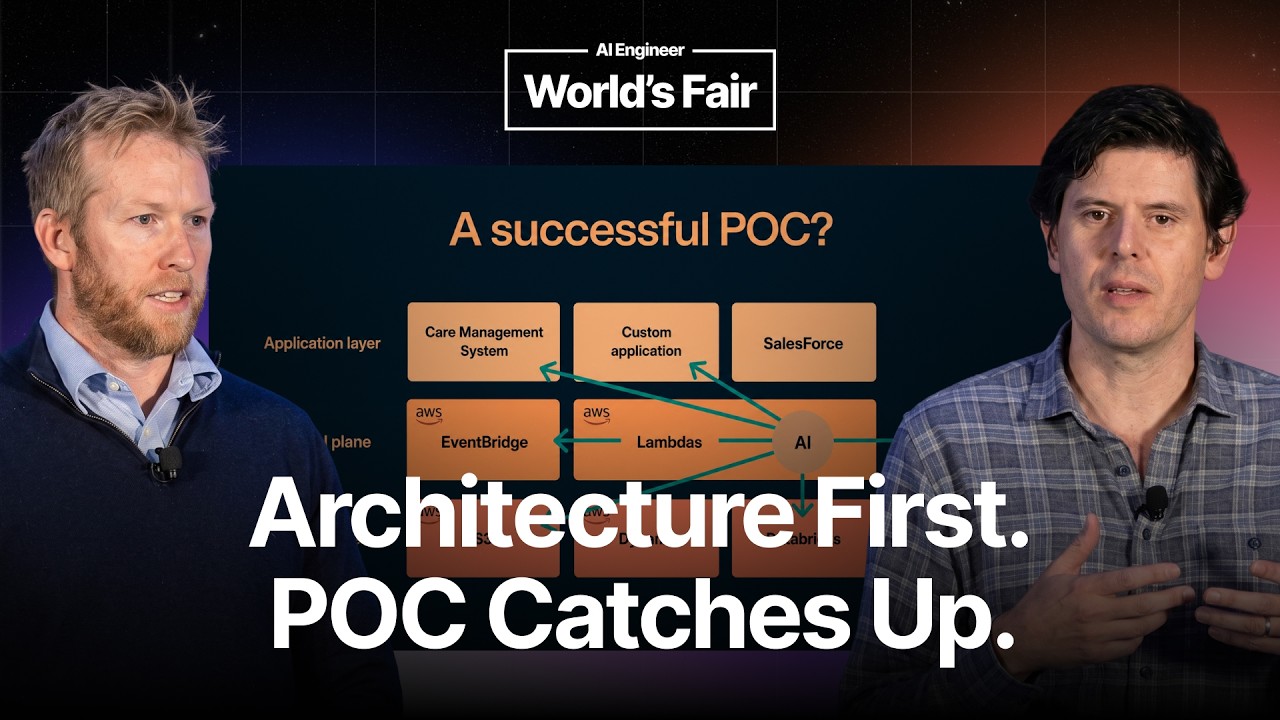
The common failure mode is building a POC for accuracy first and then trying to bolt on audit, security, and eval requirements later, resulting in a brittle system that is hard to generalize.
The recommended approach is to treat enterprise constraints (auditability, data governance, escalation, evals) as foundational architectural principles from the beginning, then build toward POC accuracy on top of those primitives.
Patterns from finance, defense, and big tech—like event sourcing and zero-trust object storage—can be adapted for AI agent architectures in regulated environments.
Tools mentioned
Techniques
- event sourcing (immutable transaction log)
- object storage with schema-driven access
- zero-trust data access via tokens
- human-agent equivalence pattern
- privacy-preserving evals via replay and human comparison
Stop scrolling. Start reading smarter.
Receive the day's most important AI & engineering updates in one concise email. No spam.
Transcript (captions)
[music] >> Okay. Hello everybody. My name is Chris Lovejoy and I'm a member of technical staff at Anterior
and I work as a forward deployed engineer. So I embed within enterprise organizations and help them get value from using AI agents. And I previously worked at Anterior with
Saul. >> Hi everybody. I'm Saul. I'm VP of engineering at Anterior. We're a New York based company selling AI uh
agentic AI to US health insurance companies. Um Chris and I have spent a lot of time building in enterprise and in health
care enterprises particularly. And health care is a very challenging place to develop and deploy AI. Uh health [clears throat] care is so
challenging because of the requirements around process and uh compliance, the regulatory requirements that that that are so important. Also because of the uh direct real
impact that your work has on people's lives, which is of course also what makes it so rewarding. Um I think a lot of the learnings you can take from working in enterprise for
health care, you can take to enterprise in other regulated industries. Like finance, defense, government work, anywhere where process is so important and has to be followed.
>> In this talk we're going to talk about um some of the learnings that we've had and specifically we're going to talk about why enterprise tech stacks aren't ready for AI agents and some of the
primitives that we've built in the past in order to unlock them. And to make this concrete, let's start by considering a scenario that might be familiar to many of you, which is the
the enterprise proof of proof of concept, the enterprise POC. And let's say we have identified a customer that we want to serve, and we've identified a priority use case
with them. So, obviously we're on the healthcare track here. Let's consider a um a large health system and a use case that is some sort of administrative healthcare workflow.
So, you work with them, you scope out a POC, you define the metrics that you are going to care about, you're going to bench benchmark yourselves on. Um you allocate two engineers, you spend
4 weeks building it, and um the actual build-out might look a little bit something like this. >> An enterprise stack is very complicated.
It's much, much more than we're showing here, but generally you can have an application layer, a control plane layer, the data plane. For your POC, you're going to need some
access to the model provider as well. And your POC is going to need access to data across all of these different planes. It may be some in the data lake, some directly from the application
layer, for example. And so, you're going to deploy it something like this. It's going to connect to all these different places. There's going to be some offline data pulling. There's going to be some
maybe some online. Generally, you'll get access to the data and push towards the results. >> And so, things go well. You you get great results. The the AI performs you
know, as you expected. You you hit the performance metrics. Um you know, it's fast. It's relatively cheap. And you hold a meeting, you present this to the relevant stakeholders, and everyone
seems pretty happy. Um so, you know, your chief of finance um in the in the company is very excited and wants to understand what's going to be the impact on the budget for next year. Uh your
chief medical officer is excited to tell his his colleagues, you know, how accurate his AI is. Um and the head of sales asks, "Okay, when can we put powered by AI? When can we put that on
the websites?" Um but the problem is that everyone here is assuming that the the hard part is done, that the AI was was the challenging part. But actually, as we know, often getting things into
production is really where the challenge lies. Um and to get a bit more specific on what that challenge looks like, um
you hold a meeting the next day, you bring in the relevant stakeholders to discuss productionizing this proof of concept application. And somebody raises their hand and says,
"Um can I see the the audit trail for this? Like for us, for compliance, it's critical that we can see every step, every action that the agent takes, every piece of data that it accesses. Can can
you give that to me?" And you realize actually, you know, with the way things have been implemented in the initial POC, without these um kind of true integrations,
that actually that's going to be quite challenging. And then somebody else um pops up with some other questions. So, somebody asks, "Okay, well actually, how is data
sensitive data being handled here? Um how's that being passed to the agents? You know, we have a very strict boundary around where our data can go and where it can't go. Um is it is this respecting
that? How does that look?" And then your chief medical officer says, again, "Who's approving the decisions here? Because we know in certain scenarios, we have to escalate
to a clinician who will then uh you know, approve or or or not agree with what the agent is saying. Um so, how does that happen? Like what's the mechanism for that?"
And over the course of the meetings, you know, you can imagine you get more and more questions. So, can untrusted data manipulate the model? How do we know that the agent continues to perform
well? How do we deal with integrations? How do we connect to Epic, to Salesforce, to the other kind of applications that we care about? And for the purposes of this talk, we're
going to focus on these four, the highlighted ones. For the other two, feel free to come and chat to me and talk about these later. We're very happy to talk, but um just in the interest of
time, we'll stay focused. And let's start with uh this one about the audit trail. >> So, this is a question you're guaranteed to get from the security team. They're
going to want to see an audit trail. And for programmers, an audit trail sounds very like a typical developer log you might have in DataDog. Surely it's it's it's a similar kind of thing. But
for security frameworks that that exist in the real enterprise world, like SOC 2, HITRUST, HIPAA, an audit trail is is a bit more than that. It it has to contain a complete
record of absolutely every action that the agent took. It has to contain all of the places where the agent accessed data, all of the authorization by which the agent did something.
It's it's this complete record in in a much more fundamental way. And uh you one way of thinking about it is in a legal sense. It say our agent's decisions came up in
a court of law. Could we show a justifiable chain of evidence for why the particular actions were taken by a decision? And that's something that could easily happen
within the health care context, for example. When I think about architecting systems like this, I think often about what do I want to make easy?
What are But when I'm choosing my constraints, I'm saying, "Okay, these are the things I want my system to be easy and let that drive the trade-offs
that that I'm going to make." And a particular pattern that uh uh is used in lots of different industries, for example, in finance, is a transaction log.
An immutable record of events that store all of the transactions that happen throughout the system. And this is append-only timestamp log. It's complete. So, this is your source
of truth for all of the data of the system. And it's unified. So, there's only one source of truth across all of the different agents that you might have
running in parallel, for example. And architecting this way, the making this trade-off, uh means that auditability becomes trivial.
It falls out of your data storage paradigm that you've chosen. It sort of is impossible not to be able to roll back time and and see exactly the state of the system at a a particular point in
time and be able to uh provide that as an audit trail for what happened uh uh each point in time. And of course, these are trade-offs. So,
what's the trade-off you're making here? I think we could say that for this kind of event logging or sometimes called event sourcing pattern, writes become very easy. So, you just drop an event.
Reads become more difficult because you have to read through all of the events in order to reconstruct a view of what happened. And there are patterns like caching and
snapshots so you can bring to to to make that that simpler, but there always is more effort there. Although, I have seen in in the healthcare context that
actually, you're going to want different interpretations of the raw data that your agents recorded after the fact. So, for example, it might be that more events happened and that changes
the interpretation of the healthcare journey, and you want a different view of the the source of truth at that particular time. And this pattern makes that easy because
all of your views of the data are ephemeral computed projections of the event log. Um okay. Next,
the compliance officer comes and is asking, "How is the sensitive data passed around the system? What's the life cycle of data within our system?" And within a healthcare context, as we
all know, data means a lot. It's PHI, protected or personal health information. It's has legal restrictions around it. Not
just HIPAA, but other legal restrictions about the use of people's data. You cannot have your agent, just as you cannot have humans, accessing and reading and utilizing healthcare data
that they don't absolutely have a necessity to use at that that point in time for that particular journey. And so,
again, architecturally, when I think about how am I storing data within a particular system, I would like to think, "What is the shape of the data, what kind of characteristics does the
data have? For health care data, that might be that it's very complicated. It doesn't follow strict hierarchical um relationships. It's uh sometimes unstructured and it's
sometimes structured. It could be very large. For example, health care data but one piece of health care data can easily be over a megabyte in size or or much more than that.
Uh it has strict access controls. As we've been saying, the R back comes into play like uh both for humans and and then for agents downstream of that. Uh
it may even be we I've seen customers where they're not willing to have their health care data leave their own environment, leave their on prem VPC for example. So, we have tangential access
to their to their data. And so, an architectural paradigm I might go to is object storage. Schema driven object storage, I think is a good fit for this. It's m- matches
well with the choice of using event logging because you can separate the two. So, the events we talked about as the record of what the agent is doing at any
particular time only contain references to the schema driven blobs that are the storage of the actual health care data itself. And uh it's important therefore that the
health care data is stored immutably again so that you can always go back in time and reconstruct what data the agent had access to at that particular point in time.
This separation of events for what happened and object storage for the data that was used at that particular point in time has actually some some very useful
benefits. For example, with a system like this, it's possible for developers to go back and debug and have observability over what happened, what particular steps the agent took, why it
did that, and and retrace the agent's steps without having access to the personal health information itself. Although because of the schema driven,
they can see the shape of that data, they they can't and to be honest, often won't be able to be given access to that health care data. So, you can separate out observability
and orchestration and instrumentation from the health care data itself. And this then has another benefit, which is zero trust. It it the object storage becomes a place
where you can apply zero trust principles. Your agents can bear tokens and use those tokens to access the data at the point of use and not allow data to flow
around the system as it likes. This then leads into a mitigation for prompt injection for the lethal trifecta. The way I think about the lethal
trifecta is can I solve for the constraint if I have an agent at point A with access to this data? Is it possible within my architecture for the agent to be also
accessing data over here? And zero trust principles, tokens are bad by the agents and object storage segregated from the event stream that has your orchestration logic gives you a
place to be able to solve for that constraint. It won't be possible for the agent to access data within the same process that that you've given it the the previous data.
>> Okay, so then it comes to how do you handle escalation? And in many scenarios, you will want to be able to escalate the decision that an agent makes or an action that an agent
makes to a human. But one of the challenges here is that this is quite dynamic. So, you don't know in advance when exactly perhaps the agent's going to escalate. It could be
that you're asking the AI to escalate when it's not sure. Um it could be that you define some sort of rules in your system, maybe in a medical context, the treatments going
above a certain threshold means that it needs to be escalated uh for an approval. But [snorts] this makes it very challenging because of this this
inability to predict. And a second challenge is also that humans and LLMs ultimately process context differently. You know, LLMs will have no problem if you give them massive
massive amounts of text, but humans that's not the case. So, what we've seen is that one pattern that can work very well here is
if in your platform you enforce you kind of a wider definition of agent which encompasses both LLMs and humans, then you can make it such that any action that can be taken by an LLM could also
be taken by a human. And this is helpful because at any point in the kind of chain of actions that your agent is taking, it can escalate to a human, the human could perform that
action, and then any step downstream doesn't care about whether it was a human or an LLM that did those actions upstream. Um
and on the second point around the context, what this also makes much easier is that you can define methods that take the context, which has
some kind of shared definition of context, which is irrespective of whether it's a human or an LLM that's going to be accessing it. And you can take those methods to then
map into something that's agent friendly, like a prompt, or into something that's more human friendly, for example, a UI. And then on this
fourth and final question that we're going to talk about, um evals. Obviously, you know, we hear a lot about evals. We know that evals can be very
helpful, that often they drive decision-making about the types of model you want to use, the type of approach you might want to use within your product. But we also know
that evals can be pretty hard, and there's various factors here. We [snorts] know that LLMs are not deterministic, so it can be quite tricky to pin down the precise change that led
to some sort of change in outputs. Um we also know that the data that you might put in an offline data set might not necessarily represent production
data, and it could be that um maybe you sampled from data, but actually that sample isn't truly representative. And then you also have drift of data
over time, so maybe your offline data set is now out of date. And what we found is that these three primitives that we've described described so far in the talk
actually give you effective privacy preserving evals almost as a byproduct without needing to kind of bolt something onto the side of your architecture.
So to make that more concrete, so the immutable ledger, what this means is that you can replay your actions. So you can go back to any particular time, you know, in this kind of sequence of
events, you can see the complete state of the system at that point in time. And if you wanted to, you could then make very specific tweaks. So you could tweak a prompt, you could tweak a model, you
could tweak the code, and you can see the exact direct impact of that because you have all of that context. Secondly, you have this human agent equivalency,
which means that for any task, you could get both the agent, the LLM agent, and the human to perform it, and your difference is your eval, that gives you the eval scores.
And then finally, what the object storage enables you to do is to actually run these evals on production data including inside your customer's environment without actually ever
exposing that data. You can get your eval results without the sensitive data ever needing to come to where your agent is performing the work. >> Right, so
we've gone through four architectural principles that we found useful for building in healthcare and more generally in regulated environments for enterprise. The immutable ledger of
actions, the orchestration adjacent object storage, the human agent equivalency, and the way that with these three principles evals can emerge as a first-class
property of the system rather than as something you attach onto the side. I think one of the matters here is that I like to think about architecture as
taking your constraints very seriously and thinking about what you want to be simple within the system and then choosing the trade-offs for that.
And of course, alongside that, some things will become hard, but it's the things that are simple that are most important to you. And that there are patterns that already
exist across enterprises that solve for a lot of these things. And sure, with AI, we need to combine them in new, sometimes radical ways and bring in other way other pieces,
but there are patterns that have worked very well within finance, within defense, within big tech that that can be applied to this kind of system architecture.
And I'd say the takeaway is that where I've seen it go wrong is taking that initial POC, that um that point solution that showed so much promise and that that showed the high accuracy, for
example, and then trying to build up from it, strapping on the enterprise requirements as you come across them. Okay, we need eval, we need uh security, we need
auditability, and bolting these on as additions to the the the foundations of the POC. You end up with something very brittle, something very hard to uh uh externalize
and to generalize across different use cases. But where I've seen it go well is if you take the constraints of a production-ready, scaled enterprise
uh system seriously from the beginning and treat those as the architectural principles that you're going to build everything upon and then build back up towards that POC accuracy using your new
primitives. Thank you for your attention. Thank you. >> [applause] [music]