Enjoying this issue?
Get tomorrow's AI & engineering digest in your inbox — hand-picked, summarized, and always spam-free.
TLDR
C15T's inbound from LLMs (Claude, ChatGPT, Gemini) overtook all other sources after the team systematically optimized documentation for agents rather than humans. The speaker's framework Lead Type automates generating LLMs.txt, markdown twins, and node_modules agent.md files, which together save agents roughly 50% token cost. The core insight is that coding agents read node_modules, not documentation websites, so putting docs there is more effective than website-only optimization.
Key points
LLMs became the number one source of inbound for C15T, surpassing all other channels. The team built Lead Type to generate optimized agent files from .mdx documentation.
Putting agent.md files directly in node_modules saved 50% token cost for coding agents. This worked because agents read the repository and node_modules instead of visiting documentation websites.
Hand-written LLMs.txt with 40 good lines outperformed 1,000 lines of auto-generated noise. Providing markdown versions of pages via header detection or URL query parameters was also critical.
Tools mentioned
Techniques
- LLMs.txt
- LLMs full
- markdown twin
- markdown header detection
- URL query mode
- node_modules agent.md
- WebMCP
Stop scrolling. Start reading smarter.
Receive the day's most important AI & engineering updates in one concise email. No spam.
Transcript (captions)
[music] >> The talk title, we'll see if it lines up by the end of it, but when we put this talk title in just to be honest with you, so much
changes in like 3 days at this point. We'll see how it goes. So, yeah, the whole point of it was that how I got LLMs to understand my open source library and what I did to do it
well. Is it some kind of scientific background? Am I from a lab? No. That's My slidey clicky thing's not working. So, I just like to say again, I'm just
like you. I'm just this side of the stage. I've just hacking hacking it together, figuring out what is useful, what is token efficient, these kind of things. And again, I am British. Please
don't think my accent makes me an expert. So, for quick contacts, I'm Christopher Burns. I'm the founder of Inth. I created a open source cookie banner
library called C15T. That really annoying thing on the internet. That is me. Uh I spoke at Next Conf uh after it started taking off and it had 1.2
thousand downloads at the time. Now it's closer to 2 million. In terms of like statistics, so we just checked that, you know, this is not theoretical. This is actual
uh something that is succeeding. We have 3 million NPM downloads. 4.5 uh 4.5 45% month-on-month growth. 2.8 thousand websites using it in production from Minify to Z to
Inphysical. And the whole concept of this talk was uh it goes back to we were doing all these things to make our library more
efficient. You know, we were batting upwards compared to every other tool. Every other tool was built for marketers and lawyers. We were built for the
developer. So, we had to make sure we had a very good developer experience. And we had an onboarding format said, "How did you hear about this?" And we started to get spikes that from April
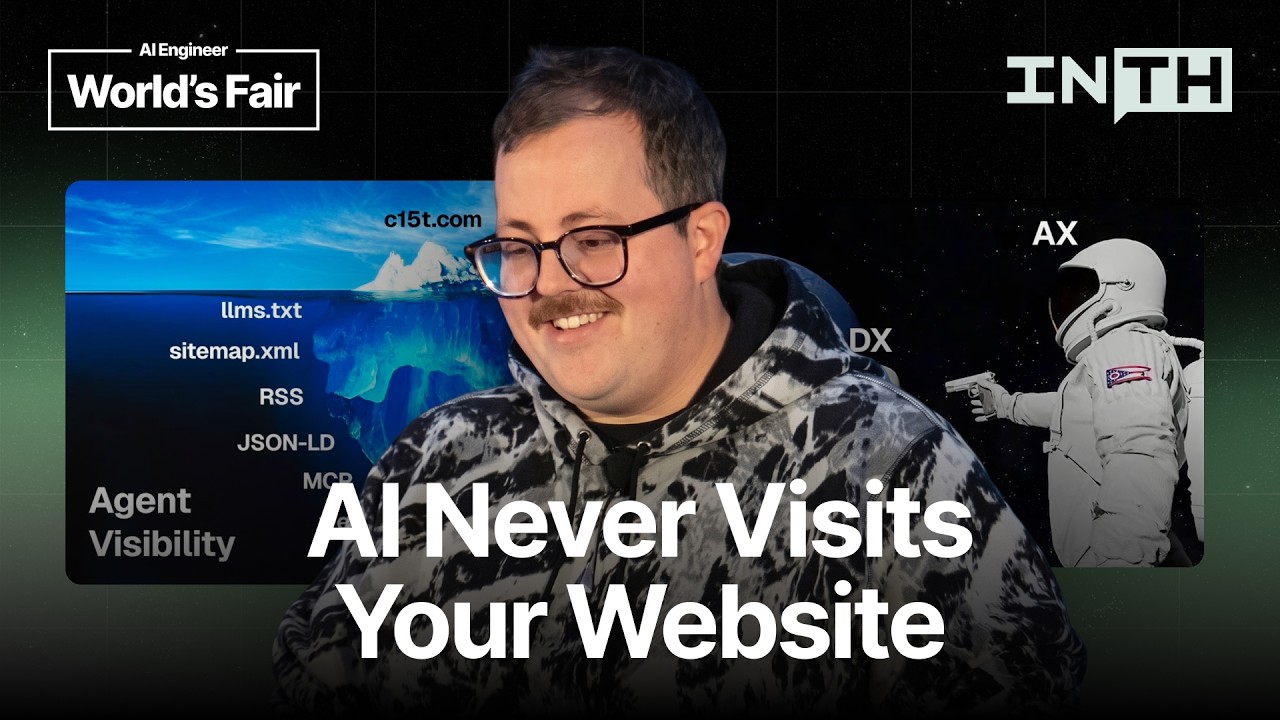
13th, you know, now it is our number one source of inbound is Claude, ChatGPT, Codex, that is ChatGPT, Gemini recommending us. And I like to think of this as, you
know, the iceberg. You know, we start with the top of C15T and there's many many tools that go into it from, you know, LLMs.txt to site maps to
RSS feeds to robot.txts. So many micro optimizations that you can do from old methods of running the internet to new methods. And uh
how many of you have, you know, made these kind of tools? How many of you have, really put simply, said, "Hey, agents, we need to this to be done." And yeah, it said, "We should install this
library." And you've gone, "Okay." Raise your hands. How many people have done this? Pretty much most people. That's a lot of hands.
So, what's really funny is that we went from wizards installing our software to agents installing them. And I just went through Y Combinator. And what's really interesting is it if
you know who these two people are. These are the co-founders of Stripe, the Collison brothers, and they had a really classic saying of like a Collison brothers install.
And they would hand you their laptop, and they would install Stripe. These days, it's kind of like just a prompt. Being in Y Combinator, we just give people a prompt. And really what that
means is that our very good developer experience primitives are now hitting agent primitives. So, as we was pulling all these things
together, there is no one tool that fixes everything. I like to think about these problems like, you know, Batman's utility belt. Loads of really small things targeted in different areas to
get it done. And we built all of these things into C15T because we wanted C15T to be the best developer framework in this tool. Think of it like Stripe Docs. And as we
was building more and more tools, more and more documentation websites, we actually started abstracting these tools into a side quest that we call Lead Type. So, all of the
things that we're going to talk about now are things that we have already solved with this open source framework. We have our friends at other developer companies implementing it and seeing
similar results about how to like optimize for the agent experience. So, again, this isn't a magic SEO tool. It's actually a very non-sexy title, but a
framework-neutral docs pipeline. Complex. But really, all it basically does is take your .mdx files, you run Lead Type generate, and it will spit out
everything for um optimized agent experience for your websites. And the rest of this talk is going to look a bit like a BuzzFeed list, to put
simply, of these problems, because again, not everybody knows even how to put an LLM.txt on their website. So, you know, that comes to the first problem of if
your docs have hundreds of pages, and how can it navigate them to find the right questions? The first solution is obviously an LLM.txt.
What we found in our research is that it's much better not to just generate this. It is much better to write your LLM.txt from hand. Obviously, AutoRaptor, but write it as you are
trying to get the answers across to the LLMs. For about 40 good lines beats 1,000 lines of noise from our testing. And that comes to the second issue of
agents don't know how to browse. They know how to fetch. So, you then need the second part of the solution of the LLMs full. Again, think of this as a sitemap, where
it takes the actual page and the links and a short description of what each page is for the LLMs to reference. Again, most people have heard these two solutions.
But, where things are starting to get very complicated and we're seeing a lot of optimizations right now, is that HTML is expensive, and why can't we just ship markdown to the agents?
And we can. And you've seen that everybody has started creating twin MDs. So, that's taking the normal website, such as Next.js quick start, and then having a dot MD on the end of it.
And when you load that, it goes to the markdown But, what's really important here, and it's really worth noting, is this line at the bottom. If you look at all the
best documentation websites, Minify, Vercel, C15T, pat myself on the back. Um they all have this in the header. This is saying to the agents whenever they visit the website that there is an
alternative version of this in mark markdown. Again, who actually supports it? Don't ask me. Perplexity, some of the agents, it's all up in the air.
And then, the second thing as well is that taking the .mds, you need to make sure that they're available through multiple methods. So, one of them is like the .md, so as you
like copy it to an agent, you say .md. Another one is just taking the normal um link and then adding a uh redirect into your like your Next.js config, so that if it detects an agent has the
header of accepting markdown, instead of returning the HTML, it will return the markdown. And then, the third one is that not all agents can append header tags. So, there's also a URL query of
mode equals agent. So, they're the ones that pretty much everybody knows. Um and it's pretty basic internet knowledge at this point. Um
but one of the really interesting ones is where we're going next. And our tooling is also helping this is that an agent can't ask your website anything. So, we need to think about the web MCP.
And this is still very early, but our tool is already uh um exposing three different tools to WebMCP. Search docs, get pages, and ask docs. Again, um our library lead type is
pulling all of that context together so an agent can easily ask it the right questions. I think we'll even see a future where communication happens over email and there's companies in San
Francisco building that today. But this is actually the most interesting one and I think the most important one that anybody who has any type of developer module surface, NPM
modules, cargo, Python, whatever. Is that the uncomfortable truth is that coding agents are actually never visiting the website if you have a library.
They're actually visiting the node modules. They read the repo and they read the node modules. They They have previous stale training data and they're trying to work it out on
what it can do from the the compiled source. So, again, following what people like Vercel are doing and people who are thought leaders in this industry is that
we take the bundled markdown documents and then we also put them in the node modules with an agents.md file.
And the agents.md file basically says, "If you've got a problem, if you've got a question, all the documents are here. Grab them." And we actually see that this has
surprisingly real effects. We can see that between many different models almost 50% token saving on instead of trying to search the web, find the right tools, pulling the markdown files from
your code base. So, if you have a library that's forever changing, then having the node modules built in is a very effective solution. This is also working without any skills, but if you
want as well, you can add skills to it to say, "Look at the node modules and go from that." And again, just uh doubling down into this point, looking at like the
agents.ai and DFile, you can say like when working with Z15 T Next.js library, read the bundles and verify that they match and go from there.
So, that's really like how we've done it. I don't want to say this is like prescriptive, that I know the answers. If you have documentation websites, or
if you have any type of markdown, if you're running your own blog, you know, I've been using our package as well on our marketing website. Every part of our marketing website also has a markdown
file. It can be something that's used for many things. We're currently just um most people are just using it for documentation. But, you can literally run it and it
will pull out all of these extra files. And one of the big things was when I put this talk together, you know, we were seeing the results
that Claude was recommending, but there was not really any like test suites yet, or test harnesses, on like is your site agent ready? And Cloudflare brought one of them out.
But, my favorite is actually one called Aura AI. Um this is brand new and it tests a lot. I'm happy to show off score of 59 because it's constantly changing. 3
weeks ago, it was a lot higher. And again, this is a forever changing area. So, aura.ai, put in your website, and it will start giving you recommendations. It's forever changing. Again, we can
just stay on top of it. And yeah, this is like one of my final slides is that the slide the the market agents, LLMs, everything is forever changing. There is no such thing
as perfection. When I started making these slides, I got so caught up of like, everyone expects me to be the expert here, but I've just been hacking on this problem a little more than you
guys have so far. So, never get caught with being perfect. Every small little increase really does matter. Every small little thing you add really does matter. Thank you so much. You can find me on X,
Burn Chris, and LinkedIn, and everywhere. >> [applause] >> WOO! I THINK
I THINK WE HAVE TIME for one or two questions. Yeah, of course. >> So, if you were building um uh we're a website agency. We work with a lot of startups building like their
own websites. >> Mhm. >> If you were just building a website, not necessarily like developer tool, but just a website to be found, which of
these methods like would you concentrate on if you're starting from scratch? >> Yeah, I think the most important ones, and we're starting to see this more and more, is
trying to provide a dot md file for every single page. A lot of CMSs are not built in this way. Um and we see this optimization happening more and more where I didn't put in the slide, but
we're seeing more and more websites being visited by agents instead of real humans. So, in terms of even like trying to be proactive and token efficient, you should provide a markdown file if you
can. Again, a lot of CMS's are not built this way. I actually built my own CMS. My name is Chris and I built ChrisCMS, short for Christmas. It's a whole It's a whole thing my team wishes I never
built. But, it does work and it does bring this like token efficiency up. So, yeah, I would say llms.txt is your first shout.
llms.txt full form .txt. Second, if you if you can, just do them manually. Say you're not even working on systems that have markdown, I still recommend them.
But, you can always get creative with creating these files on the on on the go.