Enjoying this issue?
Get tomorrow's AI & engineering digest in your inbox — hand-picked, summarized, and always spam-free.
TLDR
The core tension in LLM gateways is that availability, latency, guardrails, and cost cannot all be maximized during degradation. Fallbacks to alternative providers are essential but not transparent — differences in tool calling, token limits, and stop reasons require careful testing, and reasoning models can cause unpredictable latency spikes (P99 up to 60 seconds). The strongest recommendation from production experience: decentralize the gateway but centralize governance to avoid making the gateway a single point of failure.
Key points
LLM gateways must balance availability, latency, guardrails, and cost during degradation.
Per-request fallbacks to alternative providers are preferred over blind retries for LLM APIs.
Guardrails can fail open or close, trading off availability against security.
Reasoning models exhibit unpredictable latency, sometimes spiking P99 to 60 seconds for the same prompt.
A centralized gateway is a single point of failure; decentralized gateways with centralized governance are recommended.
Techniques
- per-request fallback
- hedging the tail
- timeouts per model per route
- load shedding
- circuit breaking with cool-down
- shared vs local failure counters
- guardrail placement (pre, parallel, post)
Stop scrolling. Start reading smarter.
Receive the day's most important AI & engineering updates in one concise email. No spam.
Transcript (captions)
[music] I'm Kanesh Manuja. I'm a principal engineer at Twilio. Let's start with a quick show of hands. Who here has seen the message, something
went wrong. Please try again. Well, we have a few lucky ones and a few that have had a good lunch. Um, so behind that simple message is actually a system that is very complex
that serves you that message despite the model providers being down. And that's what we're going to productionize today or discuss productionizing today.
So what is an LM gateway? An LLM gateway is an entry point or a middleware between your apps and the model providers behind them. It does a bunch of things. Routing, authentication,
fallback, rate limits, all kinds of governance that you can think of. And right at the heart of the gateway is a fight between four things. It's availability, latency, your guardrails
and costs. In case of a degradation, you cannot maximize all four. You need to pick what you want. So with this talk, if you use an LLM gateway, I want you I want to
help you to make that trade-off for your use case. And if you design a gateway, I want you to design or provide those levers to your callers and customers u so that your customers are happy.
Let's start with availability. If you have a single model provider, their ceiling is your ceiling. Their outage is your outage. So in typical software engineering, the
way you tackle unreliable dependency is by retrying. Retrying with exponential backoffs, with jitters. And when all of that fails, you have a circuit breaker that trips after
you've seen sufficient failures and you stop calling the damn thing. This is not enough for LLMs. LLMs are very different compared to your fast cheap APIs that you retry on. Retrying
an LLM API eats into your latency budget really fast. And also tripping over a circuit breaker when you have another perfectly fine model provider to route to doesn't make sense. You should use
the second model provider. And third, as I said, the calls are slow and expensive. So blind retries just multiply your cost and your tail latencies.
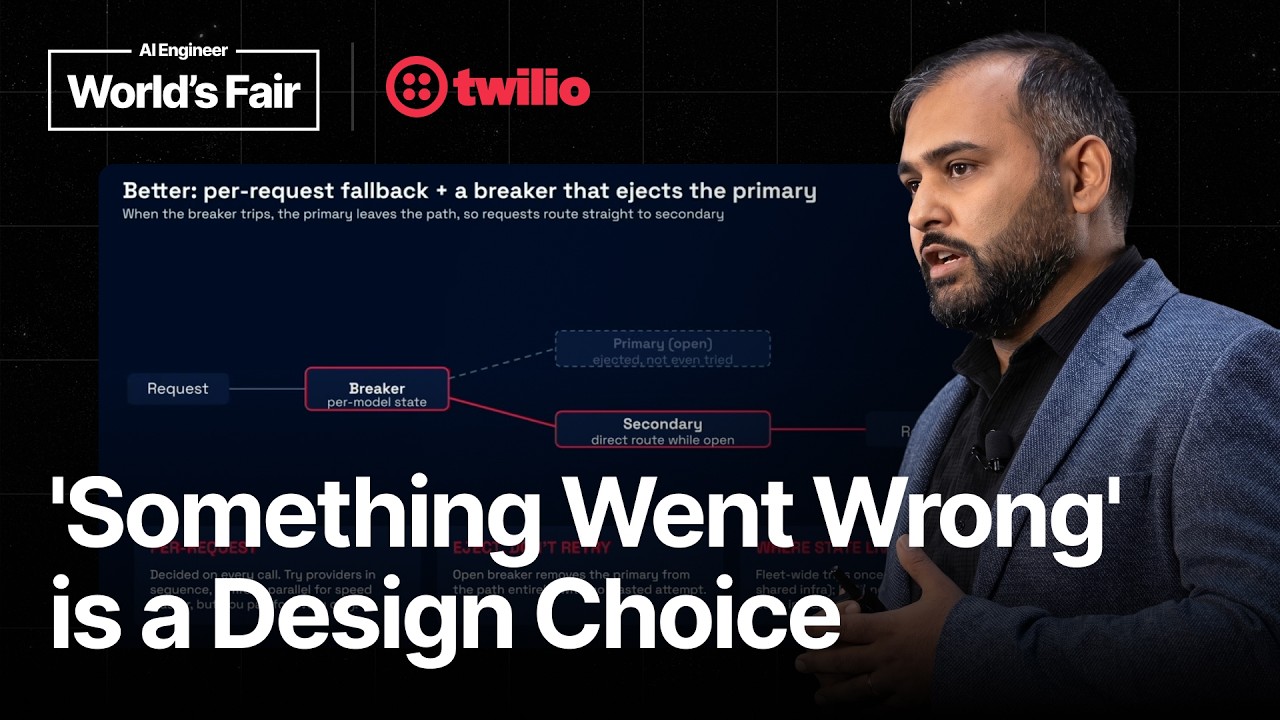
So what is a better idea here? It is actually a per request fallback. What that means is you can actually try model provider A and then in sequence try model provider B if your request to
model provider A fails. Another option to consider here is you can fire requests to both the providers in parallel. But that's only if you're highly highly obsessed with latencies
because that's just going to double your cost. Some of the similar circuit breaking patterns apply here to LMS as well. If you know that your primary has been
failing for some time, it doesn't make sense to try it again. You put it, you take it out of the load balancer or your request path and put it in a cool down and then after a few minutes have
passed, try putting that back again. One interesting choice that you have to make here is where your failure counts live. You can decide to have the failure
counts live in memory on the instances that are serving your traffic or you can have shared infra where your failure counts are shared across the fleet. There are trade-offs.
If you want quick failovers, then fleetwide helps. And with instance uh with local state counters the issue that you run into is whenever you change your deployment size your configuration and
your expectations change. So something to consider. What that clean diagram did not really show you are some of the other gotchas that I'm going to discuss. So fallbacks
are not transparent. While the industry is converging on an OpenAI API compatible format, I would say there are still nuances. So you need to really test your fallbacks well. They
can have differences in your tool calling schemas, token limits, stop reasons and what have you. So with LM gateways, you can have a normalization layer that can ensure that you can do
cross provider fallbacks as well. Another thing is streaming it. So essentially nobody wants to wait for 30 seconds to have a wall of text appear
in front of them. So there are use cases where streaming is absolutely required. But it comes as at a cost. You trade away your levers. You cannot once you have decided to go with provider A, you
have to continue going with provider A. You cannot mid-stream change the providers. Whatever has been sent to the client, it's done. And that's where the something uh went wrong message, that's
the one that you see. It's not because of laziness. It's by design uh that you see that and it's one of the trade-offs. I would like to call out one other thing where I've seen teams trip over and over
again. They really provision and test their primary providers really well, but they the second provider, the fallback provider doesn't necessarily get the same level of love. And I would argue
that your throughputs or your capacity or your headroom should be even higher for the second provider or the fallback provider because that's your last line of defense. If that goes down, your
application goes down. Let's discuss latencies. Availability failures are right in your face. They fail. You get alarmed. You get paged. But high latencies can be the
quiet ones. And they need to receive more love um than I would say tuning your services for just availability. One thing to call out, a gateway may run mixed workloads
and you can have embedding embedding requests that takes just less than a second. You can have classification requests that take less than a second. Uh you have chat requests taking 3
seconds and reasoning requests taking a long time. Quick show of hands. If you measure your aggregate latency for your entire service.
Well, that was a trick question. Sorry. You shouldn't. It doesn't make sense. It's a lie. You should be tracking your P99 per model per route, not a gateway wide number. Gateway wide number doesn't
make sense, especially if you're running mixed workloads. And I hope you're not u for those who raise your hand. Another thing that can really I cannot emphasize this enough is for you to set timeouts
on per model class per route. That's where that's the number one root cause of your silent outage. If you don't have a timeout, your gateway thinks you're hap your request is being
happily served while it is not. And I'll leave you with this message for for latencies. Um, specifically a reasoning models normal is actually a chat models outage. So you definitely need to track
latency per route. Okay, this is the most painful or this the slide that has given me the most scarse which is reasoning and router models. So this is where truly the
latency is unpredictable and reasoning models they do not give you they they're highly undeterministic more deterministic undeterministic than your
normal models. You cannot set the temperature to zero in many cases and the same prompt can take somewhere from 2 seconds to 60 seconds and we've seen that in production where P99 suddenly
popped to 60 seconds for no good reason. So that's while there's no magical solution to it. I would recommend that you at least start with fixing the reasoning level
per route. So with router models, they hide that abstraction behind you. Like they pick which models to run and I would highly recommend that you at least make as much uh you make requests as
determinist deterministic as possible with an undeterministic system. Another idea is hedging the tail. You can have a you can fire another request if your primary request actually
consumed let's say P90 of your latency budget. This can hedge the t this can really hedge the P99 tail u for for your services.
All right. This is one of my favorite ones. Um to keep your model secure you need to have guardrails. And with that, guardrails are necessary
for preventing your services from prompt injection attacks, keeping PII filters in place, having toxicity filters, keeping the LMS to stop swearing at your customers, all those good things. But
just like a model provider, there are trade-offs, too. Guardrails are just like another service that can go down that can be unreliable and that's where you need to choose do you fail open or
do you fail close when I say fail open you can still serve the request even if your guardrails are down fail close you block the request and say hey I'm not available that's the trade-off between
availability and security to certain extent while there's a no universal answer it really depends on your use case you can decide like for example a toxicity filter if it's not up and
running you can still serve that request. So the default choice should be the worst case that you can live with. There are a few things that you can
actually do to improve the behavior of your systems in face of uh you know guardrails being down and and managing just unreliability of the guardrails themselves. So the first is time budget.
Your request should never be bound by your guardrail timing. It should always be the LM that is the rate determining step. So make sure that you have timeouts in place and those guardrails
run with a specific time budget. Another important thing is fallback. You've heard, you probably know and I've talked about it. We always discuss fallbacks with regards to model
providers, but guardrails are critical services too where you can consider fallbacks, have secondary provider, secondary checks, cache decisions uh to keep your service available when a
guardrail provider is down. Another interesting choice that pops up with regards to guardrails is the placement of the guardrails. Typically, you can place the guardrail
in three ways. You can have a pre- hook that runs where the guardrail actually runs on the input. You can and that's probably the safest uh but it does add serial latency uh to your requests.
Another one is in parallel. This is one of my favorites, but just to call out, streaming wouldn't work well here with with parallel. So if you're specially producing structured output, please
don't stream them. Uh try to save your latencies and run run these guardrails concurrently for your structured outputs. Another one is post hooks. The these are best for um output monitoring,
auditing your outputs and and so forth. So, so far we've all I've discussed all the things that can go wrong with regards to our dependencies. We haven't discussed that we are
actually adding another dependency in the request path itself which is the central or which is the LM gateway itself. There are a few things where we have been bitten by u and we've learned
some lessons that I want to share with you. If you're working on an LLM gateway or using one, one is shared limits. Make sure that your API keys are segregated per route, per use case to
the most granular possible uh to the most granular thing that you can imagine. U having a noisy tenant can be one of the biggest problems here.
Another thing is load shedding. This is a feature that you should uh as part of your runbooks, game days, uh make sure that the gateway that you're using supports load shedding because when you
have a retry storm, it becomes really hard to just scale out. You cannot simply scale out services that is under a retry storm and all these web servers they have an internal queue and they're
configurable. Make sure that they're bounded and they cannot request they cannot accept requests that are unbounded. And if you want to have some custom logic, you can even have traffic
prioritization here as well to make sure under load your most important use cases get served. Well, last thing that I wanted to discuss is the whole idea of a central gateway
itself. It is a single point of failure. So if you're thinking of having a central gateway for your entire company for to LLMs, I would recommend rethink that and see what are the reasons that
you want it. What I've noticed is that in most scenarios, it's not the central gateway that they want. They want centralized governance. And there is a path forward where you
can actually decentralize the gateway and still centralize government governance. So do not try to centralize your traffic but you can have plugins, you can have custom code that can
centralize your governance. Uh governance can be in the form of cost tracking, rate limit managing management and there are other solutions possible. So explore those before you chart on
having one central gateway for your entire company. It can be managed by a single team, but I wouldn't recommend deploying it as a single deployment for the entire company even though it's
distributed. With that said, I want to end this talk on a personal note. So, it is my son's birthday today and I'm here talking to strangers about circuit breaking. So the
least you can do for me is please go and prevent one incident for me and for your customers. Thank you. If you have any questions. Yeah. >> [music]