Enjoying this issue?
Get tomorrow's AI & engineering digest in your inbox — hand-picked, summarized, and always spam-free.
TLDR
Fable 5.1 is the best model on benchmarks but costs more per task than Fable 5 because it uses 1.7x more output tokens, despite a 75% cut in cache read pricing. The real story is that Anthropic's cost reduction is real only for repetitive agentic workloads, while one-off tasks remain expensive, and the model's higher intelligence comes at a token premium.
Key points
Fable 5.1 scores highest on Artificial Analysis but costs $369 per task versus Fable 5's lower cost.
Cache read pricing dropped 75% to $0.25 per million tokens, but non-cache input/output prices are unchanged.
Mythos 5.1, with fewer guardrails, outperforms Fable 5.1 on coding benchmarks and is slightly cheaper.
Anthropic introduced zero data retention via EFS but still accesses customer data for misuse detection.
New safeguards prevent distillation attacks by blocking manual editing of Claude's prior context.
Tools mentioned
Techniques
- Cache reads for cost reduction on repetitive inputs
- Zero data retention with enterprise frontier safeguards (EFS)
- Watermarking for EU AI Act compliance
- Reward hacking detection and reduction
- Distillation prevention via context editing restrictions
Stop scrolling. Start reading smarter.
Receive the day's most important AI & engineering updates in one concise email. No spam.
Transcript (captions)
Fable 5.1 is here. We have a brand new Frontier model from Enthropic. They say Fable 5.1 is not only better, but much cheaper with a big cost reduction, but not everybody agrees. I'm going to break
this all down for you. Two new models released today. We have Fable 5.1 and Mythos 5.1. These are the absolute frontier of artificial intelligence. the best of the best coming out of
Anthropic. And the main story, the main thing that Anthropic wants to convey here is that there is a significant cost reduction. Right now, Anthropic models are the most expensive models on the
planet. Even the best models from OpenAI are substantially less expensive. And while we did get an effective price cut on Fable 5.1, it is and still remains the most expensive model on the
Frontier. Now, Fable 5.1 will cost an estimated 25% less than Fable 5 for typical workloads. However, if you look at the actual pricing, the cost per million input tokens and the cost per
million output tokens, they are the same as Fable 5. But there are two things working in our favor to get the price down. And remember, it is all about cost per task completed. The cost per input,
the cost per output tokens, these things don't really matter as much because if one model uses a tenth of the number of tokens to complete the same exact task, it is much less expensive. And they even
go on to say for highly agentic work the savings will often be much larger up to approximately 45%. Again a very healthy discount. Where the price reduction actually comes from is
right here. They are reducing their pricing on cache reads. That means where the model reads inputs that have already been processed and stored. So, if you're doing a lot of agentic workloads that
require you to give similar templates for the prompt over and over again, that's where you're going to see the biggest cost reduction. One of the other massive pieces of feedback and criticism
for Fable 5 was the fact that they did not have a zero data retention policy. If you're using Fable, you were giving them your data. So, a lot of companies simply could [clears throat] not use
Fable for that exact reason. They are still looking at the data except you control it. EFS which is enterprise frontier safeguards and zero data retention really matters to enterprise
companies. EFS works by storing data in cloud infrastructure controlled entirely by the customer not anthropic. Now I want to talk about this zero data retention and specifically the EFS
enterprise frontier safeguards. First of all why do they even do this? Why do they have to collect data? They say it is for detecting misuse. So they're still storing all of it, but this time
they're going to allow you to store it and they get to read from it, which again is kind of weird. You're still trusting Anthropic with your data. They still get to look at it. You just get to
control it. So it's kind of this like half measure. And I don't know if most enterprise companies are going to be okay with this because ultimately if anthropic still has access to your data,
you still have a lot of those same concerns as you did yesterday when they were actually collecting and storing all of your data. Okay, but enough of all that. I know what you're here for.
Benchmarks. So here's the first one. This is terminal bench science. And this is where Fable 5.1 got a massive boost in performance. And if you remember when Fable 5 was first released, a huge
criticism of Enthropic was simply a lot of scientists could not figure out how to use the model without getting refusals, without the model saying, "Hey, I can't do that. That's against
our policy." And I'm going to get back to that theme a few times in this video. Because there's this very well-known property of artificial intelligence. The more guardrails you put on it, the worse
it performs overall. Basically when you restrict it from doing certain things you are effectively reducing its intelligence. So the mental model I have about this specific property is it is
taking some amount of effort from the model to know when to refuse certain prompts. And if you are taking any effort away from the model the kind of unrestricted version of it will always
be better. it will always have 100% of its capabilities versus some percent less when you restrict it. Okay. Now, back here, what we have is accuracy on the y-axis, cost on the x-axis. So, if
you're not familiar with terminal bench science, it is a benchmark that tests the model's ability to kind of conduct real scientific experiments. So things like data analysis and recreating
scientific analyses with code, proving theorems, model fitting, and all these really important things when you're trying to discover new science. And what we see here is that the loweffort
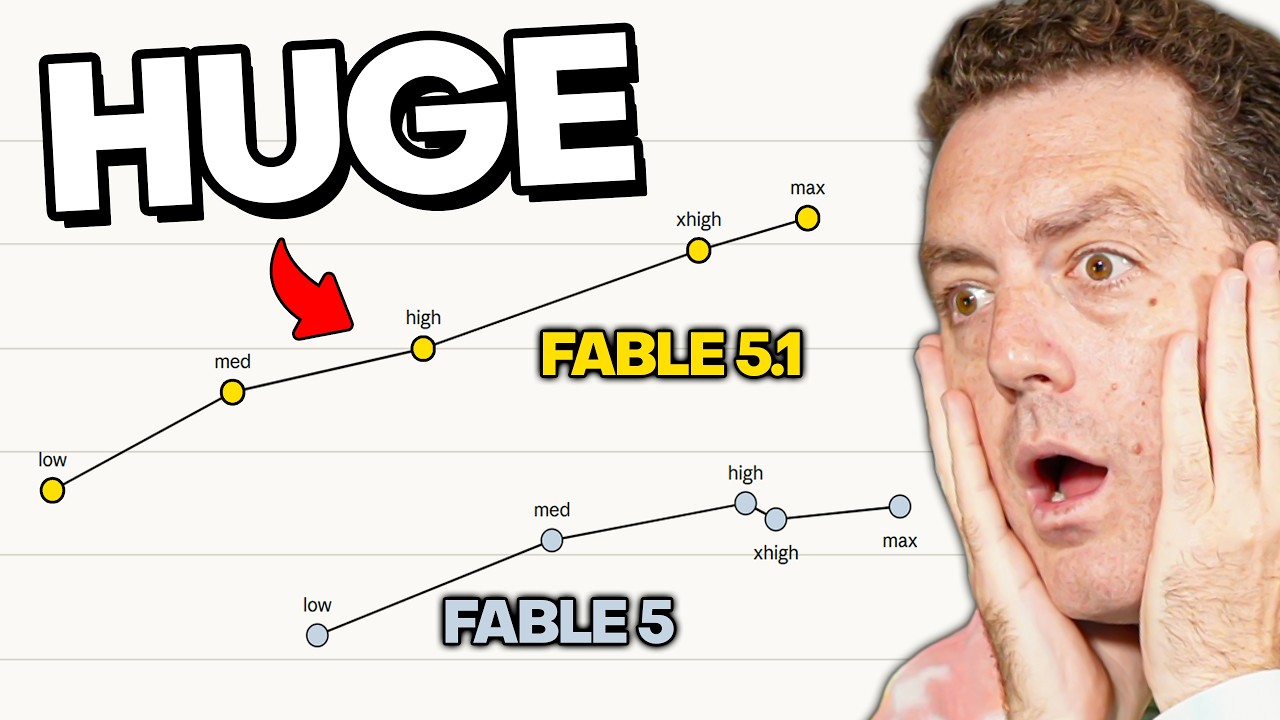
Fable 5.1 is actually better than the max effort Fable 5 and significantly less expensive. So, Fable 5 High actually seemed to score the highest score. So, this is at 25% at a cost of
$34. Whereas, Fable 5.1 low cost $11 and scored 26%. And the max all the way up here, if you don't really care about price, scoring 52.6%. That is effectively doubling the score
on this benchmark. And if you want to test out Fable 5.1 and compare it to some of these benchmarks, you can do so in cursor, in factory, and of course in cloud code. And the cool thing is all of
them work with here. Now here is the easiest way to publish anything to the web by your agents. Literally just install the skill and your agent will have the ability to publish a web page,
a report, a game, PDFs, powerpoints. Basically, anything that you can think of, you can publish it easily. And here's one of the tests I ran with Fable 5.1, which you can see right here. I
just published it to here.now. You simply tell your agent to publish to here. Now, a few seconds later, you get a link that you can share with anybody. And the best part, it is free to use.
So, go check out here.now. Let your agents publish anything to the web instantly. Click the link down below to go check them out. Thanks again to here. Now, probably one of the most important
benchmarks out there if you're using these models for coding, we have Terminal Bench 4. And here, both Mythos 5.1 and Fable 5.1 have now increased in quality and become cheaper overall. And
I think just to point out what we were talking about earlier, look how Mythos 5.1, which again is the same exact model, just different guard rails, scores higher than Fable 5.1 across
every reasoning effort. And surprisingly, it's also cheaper. Not by much, but it is cheaper. And it is kind of significantly better. At max reasoning effort, it gets a 5% better
score than Fable 5.1. Here's humanity's last exam. On the y-axis, once again, we have the pass rate or quality. On the xaxis, we have the mean cost per task. And what we're seeing is Fable 5.1
didn't actually score all that much higher. Definitely scored higher, especially with tools, but at max effort, we have 65% as compared to Fable 5 at 63.8%.
And so, not that much different. Now we have cursor bench which is obviously the benchmark from cursor and here is where we have not only a big improvement in quality but also a quite substantial
reduction in price. So at max reasoning effort we have a 70.5% for fable 5 max coming in at $17.32 and then for fable 5.1 we have 73.4% 4% which is a nice bump coming in at $964
which is much less expensive and we see that trend across all of the different reasoning efforts. Okay, so another few benchmarks I want to show. Here's computer use. We have a nice fivepoint
jump right there. We also have GDP val which is an eval created by the OpenAI team and a massive leap 130 point leap basically and that is better than Opus 5 which was incredibly
good and a pretty darn big gap between that and GPT 5.6 Soul. Now they are saying that Mythos 5.1 and Fable 5.1 don't cheat as much as Fable 5 and Mythos 5 did. And if you remember a few
weeks ago, OpenAI had a model that basically broke out of containment during a specific hacking benchmark. And so this is all within the category of what's called reward hacking, optimizing
for some goal and basically ignoring all rules except for trying to achieve that goal. And so from our review of its training data, Mythos 5.1 both attempts and succeeds at reward hacking or
cheating at a lower overall rate than Mythos 5. So this is a good thing. And in fact, Enthropic just put out an entire paper specifically about a model that they removed all guard rails from
and kind of encouraged it to go hack out of its system. Though generally our alignment evaluation showed improvements, our testing found the model can still sometimes bypass
approvals and auto mode classifiers. And we all know Anthropic is very worried about distillation attacks. And if you're not familiar with that, it's basically just another company trying to
steal the data straight from the model itself, asking it a bunch of questions, taking the answers, pairing those question and answers, and making a new model based on the intelligence that it
just extracted from that model. And they're actually putting in an additional safeguard to prevent distillation. Now, it is funny that they say distillation is a safety risk. And
this is very much their opinion, although I think most onlookers might disagree with this as I do. I don't think it is a safety issue. But here's why they say that the distilled
capabilities can subsequently be released without adequate safeguards, which is basically an argument against open source. They didn't say it directly, but that is what they're
saying because with open- source open weights models, you can just remove the safeguards. And they're basically saying, hey, if another company can produce a really good model and release
it and it's not to our level of safeguards, what we believe, then yeah, it's unsafe. And so, this is a little bit technical. I'm just going to cover it briefly, but how they're doing it is
new API accounts can no longer manually edit Claude's prior context in a multi-turn conversation while preserving the transcript of Claude's prior thinking. So basically what they're
trying to prevent people from doing is changing the context over and over again to get the changes in chain of thought and basically recording those and that is all you need. Those are the
ingredients to create a new model. They also say this model will have watermarks because of the EU AI acts code of practice on transparency of AI generated content. They are now required to put
watermarks in models. Now, it's interesting that OpenAI hasn't talked about this. Anthropic has. Open AAI has not. So, this requires us to add a watermark, a numerical way of
determining the likelihood that Claude was involved in writing a piece of text to the outputs of models released after August 2nd. So, basically, they're going to be able to determine if a piece of
text was written by Claude or not. And they also say it shouldn't affect anything. You shouldn't be able to tell. The only way you'll be able to tell is if you ask us. Us being anthropic, which
you know, okay, fine. All right. Now, back to cost. Cash reads are now 75% less. That is 25 cents per million tokens, which is actually quite cheap. That is a massive cost improvement. But
the actual cost of non-cash hits, input, and output are the same exact cost as it was for Fable 5. So, I just finished recording this video and Artificial Analysis came out with their own stats.
And it turns out Fable 5.1 is in fact not cheaper than Fable 5.0 on the artificial analysis benchmarks. In fact, it's more expensive. Let's take a look. So, number one, what they come out of
the gate with is yes, Fable 5.1 is the best model on the planet. It is the absolute frontier. And we can actually see that on the artificial analysis website. Here it is coming in at a 66,
the highest score so far ever. But even with the 75% cash read price cut, Fable 5.1 still costs more per task because it uses 1.7x the number of output tokens. So it needs
more tokens to achieve that same intelligence level, more tokens to solve a given task. And interestingly, it says it has the highest scores on agentic work task, but effectively tied with
Opus 5. And Opus 5 is a great model. So, here's where it falls. Here's Claude Fable 5.1 Max with fallback 66. And we can see Opus 5 at 63. And then GPT 5.6 Soul all the way down here at 61. Look
at that. By the way, basically of the top 10 models, Enthropic holds eight of the positions, which is kind of nuts to think about. We have 5.6 6 soul and grock 4.6 right there coming in at
number eight and nine. But here is where it really matters. $369 per task completion. And if you look, here's Grock 4.6 at $1.23. And remember, way down here, here's GPT 5.6 so high
coming in at 43 cents. We have GLM 5.3 Max at 68 cents. I mean, these are incredibly inexpensive models down here and nearly the same score. Soul is just the best bargain for the intelligence
that you actually get. All right, so let me show off some of the tests that I gave to Fable 5.1. Now, I just tested GPT 5.6 Soul and GLM 5.3. This is a test that I gave to both of those. Alex, put
both of those on the screen while I show this, please. All right, so here it is. And in fact, it looks really good. If I zoom in, the details are fantastic. We have the little raincloud raining down
into a beautiful lake, a little log cabin with a moving fire. I'd say this is definitely better than GLM 5.3, but maybe not quite as good as GPT 5.6 Soul. We have the little farm right here.
Here's the tractor. Here's the windmill, the actual barn, some flowers. Everything looks really good. Here's the beach. Look at this one. This one looks really good. The ocean view, except it
has this little shimmering right here at the bottom, which I don't know what's causing that, but tons of fish swimming around in this ocean. We have this boat on top. We have a little buoy bouncing
around there. Look at those little seagulls floating around the boat. Really nice. So, yeah, overall very good, but I still think GPT 5.6 was better. All right, next. Here's the
Rubik's Cube simulation. Of course, I had to do it. And yeah, it looks really good. Interestingly, it actually says the different sides, which I've never seen a model do before, but yeah, it has
a bunch of different sliders that I asked it for. So, let's scramble it. There it goes. And solve it. Yeah, all models can pretty much do this. Now, what I'm looking for is the completeness
of the simulation, the features that are available, and how well it follows the instructions. It does have a ton of different sliders. You can actually set the colors for each it looks like, which
is really neat. Not something I've seen before. Sticker corner radius. A lot of these I've never seen before. So, very, very nice. Next, I had it create five different websites. Again, throw those
up on the screen while I'm reviewing this, please. We have a website dedicated to apples. Here, it did not actually search the web for anything. This is all what it had in its weights.
So, it created a picture of an apple. Looks pretty good. The website is okay. Here's some rankings based on sweetness, tartness, where you can use them. So, yeah, it it's okay. I wouldn't say this
is fantastic, but it's a very complete website. And surprisingly, I don't know why this keeps happening, but when I ask the model for this Apple website, it gives me a very specific address. I
don't know why it does that. That is concerning to say the least. Here's a website about the GGX Spark. So, it actually tried to create a 3D rendering of it. That is definitely not what it
looks like, but okay. The website looks quite good. It is very much the colors of Nvidia. Yeah, it's good. I actually really like this. Let's see if I can type into it. I cannot, but it has a
nice terminal view right there. I asked it to create a website about rubber ducks. I think this is actually quite good. You know, it's interesting. This is very similar to GLM 5.3. And now I'm
thinking about that a little bit. Anthropic pretty directly called out these Chinese AI labs for distillation attacking them. And now when I'm looking at the colors being used, the tone, the
assets, it is extremely similar in all of these examples. Here's a Galaxy Fold. This one is different. Okay. Pretty good. Pretty good. And then Tesla Model Y. Again, a terrible SVG rendering of
what it thinks a Tesla Model Y looks like. This one is not like GLM at all, but I actually think the website is pretty darn good, you know, except for this. It did get the stats right. 300 m,
3.3 seconds for the performance version. And then finally, I asked it to create a PowerPoint slide about data centers. And yeah, it looks okay. Nothing to write home about. Pretty good overall. So,
I've published all of these tests to here.now. I'm going to drop links to all of them down below so you can check them out. So, I am definitely surprised at how similar some of these tests came out
to GLM 5.3. If you want to see the full GLM 5.3 review and all of those tests, go check out that video right