Enjoying this issue?
Get tomorrow's AI & engineering digest in your inbox — hand-picked, summarized, and always spam-free.
TLDR
The AGI debate is fundamentally split between mechanism (how intelligence works) and capabilities (what tasks it performs), making the term nearly meaningless as a scientific target. Different companies measure AGI differently, so they will inevitably claim reaching it at different times, driven more by economics than science. The first system labeled AGI may be less capable than existing narrow AI, risking another hype cycle that mismanages public expectations.
Key points
Yan Lukun argues that current AI cannot fix bathrooms, help watch kids, or drive fully autonomously.
Models like Astra achieve high ARC-AGI scores via hand-engineered harnesses, not by learning during the test.
The harness layer acts as a stopgap for model weaknesses, but the Bitter Lesson suggests this should eventually be learned.
Tim Urban's 11-year-old framework distinguishes narrow intelligence from general intelligence as a separate problem.
Different AI companies define AGI differently, so they will inevitably claim reaching it at different times.
Tools mentioned
Techniques
- harness
- next token prediction
- ARC-AGI benchmark
- Bitter Lesson
Stop scrolling. Start reading smarter.
Receive the day's most important AI & engineering updates in one concise email. No spam.
Transcript (captions)
Recently, tech CEOs have been saying that we either achieved AGI or we are at the verge of achieving AGI. And yet, nobody really agrees on what AGI really is. One question worth pondering here is
whether AGI is even possible at all. And this debate goes all the way back to 1980s. And Penrose stated that human understanding is fundamentally non-algorithmic and cannot be produced
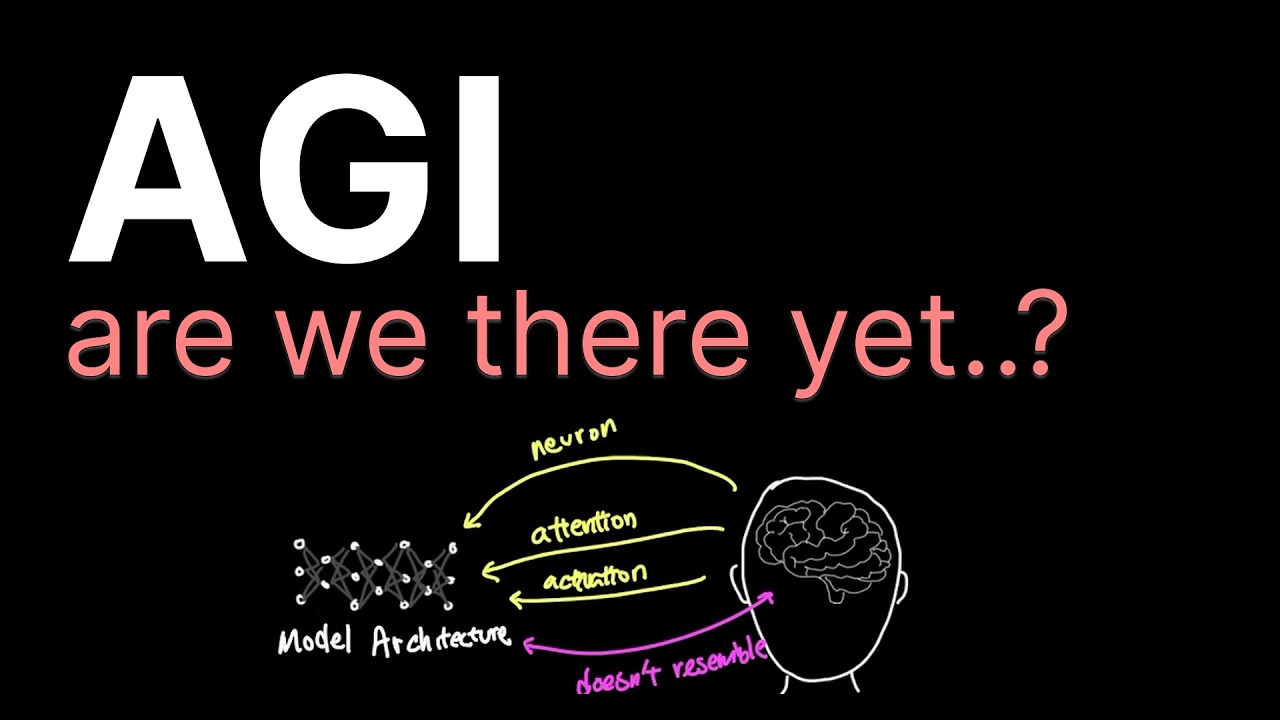
by computer. And he came to this conclusion by loosely applying mathematical theorems from the 1930s. And when we look at how the current model architecture looks like, although
it borrows terminologies from neuroscience, these are just loosely related terms, but in reality, model architectures today don't really resemble human biology or human brain at
all. So I think it's fair to say that at least if we really are close to achieving AGI, AGI doesn't really require us to reproduce the mechanism of human intelligence. Now going back to
the 1980s, the framework that we often use was this idea called weak AI versus strong AI where weak AI is a narrow intelligence which is something that we already have today. Machines today are
already doing faster and more optimized tasks in narrow domains. And we also have strong AI which is fundamentally different where the actual definition ties it closer to having a mind of its
own. But our public discourse around AGI cares less about whether AGI will have a mind or not in a philosophical sense. But people today care more about how capable these models are. So instead of
using this older framework though it's really helpful to know, we'll look at it in these two axes in our discussion on AGI. Mechanism and capabilities. Mechanism referring to how intelligence
is acquired and updated and capabilities referring to the tasks that it can demonstrate. And people will hop back and forth between these two to either prove or disprove that AGI has already
been reached. People argue that large language models by mechanism are nothing more than next token prediction. So it cannot and does not fully understand. On the other side, people also say things
like, well, Astra can't really do this task or Fable can't really do that task on the capabilities axis. And one prime example that really embodies this is Yan Lun. Yan Lukun has long been arguing
that LLMs are dead, but he also has been critical towards what LLMs can't really do in terms of capabilities. Recently, he showed up on my LinkedIn making comments like this, saying that current
quote unquote AGI can't really fix the bathroom, help watch kids, or even drive vehicles fully autonomously. So, as we unpack the state of AGI, I'll be using these two axis to ground our discussion.
Now, let's start with the mechanics behind AGI. In an interview with France, he reasoned that we haven't reached AGI yet. And his opinion really boils down to whether or not the model can acquire
skills in novel situations. The problem right now is that models like Astra and Fable are manufactured in the lab and trained in the data center for months until a checkpoint is released to the
public. But the intelligence that's currently baked into the parameters of the models are more or less immutable during inference. So by France's definition, we haven't reached AGI yet.
You see a similar opinion being shown when we look at the benchmarks that he created. ARC AGI. Arch AGI tries to measure the unspoken rule that the model needs to learn on the fly. But the
reason why models like Astra can reach upwards to 99.9% on ARGI 3 despite the model still not really learning anything has a lot to do with the harness. Astra scored very differently depending on
which harness that you used. So while the model doesn't actually learn new skill during the ARGI3 test, a lot of learning is actually possible through the harness that helps manage its own
context, help have longer memory, provide an execution environment, and help recover from errors. And these are essential elements of intelligence that we just don't see in the model layer
alone. But when we put the model with harnesses like codecs that provides skills MCP for databases, terminal and loops, we've essentially outsourced the currently difficult task in the model
architecture to handwritten code directly in the harness. So while we certainly can't say that the model by itself has reached AGI just yet, we could reasonably make a case that we're
seeing early signs of AGI when we look at the entire system that includes both a model and a harness that currently acts as a stop gap. And this certainly brings back to the famous bitter lessons
from Richard Sutton. Since the harness layer right now is handgineered by writing rules and programs. And if the bitter lesson is true, some of the structure that currently exists in the
harness should get replaced with learn behavior rather than being explicitly programmed. And even looking at cloud code, Boris Shurnney, who created cloud code, has labeled this harness layer as
a trade-off where engineering work can essentially extend the model's ability by 10 to 20%. Another angle worth considering here is when we look at the capabilities access of AGI and having a
capable AGI requires good computers which is why you have to shop and Microsenter are sponsoring this video. September is all about build, upgrade and save and it's perfect time to
actually upgrade your PC at home that you might have been putting off. As hardware prices continue to climb, having a deal on what helps you run your next LLM at home helps a ton. Starting
with RAM, which helps you unload KV cache so that you can run lama.cpp CBP at home. And as you upgrade these components, you're going to need to improve your power supply as well. And
as you can see, they got PSUs currently on sale. MicroEnter is also running clearance sales through September. So if you're looking for a discount, you can check out anything from refurbished
products like Mac Minis or more. And right now, if you're near Austin, Texas, you can sign up for a free 128 GB flash drive to redeem it in store when they open later this year. They also have
this cool site, Microsenter News, to keep up to date with what's happening in the industry. link in the description below. One way to talk about capabilities is looking at the famous
blog by Tim Urban, Wait, but why? And in his blog post, which is already 11 years old, he introduced the framework of ANI to AGI to ASI. ANI refers to narrow intelligence where AI specializes on one
narrow area. But making the leap from ANI to AGI is a much different and much more difficult case because general intelligence is less about a collection of narrow intelligence into one domain.
Tim wrote about how building an AGI is hard since it's a computer that's as smart as humans in general, not just one narrow specialty. So AGI is a completely different problem than ANI. That's why
when we talk about AGI only in the capabilities axis, measuring whether we reach AGI by listing some arbitrary tasks that AGI can't do is a weak argument. In other words, we could have
reached AGI while still underperforming some narrow domain tasks that ANI could do better because general intelligence is more about its ability to transfer its learning and adapt to new situations
than having many tasks that it can do best at. So rather than listing arbitrary tasks like fixing bathrooms, babysitting, or doing the laundry, the capabilities we should really be
measuring is how well it can transfer knowledge, how well it can reason, and how well it actually adapts to changing environments. Now, after seeing this progression, you might have concluded
that this entire debate around whether we reached AGI or not is kind of pointless. And you're not alone in this since many people agree on that sentiment. Daario from Anthropic thinks
that AGI is just a marketing term. Though ironically, he goes ahead and uses more marketing terms like saying that we will soon have a country of geniuses in a data center, whatever that
means. But whether or not the term AGI is important in a scientific sense or not, we can't really deny that it has a huge economical weight to the term given how so many tech CEOs are promising AGI
as something that will achieve in the next 5 to 10 years. And this isn't the first time people in the AI industry were overpromised looking back at two AI winters that can both be characterized
by hopes and promises that ended up underdelivering. While generative AI is certainly different compared to previous iterations given just how powerful it already is. AGI is not just a scientific
hypothesis now, but it has a huge economical narrative built into it, which makes it really difficult to not talk about AGI given that our goal towards AGI currently shapes how we
allocate funding, how we value AI companies, the infrastructure spending into data centers and hiring top talents and engineers. So, because all these companies have different ways to measure
AGI, by definition, different companies should then reach AGI at different moments. Just like how Jensen recently said that OpenAI did achieve AGI with Astra using Nvidia chips. Emphasis on
using Nvidia chips. But what matters less is a definition of what AGI is, but more that we continue our progress forward and manage our expectation in the meantime on what AGI could really
mean. And kicking the can down the road and moving the goalpost only risks repeating the same cycle all over again. And I'm sure that people will get tired of hearing the same narrative over and
over again that says that future is only five years from today. I think it's important to keep in mind that the first AGI model might be less capable than other models that we already have that's
closer to ANI. This definitely raises some concern to me about managing people's expectation since AGI is building up to this very thing that certainly will change everything
overnight, which I don't believe would be the