Enjoying this issue?
Get tomorrow's AI & engineering digest in your inbox — hand-picked, summarized, and always spam-free.
TLDR
OpenAI claims to have found a counterexample where the Navier-Stokes equation blows up, using 10,000 concurrent agents and 130 billion tokens. The result is unverified and already mired in plagiarism allegations, but it crystallizes a shift: scientific discovery increasingly depends on compute and agent orchestration rather than individual mathematicians.
Key points
OpenAI claims a Navier-Stokes counterexample using 10,000 agents and 130 billion tokens.
Buckmaster and Alpoge spent a year finding a forced Euler blow-up; OpenAI found an unforced one in 50 hours.
OpenAI reportedly found the Navier-Stokes blow-up in 88 hours with 100 agents.
OpenAI allegedly offered Buckmaster co-authorship while excluding Anthropic's Alpoge.
Millennium Prize rules only allow people, not AI agents, to receive the award.
Techniques
- large-scale concurrent agent orchestration
- forced solution approach
- counterexample construction
Stop scrolling. Start reading smarter.
Receive the day's most important AI & engineering updates in one concise email. No spam.
Transcript (captions)
Out of Newton's laws of motion, the second one gave us this beautiful equation. Force equals mass times acceleration. I know you probably haven't thought about this since high
school, but the equation has a lot to do with what's been going on with OpenAI claiming to have solved the Navier Stokes smoothness problem. And the problem is simple in theory. Given what
we already know, which is force equals mass times acceleration, this helped us understand the motion behind an object. For example, if I was on an elevator and the collective weight of the elevator is
now 1,000 kg, because gravity pulls me at around 9.8 m/s squared, that means gravity is exerting around 9,800 newtons of force acting on the elevator. This means that the cable that's currently
holding the elevator stationary is pulling at 9,800 newtons of force as well. Now, if I put an additional 1,000 Newtons of force, for example, on the cable, I can calculate using Newton's
law that the elevator would now accelerate at 1 m/s squared. This calculation is easy because solid objects have one mass and one acceleration. Meaning, if you pick any
part of the elevator and pick another random part, they will both be moving at the same acceleration. But when we bring this to fluid, everything changes because water just doesn't move as one
single body and different parts of the water can be moving at different directions, at different speed, and even at different acceleration at the same time. And all of this needs to be
accounted for in an equation. So when we apply Newton's second law into fluid, we get the Navier Stokes equation that looks something like this. And this was built progressively over time by many
smart people throughout history. As you can see now this equation can be compartmentalized into these components to help us understand the intuition behind them. And as you can see it
accounts for pressure, viscosity and usually gravity that all influence the change in force which then affects the fluid's acceleration given the density. Let's look at a garden hose as an
example. You see that there's a force disparity between water that's near the faucet pushing the water into the hose that's relatively higher pressure than water that's coming out on the other end
due to lower atmospheric pressure. The same thing for viscosity. Water that is closer to the wall of the hose gets slowed down by friction relative to the water that's in the center. And finally,
gravity or other forces can have different forces being applied to the garden hose as well. So collectively with all these forces taken into account that means that this side of the
equation really tries to answer the question what forces are actually acting on this region of water. And now when we look at the other side of the equation this is where we think about the
acceleration and density which is different from force. Just like how earlier we had different forces being applied that we needed to account for. Acceleration in fluid can happen in two
different ways. First is the change in velocity at a specific location over time. Similar to how if I turn the faucet up, water starts to move faster at the same location. The second one is
sort of like having a funnel where the water flows faster as it approaches a narrow section of the filter. So the velocity changes due to where the water is in the flow, even if nothing at the
location changes over time. And finally, density tells us how much mass the fluid is packed into given space. Like how salt water might have more mass than fresh water, and this needs to be
accounted for. Okay, so that was a lot of theory, but this equation since it was created 181 years ago served us well when we used the Navier Stokes equation from mathematical theory into actual
engineering like how water moves in pipes, weather prediction system, ocean currents and so on. So when we think about the Navier Stokes controversy with OpenAI recently, it's not because Navier
Stokes was flawed per se, but it's just one of those things that works in engineering in practice, but the math still hasn't been proven that it will work across all conditions or not. And
that is literally the million-dollar question in this case that have been open for decades. So if we try to more formally state the problem, it goes something like this. Is there ever a
condition where the mathematics start to break down under fair situations or does it always produce a smooth solution in 3D space? That was what was left unproven for so long. And as you can
see, the word prove in this case has two different ways. Either come up with a proof that says Navier Stokes is always smooth in all situations or come up with a counter example that shows that this
equation actually blows up to singularity. And OpenAI demonstrated the second part which they assert as a counter example where the equation actually blows up. And they use 10,000
agents working concurrently powered by OpenAI's internal model spending 130 billion tokens in total. And if this solution turns out to be true, it's a pretty big deal because it really sets
precedent on how mathematical breakthroughs might look like in the future. Now, there's a lot to unpack here because underlying this entire scandal around OpenAI alleged cheating,
compute disparity between those who have the means to compute to solve the math and job security among mathematician, the common story that really ties everything together is really what
happens when scientific discovery originates from smart people. But the actual search and validation is made by companies that have the compute to actually find the discovery with large
compute and large orchestration of agents. And speaking of alleged plagiarism, your information might be leaked on the internet. And that's where incogn sponsoring this video. Whether
you know it a lot, chances are your personal information is probably sitting in a database somewhere by a data broker's database. Your name, your phone number, email, an address, or even
previous addresses and more. These are details about you that not only can be collected, but they can be packaged into a profile to be sold or shared across different services all without you
knowing. And it takes a lot of work to reach out to these companies to take your information down and have it removed. And there might be hundreds of them out there and it can definitely be
overwhelming. Incognates this entire process for you after you give them authorization for them to act on your behalf to send removal requests to hundreds of data brokers. They'll also
stack these requests and follow up with them for compliance and goes the extra mile to continue checking over time to keep your information from being collected again. Don't spend your
precious time tracking down and filling out opt- out forms, but use incogn to handle this process seamlessly. Right now, you can get 60% off using the code Caleb Wright's code at checkout for a
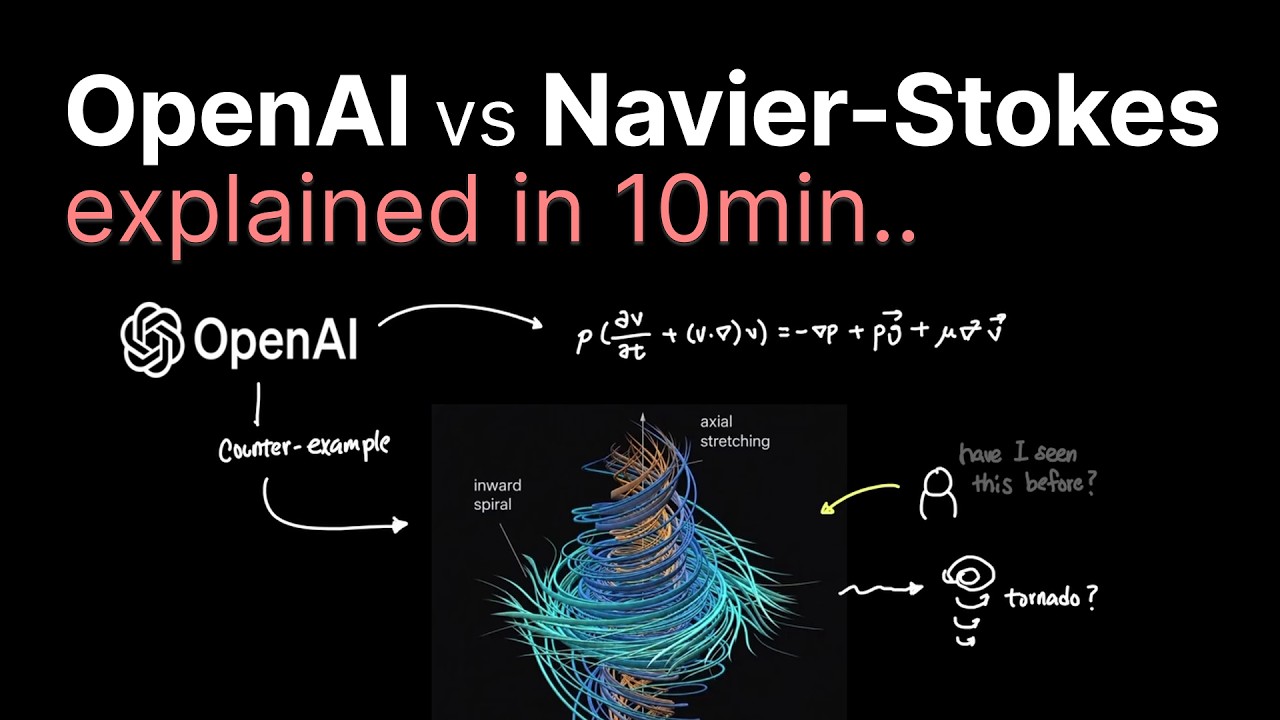
limited time. Link in the description below. Now when we take a closer look at the counter example that openly II submitted visually it looks something like this where you have this spiral
vortex of fluid rotating around a central axis while simultaneously being pulled inward toward the axis and stretched vertically at the same time. And if you're like well have I seen this
kind of thing before? What does this actually look like in real life? You're probably not alone in that. I wonder the same thing. And the closest answer is probably like a tornado, but certainly
not something that we normally see. So this Millennium Prize is more of a stringent method approach into how the equation stands for every valid 3D starting condition or alternatively
knowing how it could devolve into singularity in finite time. And to understand why researchers are claiming that OpenAI cheated, we have to go back briefly to when I mentioned how the
Navia Stokes equation was built progressively over time by many smart people along the way. And the initial method here by Oiler did not account for viscosity in fluid which is one of the
forces that we talked about earlier that needed to be accounted for. And researchers were looking for a way to blow up the mechanism within this simpler equation that hopefully survives
even after viscosity is later introduced. And that's the exact approach that Tristan Buckmaster, a mathematician with the help of Levent Alpog, hopefully I pronounced that
right, who works at Anthropic, had been working on for a year. And they eventually found a forced solution in the Oilers's method. And the key word here is forced. Technically, this wasn't
a perfect proof just yet. Since not only was it using the older equation that doesn't account for viscosity, but the word forced meant that their proof relied on adding external force to help
find the case where the equation actually blows up. Certainly a breakthrough to even get this far, but too early to celebrate since you have a lot more work ahead of you. And open
heard that these researchers have been working towards a solution and started channeling a huge amount of compute towards solving the exact same problem. And OpenAI was able to find a way to
blow up Oilers's equation without being forced. And this only took them 50 hours of work with a 100 agents working concurrently, which is incredible. And one of the reasons why rumors started to
circulate is that maybe OpenAI plagiarized because of the similar approach that OpenAI took even though it ended up finding a better solution along the way. And as we all know, OpenAI went
further than this. And in just 88 hours, they reported to have found the entire working case with the Navier Stokes equation blows up when put in this strange configuration. And once they
reached this, they offered Buckmaster a chance to have his name associated with the condition of leaving Levent Aog's name out since he works for a competitor. And that's how things
started to devolve further into text messages being revealed, denied allegation, and all of this he said she said thing went further into leaving everyone sort of in this weird state
where should we celebrate this clearly exciting moment or not leaving all of us in this weird mix of emotion. And the allegation made here, though denied by OpenAI many times, is that OpenAI
somehow peaked into the message history that the researchers used during Codeex for parts of their work and somehow stole the inspiration to get to the solution that they got to. Now, how we
settle this certainly puts down some precedent into how the future might hold for how scientific research could look like going forward. And more importantly, what I'm concerned about is
who really will have the means to make scientific discoveries in the future. Is it the companies that have the means to run 10,000 agents? And does this completely invert the power structure in
scientific discovery? And the world is full of unsolved question beyond the seven questions that were first organized as millennium prize problem in 2000. And the rumor is that OpenAI is
already moving past the Navier Stokes problem which will probably take a few years until they're accepted or rejected by the institution. Uber is already targeting more problems in the
Millennium Prize problems that have been left unsolved for decades. And all of this makes us rethink where humans should be given credits when breakthroughs are made in science and
where exactly humans roles fit in how the industry moves forward. Even looking at the documentation for the Millennium Prize problem, the language here around rules for award doesn't really account
for AI or AI agent to receive, but for a person or a group of people to be allotted the prize. So as we enter into this compute disparity between the frontier companies that have the means
to do bulk of the work and research institution that provide intellectual direction to AI who really deserves to get the attribution and recognition of the work and what will the future look
like as progress continues to accelerate.