Enjoying this issue?
Get tomorrow's AI & engineering digest in your inbox — hand-picked, summarized, and always spam-free.
TLDR
Full-duplex speech-to-speech models solve the walkie-talkie problem of turn-taking, but they pay a fundamental intelligence cost because adding audio modality consumes model capacity that would otherwise go to reasoning. The hybrid approach — a small, cheap full-duplex interface that delegates thinking to a background text LLM — is more economically viable and gives users control over the backend intelligence, which is why Gradium bets on it over scaling a single monolithic speech-to-speech model.
Key points
Full-duplex models allow both parties to speak simultaneously, matching human conversation where up to 20% of time has overlapping speech.
Speech-to-speech models are fundamentally less intelligent than cascaded text-based systems because audio modality consumes model capacity.
Gradium's hybrid approach uses a small full-duplex interface model that delegates reasoning and tool calling to a background text LLM.
OpenAI's advanced voice mode was powered by GPT-4o for months after newer text models existed because retraining is expensive and slow.
The hybrid approach is cheaper than running all traffic through a giant multimodal model for simple chit-chat.
Gradium released Moshi in 2024, the first full-duplex speech-to-speech model, using multi-stream language models.
Tools mentioned
Techniques
- multi-stream language models
- neural codecs
- audio tokenizers
- hybrid speech-to-speech architecture
- full-duplex conversation modeling
Stop scrolling. Start reading smarter.
Receive the day's most important AI & engineering updates in one concise email. No spam.
Transcript (captions)
[music] >> Okay, hi everyone. I'm Nel co-founder and CEO of of Gradio. So Gradio is a startup based in Paris.
Most of our background is from research. In particular, we have invented algorithms such as audio LLMs, speech speech-to-speech models, neural codex, and so on and so forth.
And basically we started from a research project called QTI, a non-profit research lab that has been focusing on voice since
day one. So in particular, we released in 2024 the first full duplex speech-to-speech model called Moshi, the first real-time speech-to-speech translation system
called Hibiki, and the first TTS model that can run locally on a on a smartphone. And basically I will just say a few words about what we do, but we are
a model company that trains models for building voice agents and voice applications. So we do TTS, API, and on-device speech-to-text, speech-to-speech translation, and much
more to come. What we do is that we train foundation models for audio, and then we can apply them for a lot of different tasks. So I go quickly on voice agents because
it's the fourth talk about the topic, but basically now we have these voice interfaces that we can use to do a lot of things across a variety of
products and types of interactions with NPCs, with customer agents, language learners, coach, and so on and so forth. And in this talk I tried to go through the history of this technology and
where I see it going in the next years. And maybe to start, I think we can take a look at the announcement of Siri back in 2011. And you'll see that it's actually, you
know, I think it it aged pretty well. >> What is the weather like today? >> Here's the forecast for today. >> It is THAT EASY. >> [cheering]
[applause] >> LOTS OF THINGS. We've integrated with the stocks. So, you can ask it about the stock market. Something like How is the NASDAQ doing today?
>> NASDAQ composite is down right now at 2,321.70. >> Again, you can ask this from the lock screen anywhere. Just press the button and ask. You can ask about, you know,
the NASDAQ, the Dow. >> So, what you just saw is what kind of a voice agent. It was a bit constrained, but it was technically a voice agent.
And the architecture behind it, so you have seen a thousand times today the STT LLM TTS. Back then, it was even worse, right? So, there was no LLM, obviously. So, there was what was called natural
language understanding. So, you would go from the transcript and uh try to do basic classification of what is expected, uh what is the app that is supposed to be uh controlled, what is
the action to trigger, and so on. So, it was a very complex pipeline and very constrained to very specific use cases. So, it was what was called close uh ended um
uh dialogue back then. Then, the next generation of models, uh I could say, I think was is illustrated pretty well by the OpenAI voice mode, not the advanced voice mode,
the original one. In which case, you just have um a conversational experience that is open-ended. So, it's much less constrained than Siri. You can talk about pretty much anything. At the same
time, you don't have um as the same agentic capabilities, let's say, in the sense that it cannot really give you the NASDAQ or uh give you the weather.
>> We want to hear a bedtime story. Tell us a story about the super-duper sunflower hedgehog named Larry. Start with telling us a little bit about him.
Larry was a unique hedgehog unlike any other. He had bright sunflower petals instead of spines. Residing in Meadowville, Larry spread joy and color wherever he
rolled. >> So, in that context, basically that was, you know, kind of second generation of models where all the logic, the very complex logic was replaced
uh by an LLM. And if we compare Siri and the voice mode from OpenAI, uh not the Ad Ons one, Ad Ons one, the
original one, uh the big strength is opening the dialogue, but the agentic capabilities were inexistent. The naturalness was,
obviously, much better than with Siri. The latency was still pretty bad. So, we are talking about several seconds, and that was documented in the in the previous presentation.
And so, then, you know, we're in this third phase, which is a voice, what we call voice agents. Uh and here I'm going to show a quick demo of uh of a drive-thru bot uh live-coded with our
with our voice models. >> Hi there. What can I get started for you today? >> Hi, I'm actually in a hurry and I'd like to order a chicken sandwich quickly.
>> We have the classic, spicy, deluxe, or grilled chicken sandwich. Which one would you like? >> Uh let's go with the classic chicken sandwich.
>> Anything else for you? >> Uh what else do you have on the menu? >> We have sandwiches, sides, drinks, and desserts. What can I get for you? >> Can I get some mac and cheese, maybe?
>> You have a classic chicken sandwich and mac and cheese. Your total comes to eight. >> So, now you know, unlike what we just saw, it's an actual agent. It's taking
actions. It's keeping track of the order. It's then going to make you pay. So, it's it's an actual voice agent that can do uh real tasks. So, here instead of having an LLM that is just a
conversational interface, we have a real agent that is empowered with tool call, reasoning, planning, and and all this stuff. So,
what we see now is we have gained back agentic capabilities, and actually they are much more uh powerful and generic than before, while keeping a very good level of uh of
naturalness. And that's where speech-to-speech LLM came. In particular, what we could see here is the latency, it's better with cascaded
system, but it's still higher than you will have with human conversation. And as also was explained before, the naturalness is fundamentally limited by the fact that you go through text, so
you lose a lot of information about what uh is said, the tone, the emotion of the user, and so on and so forth. So, now that we have tackled intelligence and agentic capabilities,
speech-to-speech seems like a natural next step for naturalness and latency. And so here it's the announcement from the uh OpenAI advanced voice mode. >> [clears throat]
>> Hey, ChatGPT. I'm Mark. How are you? >> Oh, Mark. I'm doing great. Thanks for asking. How about you? >> Hey, so I'm on stage right now. I'm
doing a live demo, and frankly I'm feeling a little bit nervous. Can you help me calm my nerves a little bit? >> Oh, you're doing a live demo right now? That's awesome.
Just >> I think we all remember it was very impressive very impressive release. And in that context now, all the steps of STT, LLM, and TTS have been absorbed
into a a single one. And so now, intelligence, you know, like naturalness is still very good. Uh
actually it can be better because it can understand non-linguistic information. Latency is really, really nice. Honestly, it doesn't make sense to go uh better than that.
Interestingly and everyone was used any uh speech-to-speech model can uh attest that the intelligence is still much more limited in that
context than uh the cascaded counterpart. So, the speech-to-speech models are fundamentally still limited compared to the textual models. Another limitation is turn-taking. So,
people tend to mix speech-to-speech and full duplex. But basically, when you do have a speech-to-speech model like GPT-3 time, it's still based
on fundamental turn-taking. In the sense that it's going to segment the conversation into as long as the model is speaking or the model is listening. And to give to show you how this can
make an interaction unnatural, I'm going to show a a small demo with what is called backchanneling, which is this very human thing that you do when someone talks to you is that you say,
"Mhm, yeah." and so on. >> Hey, how's it going? Just like to brainstorm a bit about it with you. >> Oh, that's a great topic. Yeah, I'd love to help you brainstorm. Are you thinking
what Exactly. Yeah, I was thinking >> No, no, I didn't mean to interrupt, you know, I was just saying, "Yeah." like that. You can just keep going. I know,
don't mind me. It's just something I typically do. >> Uh no worries at all. Yeah, I was just going to say we could break it down into a few aspects. Like
Yeah, exactly. >> please stop stop interrupting. You know, it's called backchanneling. Humans do it all the time. It shows that you're just following the conversation. That you
don't, you know, like interrupt you in your flow. Just just going. >> Ah, got it. Thanks for letting me know. >> No problem.
Oh, come on. >> Yeah, so you see, you know, it's it's still very annoying. Uh you can have lightning speed latency. Fundamentally, this is
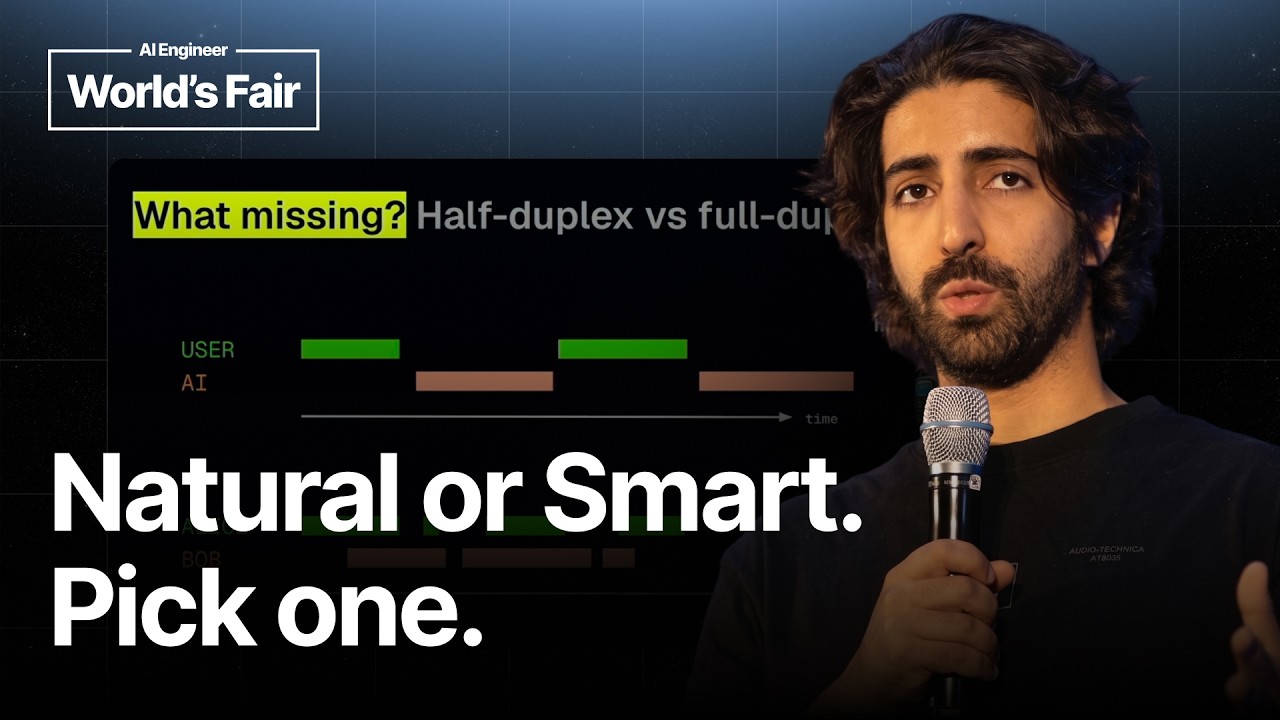
uh an issue that can not be resolved when you're using turn-taking. So, here that's the walkie-talkie. Um any real-time model today, I mean, now there is a bidirectional one that
will come from OpenAI, but it's called half duplex. So, the model is listening or speaking. A human conversation has a constant flow between two people. People do back channeling. People
interrupt one another, talk on one another, and so on. If you have If you're having a relative on the phone, there is up to 20% of the time where you are both speaking at the
same time. And that makes, you know, this very flexible dynamics in the conversation makes it much more comfortable for humans.
And so, to understand how we can make a model full duplex, I'll give a very short presentation of how we train such models. So, the way you create a
speech-to-speech model half duplex or full duplex is the following one. So, you you start from a text LLM, which is a probabilistic models over over words. And instead of predicting the next word
based on the past, what you want to do is rather predict the next audio based based on the past audio. The issue now is that if you pass a raw
audio to your model, which is, you know, a waveform, it's air pressure variations. Uh basically, you take this sentence, it's
eight words. It takes around 3 seconds to pronounce it. And so, at 24 kHz audio, instead of having eight words, the audio form is 72,000 time steps that you would need to
feed to your LLM. Given that LLMs have quadratic complexity with sequence length, so the complexity is the square of the sequence length. A 10,000 times longer sequence is 100 million times
more expensive to to process. So, there is no way you can train an LLM on raw audio. So, the way you address it is by creating neural codecs, or you can also call them audio tokenizers. And
basically, it's an encoder that takes an audio and compresses it in a very dense compressed representation, a bit similar to text. And then you have a decoder that can reconstruct high-quality audio
from it. So, now you have gone from the audio domain into a abstract representation domain, where you can train an LLM exactly like you would train it on text.
And the speech-to-speech model from ElevenLabs, as I was showing before, works in this fashion. So, instead of having text tokens into your model, you have audio tokens that represent either
the LLM or the user, and you put them one after the other, and the model predicts the audio tokens uh that should be said by the model, being given the context from both sides of the
conversation. However, you can see that it's still a sequence between user and system, which is still half duplex. So, how did we make the first full duplex model ever?
Very simple. We call it multi-stream language models. That's the technology now used also by Thinking Machines for their interaction model, and most likely by the for the by the directional model
of OpenAI. Is that instead of having a transformer that models one sequence of tokens, it models two of them, so that both parties can be active at the same time, inactive at the same time, one
active and one inactive. And I just show a very quick demo of uh of how it sounds [snorts] like, but that's the release of machine August 2024, uh where we did an announcement live on
stage talking to it for the first time. And you'll see that the model often guesses the end of the question, answers over the speaker, and both speaking at the same time is
not breaking the flow like we saw with GPT. The whole thing is just extremely resilient to the most chaotic uh situations. >> So, the planet is serious 22. Can you
plot a trajectory course to it, please? >> Yes, sir. >> Okay. How long is it going to take us to get there? >> it out. It's approximately 5 months to
get there. >> Okay, that's that's not too bad. Uh do you think we have all we need on board the ship to start the mission? >> We have everything we need.
>> So, back then it was even a bit irritating to people because it was interrupting you all the time. But the thing is that you can use you could still use it in extremely noisy
environments with a lot of noise, people coughing, and so on. And you know, the flow is just constant. You don't get this very irritating break of the conversational flow. So,
these full duplex models, they are the highest level of naturalness you can expect. That's the same conversation with a human. The thing is, in with our models, it was
even more stupid than speech-to-speech models that were already less intelligent than cascaded systems. It's probably fine for some use cases if
you just want to have a chit-chat. You know, the model doesn't need to be very intelligent. But make an actual full duplex voice agent, there is no way we can give up on on
intelligence just to gain uh speech-to-speech abilities. So, how do we finally make models that tackle all these aspects jointly? And I think interestingly, if you if you
look at the history I showed, there is a tension between naturalness and intelligence. So, every time we improve naturalness or humanness of the of the models, they were less intelligent than
the cascaded system. The cascaded agents, they are basically as smart as the best text models. So, if you have a voice agent that is powered by the latest model from Anthropic or OpenAI,
it's going to be extremely smart, have all the same reliability for tool call, and so on. Speech-to-speech has this naturalness aspect. However, you give up
intelligence to get that. And the reason why you give up intelligence is remember that the LLM is a model that has a certain number of weights that we call the capacity.
And if you take a text model and now it not only has to handle text, but it also needs to understand speech and produce speech, it's taking some of its capacity, and
this capacity now is taken from the intelligence. So, fundamentally, there is a cost of adding a new modality to a text model that is going to be paid in in intelligence.
So, where do we go from here? There are two paths that are in front of us, and both are going to be explored at the same time. The first one is scaling the model. So,
making your speech-to-speech model bigger, better pre-trained, better post-trained, and so on. We likely progressively increase its intelligence until it it's good enough for a lot of
use cases. The second one is splitting the model between naturalness and intelligence. The first one, I'm not at OpenAI, so I don't know
because they don't release their model. I guess OpenAI is the path one, so it's a frontier text LLM with a lot of science around post-training, in- instruct tuning to fine-tune it on
audio, and teaching it to be quite smart while using audio. The nice thing about that is you have a single model to orchestrate, so it's quite easy to deploy.
Um and one big aspect, however, is that it's a extremely complex and costly process to
go from the text model to the speech-to-speech model. The second path is to split it. It's an approach that we introduced in one of our recent papers called Moushiraq, and
that has been reused by, in particular, the Thinking Machine Interaction models. Where, basically, the idea is that now you have two models. The first one is a small, maybe even on-device,
full-duplex, extremely natural speech-to-speech interface. And its only role is to keep a very natural conversation and be able to delegate
all the thinking, tool calling, reasoning, agentic capabilities to a background text model. And so, the way to see it is you have a background text LLM
that receives asynchronously queries from hundreds to thousands of small voice interfaces and just give them their text, you know? And, basically, what we did is um
very small full-duplex model that just needs to know when it doesn't know, so that it can delegate to the background model. And the reason why we believe mostly in
this approach, um and I go back to to it later, it's a our uh
let's say our culture is more of first one, the bitter lesson. So, every time we've been pushing for end-to-end systems and so on. But now I think the hybrid approach has two main
advantages. The The first one is cost. So, speech-to-speech models are notoriously quite expensive. And when you think about it, it's a loss of money to do chit-chat
with gigantic speech-to-speech models that can resolve differential equations and so on. So, it doesn't really make sense economically to get all your workflow through this gigantic
multimodal mixture of experts. At the same time, we see that people are very attached to their ability to control the backend, to be able to switch So they So they 5 was released a
few minutes ago. People want to switch the backend and the intelligence and get a lot of optionality on that, right? When you're using a speech-to-speech model, your your hands are a bit tied
with this model provider. And to give you an idea of that, until recently the AdSense voice mode from OpenAI was powered by GPT-4o, despite the fact that there have been
several generations of the text model since then, because this process is so expensive and so long. For this reason, we rather bet on the hybrid approach because that will give
something that is not only very natural and very nice for demos and impressive, but also will be a viable alternative from a economic point of view and agentic capabilities point of view
to the best cascaded systems that are still most of the market today in voice. So, what now? Uh you can use our models on gradium.ai.
You can apply to gradium. We are recruiting research scientists and engineers. And thanks for your attention. >> [applause]
[music]