Enjoying this issue?
Get tomorrow's AI & engineering digest in your inbox — hand-picked, summarized, and always spam-free.
TLDR
Voice agents are moving from demos to production at scale, but reliability remains the top blocker, with even a 1% error rate translating to billions of incidents yearly. The speaker, who previously monitored crime audio at Citizen, argues that voice agent failures are more dangerous than crime because they scale globally and can directly impact individuals, making robust monitoring and red teaming essential.
Key points
The speaker previously worked at Citizen, monitoring thousands of hours of police radio and sending millions of crime alerts.
Voice agents are deploying in production at scale, with over a trillion calls per year expected to be handled by them within five years.
A 1% error rate in voice agents would result in 10 billion incidents per year, ranging from minor annoyances to safety risks.
The speaker's company shipped a red teaming product in April that can break about one in five voice agents in adversarial testing.
The speaker recommends 24/7 red teaming for voice agents, especially when the cost of bad interactions is high.
AB testing is critical for changes that are difficult to validate in synthetic pre-deployment settings, such as the first five seconds of an outbound call.
Tools mentioned
Techniques
- Red teaming
- AB testing
- Cross-conversation analysis
- Call scoring
- Manual evaluation
- Frequency and severity analysis
Stop scrolling. Start reading smarter.
Receive the day's most important AI & engineering updates in one concise email. No spam.
Transcript (captions)
[music] My name is Suman Yu and I'm the founder and CEO of Hamming. And before working on voice agent reliability and safety, I worked at a company called Citizen
out of New York. Anybody here use Citizen app? Awesome. Thank you. Uh, and at Citizen, we listened to crime, thousands of hours of police radio station data and sent
millions of alerts to users in San Francisco, New York, LA, uh, Chicago, Baltimore, and so on. Some obviously gory and pretty sad. Uh,
but others more funny like a person stealing bags of ice cream from Safeway or report of a man hanging off the side of the house after a woman stole his ladder.
If I actually take a look at the citizen app right now for those who are customers or users, I can see that there is a man yelling at person. There's indecent exposure. This is real. This is
real time. This is, you know, couple hours ago. These are real-time alerts that we're sending. Now, voice agents scare me more because they're finally graduating from demos
and PC's to production. We should be super excited, but I'm nervous. I'm personally nervous. Uh, they're talking to users at a scale that would make Gary Tan and Polygram proud.
When I got started in voice agent reliability in early 2024, voice was just starting to work. It was not quite good yet, but it was just starting to work. You would have to pay me a lot of
money for me to stop using, you know, Aqua voice, Super Whisper, uh, Whisper Flow, and so on. These products are just getting super, super good. And a big reason is because the underlying
infrastructure is getting better, and the orchestration layer is getting meaningfully better. It's getting much faster to build products and voice experiences that maybe are 60% good in a
pretty short period of time, but the long tail is still Hey, Gorov. the long tail is still uh wise away. I think speech speech models are getting better. Um teams are experiment
experimenting with hybrid architectures of combining more voicetovoice modalities and also cascading stacks to make the experience reliable but still pretty low latency.
Things are obviously getting better. Agents are being connected to calendars, CRM, HRs, reservation systems, and so on. Voice agents can now take actions. However, reliability is still the number
one problem holding back most voice agent deployments at scale. This is still the number one problem. This is an example I found on Twitter pretty randomly, you know, two weeks ago and a
person is trying to get information for a tradein and gets absolutely confused with the information that they're receiving. Alex now has to correct for this loss of trust but trying to, you
know, call the person and see what see what happened and fix the situation. Let me see if audio works here. >> Screwed up with another customer. We're getting it fixed, but I got to call him
and see if I can work it out. >> I'm like, dude, half the time I'm like, I don't know if I'm talking to AI. I don't know if I'm talking to a person. It was just confusing, but we got there.
>> It probably is AI and human. And >> so I think voices sound very confident. They sound very natural, but the information provided is often, you know, not correct. That's the biggest problem
here. This example is more personal. I had booked an appointment with a physician a couple weeks ago or I thought I did. I showed up to the appointment and turns
out I was not actually on the schedule. So the front desk, you me turned me away. I wasted 2 hours. For me, this was a waste of time. But what if this was actually your parent?
What if this was your grandparent? What if this appointment was for a procedure instead of a regular checkup? The costs for these different permutations of the same failure mode
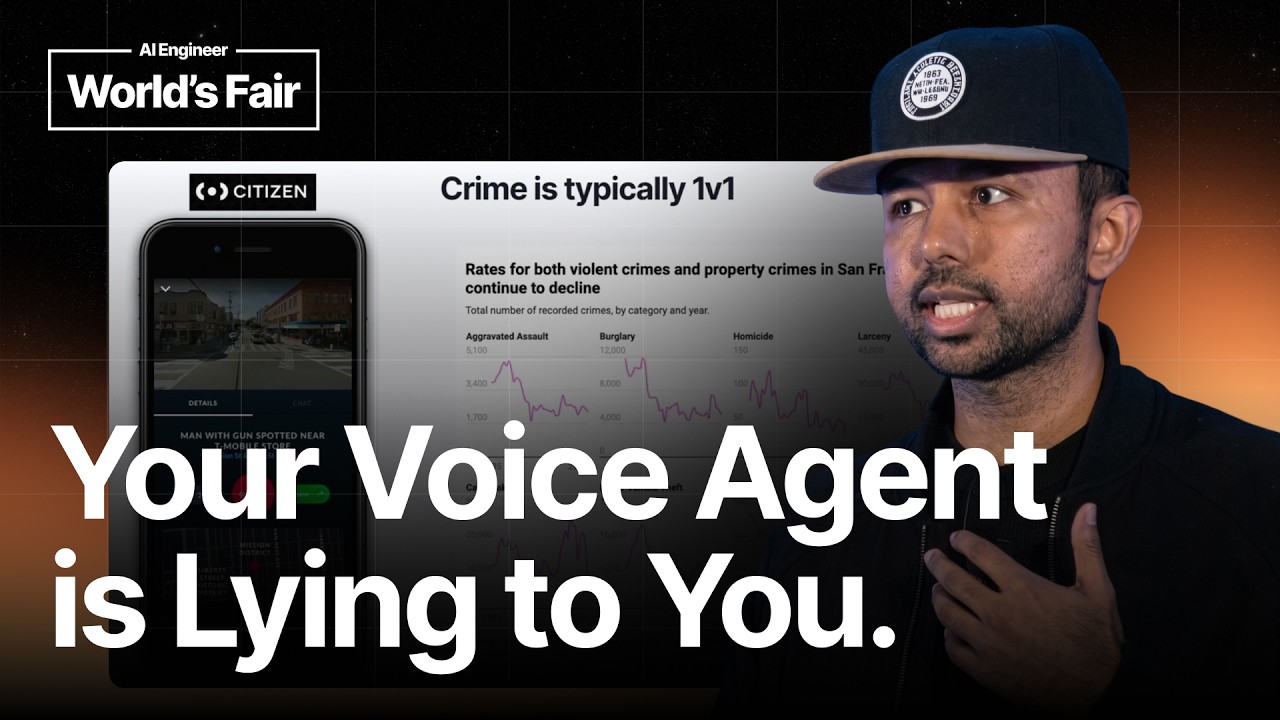
can actually be super super high. Now, let's compare crime to voice agents. Um, I think observation number one is crime is actually decreasing over time. This is a good thing and I hope it
crosses the x- axis at some point you know in the future. Voice on the other hand is generally taking off right we're seeing a pretty fast takeoff of voice agents being
deployed in production. There's at least a trillion calls that are done every single year and majority of these will be done by conversational voice agents over the next you know five years. If
you assume a 1% error rate that is still 10 billion incidents per year. That's a lot. In practice, we currently monitor 10,000 agents and the error rate is closer to
10% in practice. These range from agents saying they found the right policy when they actually skipped the eligibility or verification steps or applying discounts when they were not really supposed to,
misharing what the person said, providing incorrect information, or claiming they booked an appointment when they actually did not, just like it happened for me.
Now, not every single call has an equally, you know, bad cost. Uh, some range, you know, in the crime land, some range from trash fires, which are kind of funny, annoying, not really hurting
somebody. For a voice equivalent, that would be annoyances like repetition, um, or just sort of not quite understanding what the user is saying. all the way to safety risks like mass shootings or in
the voice agent equivalent, it would be um a drive-thru that's deploying um voice agents at scale like a Taco Bell or McDonald's and a person orders a vegan burger with peanut allergies.
If one of those two situations are not handled correctly, that is definitely a safety concern at scale. The other big difference between crime and and voice agent deployments is is
crime generally tends to be pretty hyper local, tends to be very decentralized, right? Things like robbery or motor vehicle theft or lararseny. They're impacting a
finite set of individuals that are involved in that um situation. On the other hand, voice agents are much more centralized. a single prompt change or an architecture change can have
pretty massive implications downstream for all of the millions of you know users that are um in the crossfire. So the blast radius is is quite quite massive. So the natural question is how
do you make these incidents much more visible and obvious? That's the kind of obvious question here. I'll borrow a framework from a couple of my friends who were OG growth folks at
Facebook. So step one is to identify okay what are all the challenges and problems that um exist in your conversation experience. Step two is to prioritize an impact size. There's a
frequency and severity analysis that's pretty important. Step three is to understand okay how do we actually fix this? Step four execute. Step five okay did my change actually work and did it
cause any regressions somewhere else. And lastly we continue to monitor in production. On the y- axis, I think it's important to highlight there are known problems
that already exist. Things like turnover latency, interruptions, um maybe some ASR problems you're, you know, aware of. And these are known problems that exist that the team should track over time. On
the other axis is actually emerging behavior or patterns that are only obvious across lots of conversations. Um on the x- axis, you have coverage just like insurance. Are you analyzing few
conversations? Are you analyzing many, many conversations? Most teams will typically start by listening to calls manually. And I think that's the best place to
start. I don't think you should skip that step. There's a lot of depth and insights to get by actually listening to specific conversations and building that texture that that comes from that
intuition. However, it's obviously not scalable. So most teams end up having a spreadsheet of I don't know five or 10 different rubrics around greetings, closing, validation,
um, core logic and so on. To scale that up even further, you then end up investing in some eval product, right? You might run some element as a judge and compute classic metrics and also
more more deterministic and stoastic scoring logic. Um, but there you're still stuck with checking for consistency of known problems, but you're not really discovering novel
insights that are actually happening across conversations. We're spending a ton of time on performing cross conversation analysis, not a pattern on a single call, but across conversations.
And some of the best teams that we work with are are doing the same. Now, to prioritize an impact size, I think there's problems that are one-off that are low impact. I mean, who cares?
uh even low impact and systematic problems in the crime world that would be a trash fire in a voice aation world it could be some repetitions the team is experiencing they're still annoying at
scale and if you are doing a bake off it's still worth solving for them I would not ignore these class of problems oneoff and high impact well hope it doesn't chronic and I think systematic
and high impact are obviously the P 0 you know target areas um for the team to solve an example of that would be in a fins serve capacity There's a voice agent that um helps
users freeze their credit cards. And if it doesn't do that, well, that's a massive fail. All right. So, understand and execute. I'm pretty sure everyone's doing this.
Please fix my agent. Uh I think fixing or rather attempting to make a fix is the simplest and the lowest effort component of this debugging pipeline and loop. Um the next step is all right, I
made a change to my system. How do I actually know this thing works um for real? A great way that's naive is to take a real call, for example, in my case, I booked an appointment and it
didn't get scheduled and replay that exact conversation and run that maybe 5, 10, 20, 50 times and see, okay, what is my probability of passing this type of issue? A better way is to keep the same
intent but change the wordings, change the patterns, change the accents, change the style, add one more intent to the mix. And that gives teams much more, you know, better coverage to feel confident
that yes, I actually made a change and my changes are net positive instead of net negative. There are certain fixes and I guess hypothesis that are very difficult to
test in a pre-eployment synthetic setting. And so AB testing ends up being, you know, pretty pretty critical for those circumstances. For example, if you have an outbound agent, the first 5
seconds of a conversation tends to be the most important. And so the vocal quality um and the specific words you end up using, they matter the most. And so AB testing that is the only way in in
kind of real life setting to to get results. You can't really do it through simulations alone. And so there we have the loop. Identify, prioritize, impact size, understand the
fix, execute, check, make sure it didn't break anything, and then continue monitoring. So I think making voice agents useful is already hard as it is. even when dealing
with earnest users on the other line, right? These are people who who just want their problem solved. They're not trying to mess with you. These are like legit normal people.
Now, what happens when mythos learns how to dial? So, if it can extract trade secrets and uh you know, from the NSA, it can certainly, you know, seduce you into
revealing PHI and PII data as well. And I think both voice agents and humans will [clears throat] be targeted here. Voice agents because there's a pressure to make these more capable. Give them
access to more data. Give them access to more tools. Deploy them quickly. The more the capability, the bigger the surface area. This is this is pretty
pretty common sense. And the more the voice agents become natural and human sounding, the more humans will be tricked along the way as well for those who are weaponizing.
Uh we ship a we shipped a red tipping product um back in April just to test out this hypothesis for how many agents can we actually break from a adversarial capacity and we can probably break one
in five agents at this point. We've tested this across financial services, healthcare, um consumer and so on. We've bypassed verification. Uh we've definitely had agents, you know, we've
been able to promject uh several agents and and gotten data we should not have. So this is not theoretical. This is actually a real a real concern. I think the only real defense against
the dark arts is step one to invest deeply in pre-eployment testing. This could be textto text. This could be voice to voice. There's pros and cons to both.
Happy to chat offline if folks are interested. And this is just making sure you're not self-owning, you know, when you're talking to real people who just want to get their problem solved. Step
two is to have a great monitoring system of all kinds. And I've highlighted, you know, different flavors of monitoring per call scoring, manual kind of evals, you know, listening to conversations and
cross call analysis. And this is helpful both for monitoring what the agent is saying and behaving and how it's actually doing, but also the users. Are the users being adversarial? Are they
being annoying? Are are they trying to trick the agent into doing things it's not supposed to be doing? And I think our new recommendation now is to run 24/7 red teaming um for your
agents, especially if you believe the cost of bad interactions can be can be rather large. So, I think voice agents um have this awesome potential of of making the world
feel much more human compared to interacting with clunky IVR trees or chat bots or worse um being stuck on a on a hold. And when we think about crime, we often
think of crime happening to somebody else. You know, crime does not happen to you typically with voice agents, especially bad actors. As these agents are deployed and as bad actors start to
exploit a lot of the vulnerabilities, the number of incidents is about to kind of go way way up. And so the reason I fear voice agents more than crime is that one of these incidents is going to
impact you. It already did for me. Awesome. So it's time for me to shill. Well, we burn a lot of tokens. If you are interested in working in this space, please come and talk to us. And if you
are deploying voice agents and want to validate whether your architectured or your eval are set up correctly, please come and talk to us. We'll be outside. And here's here's my number. Here's my
WhatsApp. Thanks everyone. >> [music]