Enjoying this issue?
Get tomorrow's AI & engineering digest in your inbox — hand-picked, summarized, and always spam-free.
TLDR
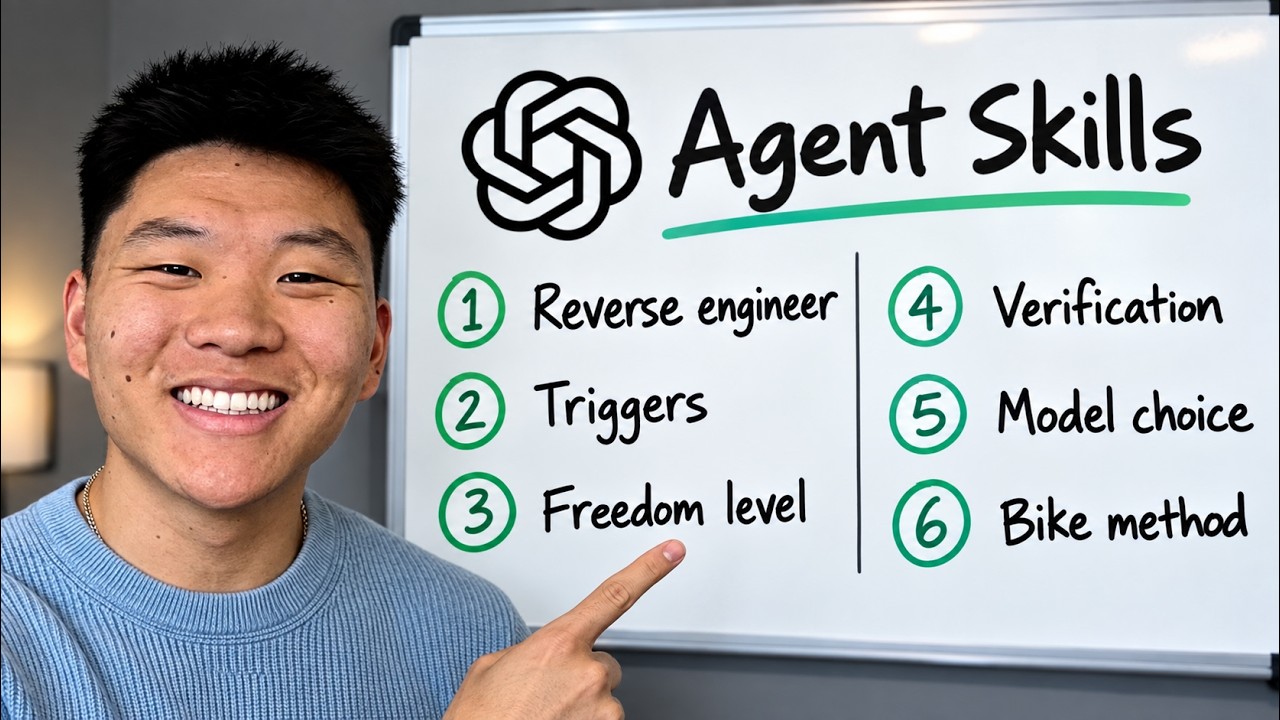
Nate Herk's six-step process for building Codex skills emphasizes reverse engineering from a desired output, defining one specific job and trigger, considering the freedom level (deterministic vs. non-deterministic), including verification loops, walking the skill down to cheaper models, and continuously iterating using the 'bike method'. The key insight is that skills are never finished and should be improved with each use. The process is demonstrated with an X article skill that transcribes YouTube videos and generates formatted posts.
Key points
Skills are stored as markdown files with YAML front matter that defines the skill's name and trigger.
Verification loops use both objective checks (e.g., fact-checking) and subjective checks (e.g., style) to improve output quality.
Walking down models involves testing the same skill on cheaper models like Luna to reduce cost without sacrificing quality.
The bike method treats skills as never finished, with each run providing feedback to update the skill.
The speaker demonstrates the process with an X article skill that transcribes YouTube videos and generates formatted posts with screenshots.
Tools mentioned
Techniques
- reverse engineering
- verification loops
- walking down models
- bike method
- LLM as a judge
- YAML front matter
Stop scrolling. Start reading smarter.
Receive the day's most important AI & engineering updates in one concise email. No spam.
Transcript (captions)
Today, I've got this proven six-step process for building codec skills better than 99% of people. So, let's not waste any time and just get straight into this one. All right, so these are the six
steps that I'm going to go over. I'm going to explain each of these and tell you why they're so important and then we're going to get into Codex and actually try some of the stuff out. And
real quick before we get started, I'm going to talk about what actually is a skill. So, if you already know what a skill is, then just go ahead and skip past this part. But for those of you who
need a refresher, here we go. So, I'm going to use my chocolate chip pancake analogy. Let's say we have this chef and this chef makes the most amazing chocolate chip pancakes and you want to
know how to make those. This is essentially the output that you're looking for. The way that you would be able to copy this chef is by looking at the recipe that the chef used or the
recipe that the chef made. So the chef gives you the recipe. This is you. And now you're able to pretty much make the exact same output, the really, you know, popular famous chocolate chip pancakes
because you followed the recipe. So this recipe is basically the skill. This is essentially the skill.mmd file which means a markdown file. It's just a simple language. It just means that
inside of the skill file there are like pound signs and asterisks to indicate like bullet points and headers and things like that. So it's it's just natural language. But then the agent is
basically able to take this skill file and just use it so that if you say, "Hey, Mr. AI agent, you know, make me those chocolate chip pancakes." It wouldn't have to be like, "Okay, well,
let me just do some research on how to make them. And I don't know exactly what kind of pancakes Nate wants. I don't know how big they should be." So what I'll do is I'll just follow this skill.
I'll follow the recipe and now I get the same output that Nate's looking for and I get it consistently the same every single time because it's all documented for me right here. And these can be
really simple. It can be a simple prompt like, hey, you know, help me turn this email into something that's more professional or something that sounds like me and maybe that's like my nate
email skill. But it could also be complicated processes like doing research on the market and analyzing, you know, 50 stocks and telling you which one to buy. So really, it's
whenever you want to basically like codify some sort of process that you do and so that you can delegate that process to an agent and then you turn it into a skill and now your agent can use
those skills. All right, so now that that is out of the way, let's start with number one up here where we have reverse engineer. So the whole idea with reverse engineering your skills is basically
that you want to start with an output. You want to start with what is the definition of done? What are you actually looking for? Because let's say you ask your agent here for chicken, for
example, and you actually want like chicken parmesan on a bed of pasta, but because you just said chicken, the agent might interpret that a little bit differently and make you a chicken
sandwich. And then next time you ask for chicken, it might make you, you know, chicken thighs. It doesn't actually know specifically what you want. So if you start with an output and you have, you
know, essentially this chicken parmesan and you say, "Okay, let's reverse engineer this food and see what went into it, how long we cooked it, how did we get here?" And that's how you build
the recipe. So, for example, if you wanted to build a skill for the end of the week report, you've got certain columns in your Excel sheet. You've got certain calculations that were made,
it's way easier to give the agent that Excel sheet to give it the final deliverable and say, "Hey, this is an output that is really good and this is what I want to build a skill for so that
you understand how to take some raw input and turn it into this output that I have already told you that I like and this is what we're looking for every time." And then it can basically walk
you backwards through that process. Okay, what data did you look at? where did you get it from? How did you calculate it? Where did you format it? You answer those questions and then you
have a version of a skill that already knows sort of like the north star that it's building towards. I think it's so much easier to run the process, get the output and say, "Okay, let's turn that
into a skill." Rather than saying, "Hey, build me a skill for building a YouTube dashboard." And then you might have this vision and your agent might have a completely different vision. And then
you're going to get frustrated when it delivers you a chicken sandwich and you actually wanted chicken parm. Now remember, all of these concepts I'm going to, you know, bring back together
when we actually hop into Codex and I show you some stuff. But let's just keep moving down the list because I think this foundation is important. So number two, we have one specific job and one
specific trigger. So remember how I said that these skills are markdown files. Skill.m MD. What happens in the skill.md is you've got a YAML description. It's called YAML front matter. And then
you've got the actual skill instructions, which is the meat of the skill. So right here is one of the skills that I'm going to keep coming back to in this video because it's it's
one of my favorite skills. And you can see up here this metadata, this is the YAML front matter. So if I view the source, it looks like this. It's actually just separated by these three
dashes. So this would be the YAML front matter. And then everything below it would be the actual instructions of the skill. Now this is markdown. And when I said markdown is very simple. It is. You
can see here are two pound signs. And that just indicates a header. We can see that we've got these little dashes which are bullet points. And so when markdown is actually rendered, it looks more
something like this. And you can see it's just formatted better. So this is the way that I like to look at it. But if you click on view source inside of the Codex app, you can see the raw
markdown file. But anyways, the metadata up here is the YAML front matter and that tells us what is the name of the skill and when do you explicitly use it. And there are other fields that can be
populated in here like in this one we have an argument hint. And basically this X article skill is used when I ask my agent to turn an YouTube video into a long form X post. And so sometimes it'll
feed in this argument which is my YouTube video URL that it will take, it will download, it will transcribe it, it will take screenshots of it, all that sort of, you know, all the stuff. And
then once the agent has basically said, "Okay, cool. Nate wants to turn this YouTube video into an X article." So, okay, cool. I found this skill that I need to use. Now that I know this is the
skill I'm going to invoke, let me read the entire description of the skill. So now I understand exactly what to actually do. And you can see this skill is pretty long. There's a lot of
instructions in here. And this wasn't like me on one try turning this into a skill. This is probably a skill that's been iterated on 25 or more times. And we'll talk more about that in a bit. But
the whole idea is that you want a skill to do one very specific job. You don't want to have a skill that's like run the marketing team. You want to have a skill that breaks that marketing team, all of
those processes into individual steps. So in my book right up here, becoming AI native, I talk about this and I call it the function breakdown. I call it the the tree. Basically, your job is a tree
and you've got different trunks with different like, you know, bullet points in your job description and then each of those trunks have branches and each of those branches have ultimately leaves
and you want to turn all of those little leaves or those little tasks into skills because you can chain skills together over time. But the point being, if you have a skill with one very specific job,
you can give it one very specific trigger, which means that your agents are going to be able to execute them more consistently, invoke them automatically. It just helps you
separate out what your agents are doing in a much better way than if you have a skill that's like 30 pages long and it's supposed to do so many different things. So think about breaking down processes
at the task level and turning each of those tasks into skills. All right, moving on to number three, we have thinking about the freedom level. So what I mean by this is when you're
automating things, you basically have to figure out is this a deterministic automation or a nondeterministic automation? Basically, is this something that's predictable and we know exactly
what comes in and we know exactly what happens and we know exactly what comes out or is it more of a non-deterministic AI agent, more of a nondeterministic black box where we know sort of what the
input's going to look like. We sort of know what's going to happen inside the process, but we do kind of know like what the output should be. We still know the definition of good and the
definition of done. You can think about it like, can I automate this using rules? Hard rules, hard logic. Is x greater than 10? Is x equal to 500? or is it something that needs a lot of
judgment? Analyze this. Turn this into an email. Turn this into a spreadsheet. And it's really important to think about where does your skill live on that spectrum? Because if you have a very
deterministic skill, like for example, it just has to take a Excel sheet and it just has to populate the cells into the CRM or something and that's basically just data processing transferring.
That's a very deterministic process. And if you write the skill in a very non-deterministic way, there's a lot more room for error. There's a lot more room for AI to interpret something wrong
and do something wrong. And that's the case where you want the skill to be like step one do this, step two, do this. Exactly. Exactly. Exactly. Do this. It's very specific. But if you've got
something nondeterministic, like for example, my ex article skill, we don't want to be so specific. We want the AI to be able to use its judgment and to be able to use research and thinking to
generate a unique output because every YouTube video is different, which means every X article is going to be different, which means all the screenshots that it needs to take are
going to be different. I couldn't say something like screenshot the video at the 1 minute mark and then the two-minute mark and then the 5minute mark and put those into the article at
line 400, line 600, line 700 because then the articles would come out feeling generic and they probably wouldn't even make sense and it just wouldn't be a very good output. So think about the
freedom level of the process and when you're doing this manually, do you follow the same set of instructions every time or are you constantly using judgment and are you constantly doing
different things within the process to ultimately get to that definition of good? By the way, guys, I've got this completely free SOP for you about getting your first Amation client. It's
going to go over the exact steps that has been proven for hundreds of our AIS Plus members to get their first paid gigs. It goes over the one-s sentence service pitch that can get you started
today, why your first client should cost you money, the 5-minute video that answers, can this person actually deliver before you've actually received any money, what to do when you have zero
case studies. There's so many good things in here that are going to help you out. Even if you already do have clients, I would recommend grabbing this because, like I said, it's yours
completely free. So, if you want to grab this, there's a link for it down in the description. Let's get back to the video. All right, moving on to number four. We have verification. And this is
probably the most important piece of building skills. So, the whole idea of building a skill is that now you can trust that your agent's going to give you an output more consistently that
meets your standard. But what you want to do in there is you don't want to be constantly being handed the agents V1. you want to be handed an output that's already good to go that you can give it
a quick skim, approve it all and then shoot it off. And the cool thing about agents building stuff to ultimately achieve some sort of northstar is that you can also have agents check its own
work, verify its own work or you know other agents verify different agents work. So every single skill that I build works in some sort of verification loop meaning the agent who builds the thing
delivers this output and then we either have the same agent or different sub agents come in and verify that output and then provide feedback. And this verification loop can go on multiple
times. Sometimes it's just, hey, here's the V2 and it's approved. Here's the V7. I've even had agents verify over and over and give me like a V15 or 16. And that basically just ensures that your
time isn't being wasted verifying and sending feedback when you can have agents do that for you. Now, when it comes to verification, there is a difference between objective checks and
subjective checks. So, let me explain what I mean by that. An objective check is something that can literally be proven. Sort of like the nondeterministic versus deterministic
thing. Objective means okay um I wanted you to do research and then the verification was to pull in 500 sources cut that down to the best 250 and then every single fact that's in the article
I want that to be double checked by second agent and that's objective we can literally prove 500 sources cut down to 250 every single fact double checked by a different agent that's objective that
is a rule does x equal y is a greater than b but then you have some things that are subjective like verifying the video right if it's it's creating a video for you or if it's creating a
website for you. A lot of these subjective checks are more like, oh, you know, does everything look good? Is everything inbounds? Is it loading in a certain way? When you don't have an
actual hard metric to align it to, you have to sort of be a little bit more subjective on your verification. And what you're thinking about doing is turning that agent into an LLM as a
judge, which basically means, okay, so if AI is going to be applying its approval, and it has to use judgment to approve, then how can you tell the agent exactly what you're looking for? What
does good typically look like or feel like even though there's not a hard rule? So, for example, with the X article skill, I've got some objective checks in there like there are 10
screenshots from the video. But then there's other subjective checks like how do you make it flow in a way that makes sense? How do you make it sound like Nate? How do you make sure that the
images that are put into the the article, the screenshots are cropped? There's other subjective checks that we have to let it do things where it like opens up the app and it scrolls through
and it reads through and it screenshots and it verifies. But a lot of those checks, like I said, are more subjective. And so that's where iterating on these skills takes a lot of
time because you're constantly running the skill, analyzing the output, giving feedback, running the skill again, analyzing the output, giving feedback, and you're basically just like training
the skill where every single time you use it, it gets better. But the thing about verification is there's always a way. You might be thinking to yourself, well, I don't really know how I would
have agents verify that process. Agents can do anything. They can use your computer. They can use your browser. They can look at things. They can listen to things. They can do anything. So just
think about it like this. If you assigned that task to a human, what would you do to basically give it the stamp of approval? And then just explain that to the agent and that's your
verification. That doesn't mean it's going to always come out 100%, but it's going to be more like 95% rather than giving you something that started off at like 75 or 80. Okay. And moving on to
number five, we've got walk it down. And when I say walk it down, I mean walking it down the model list. So whether you're using cloud code or codeex, we all know that different models have
different strengths. And we all know that models that have the strongest strengths are the most expensive. So for example, Astra is more expensive than Soul, but more capable than Soul. Soul
is more expensive than Terra, but more capable than Terra. So the idea is you build a skill and you're getting this good output. And maybe you were testing that with Astra. Okay. Well, let's run
that same skill on Soul. Are we getting the same result? If we're getting the same result and it's cheaper, okay, let's test it on Terra now. Are we getting the same result? Is it cheaper?
Okay, let's test it on Luna. There's no reason to be running a skill with Astra if you could run it with Luna and get the exact same output. But it is important to test it because not every
skill fits that. I've had some skills where I run them on Haiku or Luna because they're just super simple. For example, when I give my agent a YouTube video and I say, "Hey, I need a YouTube
video description and timestamps. That I can do with Luna, and doing it with Astra is overkill. But for this X article thing, I typically like to use at least Soul or Astra because it just
has a better understanding of screenshotting things and putting it in the right spot and cropping it down and even blurring things out. It's so much better with the browser use with Soul
and Astra. And then once you've landed on a model that you like, you can take that one step further and you can walk it down the effort level. So start it off on maybe high and if it's not good
enough, then move it up a little bit. And if it is good, then move it down to medium and just keep finding basically the simplest model or the lightest and cheapest model that still executes at
the level of quality that you're looking for. And then moving on here to number six, we have the bike method, which is I've kind of already alluded it to it multiple times throughout this video so
far, but really it's just the idea to me that your skill is never done. Every single time you run the skill, you're going to improve it. You're going to say, "Hey, here's what I really liked.
Here's what I didn't like. Update the skill so that next time it's better." Almost every single time I run a skill, I give it feedback and I tell it to update. And if you think about this,
like you're teaching a kid to ride a bike, that's what a skill really should feel like. You start off very cautious. You're watching everything. You're guiding them. You you've got your hand
on the the the steering wheel. Steering wheel, I meant like handlebars. And you're you're right there. And then what happens is you give feedback. You say like, "Okay, that was good, but you
know, you were leaning a bit too far to the left. Make sure your weight's more in the center." And then you keep going. Eventually, you take off the training wheels because the skill is getting
better and you're getting more trust in the skill. and then you give more feedback again and then eventually you take off the elbow pads, right? And then you keep giving feedback. But that
doesn't mean that you just take off the kid's helmet and let them bike on the highway. You're not going to do something reckless like that. You're also not just going to shoot them off
down the road and then go inside and take a nap. You're still going to be in in some way watching or having certain guardrails in place in order to make you feel comfortable and in order for you to
have more trust in the actual skill itself. And I truly believe in the idea that there's no such thing as a finished product unless your skill is super super deterministic and it runs perfect every
time and you don't have to worry about it. But when the skills are more on the judgment side of the spectrum, you know, as we talked about up here, the more your skills live over here, the less I
believe that you can actually have a finished skill because like I said, every time things might happen a little bit differently and every time your process might change or new models might
drop and you're just constantly going to be giving feedback every time you use it. Okay, so let's hop into Codeex here and we can take a look at how this actually works. Now when you are inside
of your project and if you're inside of your AIOS which is usually what I'm building in the codec skills will live in a folder called the aagents and then inside of the aagents there's a skill or
sorry not a skill there's another folder calledkills and if you're doing this in cloud code the skills live in aclad and then in a folder called skills now these can be transferable I basically just
tell codeex or claude hey see all the skills in there and bring them over here too so just I have duplicates of them but that's where they actually live inside of your um project unless you
have them at a global level which just means they're living locally across all of your Codex projects rather than just inside of your AOS. So that's where they live and you can always just say, "Hey,
you know, Codex, I have this skill. I don't remember where it is. Could you show me the file path?" And it will find it and you can move it if you want. But anyways, that's where they live. And you
can see I actually just ran this ex article skill on a video. So it says, "Your ex article draft is saved." I'll click into it. And I actually did obviously already publish this one, but
I didn't even have to change anything. I basically just clicked in here. I read it all and I published it. And you can see that as it's going through, it already formatted everything and it used
the video. Of course, it took screenshots of things and it like put them in the right spot to line up with what was actually being said in the article. And it even added this little
um I don't know what you want to call it, like a spotlight. It added that. I didn't actually do that, but it will basically crop things out and it will add things like that into my actual
article because I've told it in the skill to do things like that. And you can see that for this specific video, this ran on GBD6 Astra. So, what I'm going to do real quick is I'm going to
walk this down. I'm going to give this same prompt to Soul and Terra and tell it to make the X article and it's going to use the skill. And we'll see how those outputs compare to Astra's output
because this is a pretty complex skill. It has to transcribe the video. It has to open up the article. It has to make the thumbnail. It has to format everything and it has to screenshot
everything and put it in and then actually like drag it around. So there's a lot of browser use and there is a ton of judgment inside of this. Like I said, this is not a deterministic skill. So
you can see right now I have Soul, Terra, and Luna all running. It's been about 10 minutes, so I'll just check with you guys when this is done. But I just wanted to show you how all of them
because of the skill, because of the verification, are viewing images. You can see how many times Luna has viewed these images here because it's taking screenshots and it's trying to
understand, okay, which of these should be worked into the article and where and why. Same thing down here with Soul. Obviously, this one is a super super visualheavy sort of skill, but because
I've worked that in there, all of them are viewing images no matter what. And so, it'll be really interesting to see how they decide to place them and, you know, what images they actually choose
to put in there because X limits you to a certain amount of images per article. So, I'm going to let these run. We'll compare the results and we'll kind of talk about how walking it down has
changed my perspective on this specific skill. All right, so you can see now that we have Luna and Terra have finished up. Soul is still working. So, we'll start reviewing these two and then
we'll hop over to Soul. Hopefully, it'll be done by the time we're looking through these. So, Luna took 28 minutes and 33 seconds. Let's open up the draft and see what we are working with. So, we
have um the thumbnail in there. We have I designed a one person million-dollar business with Claude. Um the title is the same as like the opening line, which I don't love. There's also this weird
spacing was right there. I don't know if it tried to like center it, but I do notice that. Anyways, we have sort of like the TLDDR. We have these different headers here. I'm yet to see an image.
Here comes the first screenshot. So, this is talking about um the three different types of ideas to compare. And in the screenshot, we do see all three. So, that matches up pretty well. Um we
see agent report card as well as down here. So, really what I'm checking for right now is that it all sounds like me. So, this is kind of trained on like my LinkedIn style guide and my YouTube
style guide and like the way that I speak, but I'm also making sure that the images look good. So, the test suite is a golden data set. We know what the correct answer or correct action should
be. And we see an evaluation right here. The first run scored 88. That's what we see. Um, approved the new policy. Same 16 tests. Ran it again. That looks decent. I clicked create report and we
don't really see the report here. So, that's a little bit off, I would say, but it's not too bad. I'm actually impressed that Luna is doing it this well. This is customer support. This is
kind of just the home dashboard. And then down here we see searching for companies using clay. It did do a nice little spotlight animation here when we're looking at the actual pricing. And
then we've got the three Ps down here. Okay. So, this is not too bad. We'll have to compare, but I would say that I was impressed by Luna's ability to screenshot, add spotlights, put it in
the right spots. So, that is Luna. That also took 28 minutes and 30 seconds. Okay. So, we have Terara. And by the way, all of these are running on high. So, we have Terara here. Took 26
minutes. So, about 2 minutes, 2 and a half minutes faster than Luna. Let's open up this draft. See what we got. So, same exact um thumbnail. We have an image right away. How I built a $1
million AI business model with Claude. This image isn't great. Like to start off the article like that. That's not a very strong way to start it off because it looks like it's cut off like that.
So, that's bad. Um we go through the three filters. Oof. I mean, [snorts] this image doesn't look very good either. I would already say right now that um Luna did a better
job. I mean, this isn't a bad Also, this is a zoomed in. So, it took a screenshot of the video and then it zoomed in on the score going from 88 to 94. So, that's not terrible. Read complaint
check company fit recommend small trial. What you'll notice here is it actually, if I can open this up, it redacted sensitive details. So, it put this block over it and said sensitive details
redacted. So, I think that that's pretty cool. I like when it does things like that. It did a little spotlight effect here. It redacted more sensitive details in this one. As you can see, it did it
again here. So, it's it did it again here. It It shows so many times when it needed to redact sensitive details. It did it again. It did it again. Okay, but this is obviously an issue. It didn't
verify this good enough. Like, you can see that there's literally four images in a row down here. This one looks bad. I think that, you know, you you you have to use the browser to like drag these
around. And I think that it just gave up or it stopped and thought it was done. So, so far I would say that Luna did a better job than Terra. And Terra was, you know, it's a more capable model
apparently than Luna. It's also more expensive. So, right now, if I was choosing between these, I would choose Luna. But now Soul just finished up and Soul took 38 minutes. So, normally when
I do run this, I run this on Astra. I usually run this on Astra low and I run it on fast mode to get it done faster. But let's see. This did it. Let me open this up. Okay, so here is uh Soul's
version. I built a $1 million business with Claude. We have the same sort of like TLDDR, the three filters. We have a picture of the three filters right here. So, that's not bad. Choosing the
product. Okay, it's zoomed in here. These are all zoomed in, by the way. So, it's it's it's using more, I guess, vision intelligence to choose what to actually display in the image. You can
see it redacted here the demo receipt. So, not too bad. It zoomed in a little bit here on the report, although we don't see the score 88. What it what it highlighted here was 14 tests pass and
two failed instead of showing us the 88. So, just pointing that out. It also zoomed in down here on some analysis of that report. It did a little spotlight effect here to show the 94. It redacted
more of these receipts. It did another spotlight here. It shows sales and support without losing control. So, that's not terrible. We've got this customer support image as well. We've
got more internal source ID redacted. Another spotlight effect on the money. And yeah, so this one isn't too bad either. I would say honestly like I'm wondering if Luna's was better. And
that's the thing, like these are so different and sometimes I have tutorial videos, sometimes I have more of this style where they're edited. So, it's very hard to just say, "Okay, I've run
one test and I know that now I'm going to go with Luna instead of like Astra or something for for a specific example." Now, I will tell you guys, I've done this multiple times on multiple
different YouTube videos and Astra just seems to be the best. So, I do stick with Astra on low, but I do think it's worth running them through a few different examples and and
understanding. And that's why I said that there's really no such thing as a finished product, especially the more non-deterministic you get on that whole spectrum. And what you can see about all
of these with Luna, it gave us a QA report, it gave us a visual plan, and it gave us selected frames. Terra gave us a QA report as well. And Soul gave us a QA report. And like I said, that's the most
important part is just them proving that they've verified stuff. So, it verified the title, the body, 76 non-mpt text blocks, um 11 inline screenshots, seven H2 headings, visual review and privacy,
editorial coverage, artifacts. It's proving to me that it's done. And it's proving to me that it did its verification. And trust me, if it didn't do this QA report and it didn't do the
verification, this skill would be so much worse as far as actually getting it to place the screenshots in the right spot. So, for this specific example of the skill, let me talk about how I did
all of these things. I took an article that I did manually and I did a few of these manually where I literally went through the YouTube video, screenshotted things, put it in the right spot and I
gave it some of those to look at. So, first was like, hey, analyze all these outputs. I want to turn this into a skill. So, help me understand like what's good about these and and how do
you choose the screenshots and how do you place them and things like that. So, I reverse engineered and then obviously this is one very specific job. It was to turn a YouTube video into an X article.
It's not just to write X articles in general. We've got I've got a different skill for that. This is literally to turn a YouTube video into an X article, which means the trigger is very specific
as well. So here, all I said was turn this YouTube video into an X article and it automatically was able to invoke the X article skill as you can see. But if I wanted to do a slash command and do X
article, I can invoke the skill like that as well. But typically, if I say, hey, I want this YouTube video to be turned into an X article, it just invokes the skill automatically because
it's one specific use case and it's one specific trigger. We talked about the freedom level in here a lot. This is obviously a super super non-eterministic process. We talked about the
verification. We did the walking it down live. And as far as the bike method, like I said, guys, I would basically come into here and I would look at what Tara did that I didn't like. And I would
basically be like, "Okay, Tara, so in your article, you had some really weird screenshots in the beginning. It looked like things were cropped out." The whole idea is that people can look at the
screenshot and they won't need context of what happened a few seconds before that frame or a few seconds after. And you have multiple examples in here like the first screenshot you did as well as
the second screenshot that you did that just don't look very good. You also have things at the end like these random four images that don't feel like they're placed right. So I feel like your
verification wasn't good enough, but also the third the third image in this set of or sorry the second image in this set of three at the bottom it's like halfway through an animation. So that
was first of all a bad screenshot to take and second of all a bad place to put it. So that's some of the feedback that I have for you now. If you could analyze this, understand what I mean by
this and then update the skill so that you don't make these mistakes in the future and so that you can highlight some of the important things that I just mentioned blah blah blah. And then I
would just shoot that off and it would go through, it would look at the feedback and it would take all of that information and it would update the skill. And that is how you start to sort
of see that bike method coming into play every single run, give good feedback and also give bad feedback and tell it to update the skill. Otherwise, all of those changes that you have to make
manually, you're going to have to make manually again the next time. So anyways guys, those were the six tips. Those were all of them ran on a real example of one of the skills that I use pretty
much every day. Every time I make a YouTube video. So I appreciate you guys watching through all that. And also guys, real quick, just wanted to tell you about my second channel where I just
kind of like document these things that I'm doing at AI events or these different trips I'm taking to meet up with AI creators or speaking at things. And if you want to check out sort of
like what else I'm into besides just like making tutorials, then head over to the second channel. I'll put the link in the description. And I hope to see you guys over there. I hope you enjoy this
type of content as well. But that's going to do it for today. So if you guys enjoyed the video or you learned something new, please give it a like. It helps me out a ton. And as always, I
appreciate you guys making it to the end of the video. And I'll see you on the next one. Thanks everyone.