Enjoying this issue?
Get tomorrow's AI & engineering digest in your inbox — hand-picked, summarized, and always spam-free.
TLDR
Sarvam's 3B parameter state-space vision model beats models 100x larger on document AI by using an SSM architecture that scales linearly with sequence length, making it practical for long documents. The model was trained from scratch in India with a four-stage curriculum (text pre-training, vision continual pre-training, OCR fine-tuning, RL) and achieves SOTA on English benchmarks while leading on 22 Indian languages. The real story is that a small, sovereign model can outperform frontier models on a hard, low-resource problem when the architecture and data strategy are tailored to the task.
Key points
Sarvam Vision uses a state-space model (SSM) instead of a transformer for linear compute and memory scaling.
The model was trained from scratch on 13 trillion text tokens, 300 million image-text pairs, and 100 million OCR samples.
Reinforcement learning with verifiable rewards (RLVR) provides a major boost for deterministic OCR tasks.
Sarvam Vision achieves 84.3 on CRB and 93.2 on OmniDoc benchmarks at launch.
The model has an unbeaten lead on 22 Indian languages compared to frontier models like Gemini and GPT.
Tools mentioned
Techniques
- state-space model (SSM)
- staged curriculum training
- reinforcement learning with verifiable rewards (RLVR)
- synthetic data generation
- block-level OCR with layout and reading hardness modules
Stop scrolling. Start reading smarter.
Receive the day's most important AI & engineering updates in one concise email. No spam.
Transcript (captions)
All right. Um, hi everyone. Good afternoon. I'm Krishna. Uh, and I'm a general manager at Servin. Um today I'm going to tell you how a three billion parameter model uh small enough to run
on a single GPU gets state-of-the-art uh in document AI and beats models 100 times larger in size. It is also a slightly unusual model in two ways. Firstly u the language model
used is not a standard transformer. Um and the entire model building from data to training to compute uh was done end to end in India and for English and for 22 official Indian languages uh which I
think uh are personally uh uh one of the hardest document intelligence problems uh in the world right now. Um this is how we went from scratch to SOTA. Who are we? Uh we are serv uh a
sovereign foundation model company uh in India. We work across different modalities voice, text and vision. Uh in voice we have speech to text and texttospech models. In text we have uh a
30 billion and 100 billion parameter uh uh models and in vision we have a document intelligence model which is what we are going to talk about today. Um, India is largely missing from the
machine readable world. Um, according to a published language distribution study, well under 1% of the common crawl uh corpus on which frontier models are trained uh have uh um Indian language
representation. Now in several forums you may have heard Frontier Labs say that um India is their um India is one of their larger uh uh and fastly growing markets and to that
end um India is still missing uh in terms of data from frontier models that uh um are being trained every day here. Now why is that? Uh primarily not because there is uh a lack of data or
the knowledge does not exist. It is because the data has never been digitized and we are solving that problem at server. Um why is Indic document intelligence
hard? Uh firstly the goal is that of knowledge extraction not just purely text extraction. Uh extracting pure text without logical coherence is meaningless. And secondly in index
scripts the shape of uh the words and the language you see are very different from what a machine sees. that is Indian languages have a complex uh set of uni codes fused together to get right the
language model needs to be strong at all 22 languages. Third, majority of Indian languages can be considered low resource due to which there is a lot of uh um lack in data today to train these
models. Our answer to this is server vision India's first sovereign vision language model built from scratch. um a three billion parameter model with state space
architecture data compute and training all of which done in India. When we started the initial work in late 2025 most VLMs uh in the OCR space were monolith VLMs. uh
they performed page level OCR and we at the time took a contrarian bet to focus on block level OCR instead adding a document hardness around the model. Um a lot of models since then uh released uh
uh recently in 2026 have converged onto the same uh hardness plus small model paradigm for OCR which shows a lot of value in the direction we uh set off. Serverom vision in particular uh has two
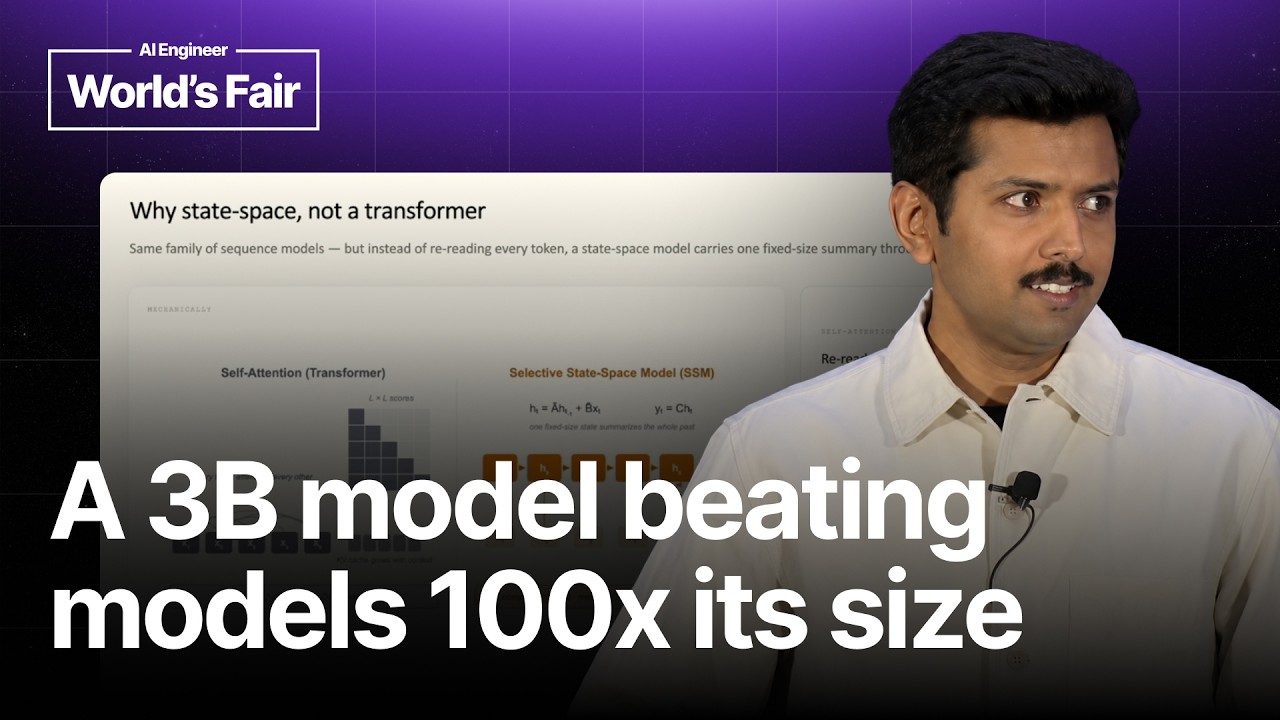
hardness modules one for layout and one for reading hardness and a state space model uh VLM for block level OCR. Again um today uh why do we use state space and not a transformer? Um most OCR
models today uh like general VLMs, open source VLMs like Quen, Gemma etc. are all transformers based. We took an alternate approach uh using an SSM. Why? Both are fundamentally sequenced models
transformers and SSMs but with very different underlying mechanics. A transformer has every token look at every other token where the compute grows with square of the sequence
length. Uh that is the L cross L interactions and the memory goes as the sequence grows as well. Now on the other hand, SSMs have a single state. They maintain a single state through the
sequence updating it token by token. Now as compute grows only linearly, the memory stays constant for SSMS. Now why is this the right uh architecture for OCR? It really depends on the uh uh
trade-offs here uh for long documents in particular which can lead up to uh uh 5 to 10,000 uh visual tokens per page and quadratic complexity of you know uh compute and memory becomes very
expensive for inference. On the other hand, um doing block level OCR with somewhat of a lossy recall using SSMs can be justifi justified to uh um avoid high
compute costs imposed by transformers. So how do you actually train this? We built a staged curriculum four stages each uh building on the last um stage one is texton pre-training uh 13
trillion tokens across English, Indian language, text, math and code. This builds the three billion parameters language backbone and a strong language prior is what lets the model resolve a
smudged or an ambiguous text from the image. the same way you can read a half blurred word because you know which word is supposed to uh u be at the right place. So we focused on building the
competence of the language model first uh before the model ever even sees a pixel. Stage two is where we performed continual pre-training uh on 300 million image text pairs. This teaches the
language model general vision capabilities and teaches how to see how to interpret pixels and so on. Then comes stage three where we performed uh supervised fine-tuning on 100 uh uh
million uh OCR uh samples. Now the um stage three is primarily focused on letting a general VM model become strong at OCR. What that includes is having diverse data across all 22 languages and
English and also incorporating all kinds of uh uh document components such as tables and uh um equations and handwritten documents and so forth. Now and stage four is re reinforcement
learning which helps push past the ceiling of whatever uh supervised fine-tuning is able to achieve. Here you will see this is a standard recipe. However, the moat here is the two things
underneath the data layer and the eval layer. Um the first is the data engine. For most of the 22 languages, there is no label data available readily. When label data does not exist, building
the data engine becomes hard. And that is something we have done extensively. We've built pipelines to create synthetic data and doc data from real documents and also helped
build the uh pipeline for continuously improving the data that goes into training based on the eval performance and so on. So we are currently actively looking at the paradigm of RLMs um as uh
uh we explore the agentic vision capabilities for our models in the upcoming releases. The second mode is the eval. You cannot reach state-of-the-art if uh um you cannot
measure how well your model performs. We have curated extensive evals to ensure what we are measuring is truly sota and also truly meaningful in terms of usefulness for end uh uh users. So I
want to take just a minute to dwell on our RL pipeline uh stage four because uh a lot of gain comes from RL. Essentially in OCR correctness is a machine readable problem right a lot of tests can be set
up to uh um reward and score the models against uh uh these uh samples that you create. And in the world of deterministic OCR, these are all machine uh uh verifiable. Hence, RL gives us a
major boost. Sample a group, score with unit tests, reinforce what the average uh uh value to beat is, and then repeat the process. And this makes RLVR for OCR very very
scalable. Now after all the from scratch training we've done and the data effort we've made we were able to establish sot in two of uh the global English benchmarks
one is CRB bench and the other is omnidoc bench at launch we were at 84.3 on CR and then 93.2 into on omnidok bench. Um the models uh that have released since have moved the needle
quite a bit and we'll soon have a a stronger model in the global leaderboard as well. Secondly and more importantly um on 22 Indian languages we have an unbeaten
lead even compared to all the frontier models such as Gemini and uh chat GPT and Opus and so on. And this is where we've extended the lead significantly and we remain uh uh strong compared to
all of these newer models that have come in. Now server vision pars our agentic document intelligence workbench called aure where we enable
human in the loop agentic digitizations uh and uh extractions and then injections for various uh downstream uh document intelligence problems. We provide confidence scores um and we uh
have block level grounding and then also the ability to do uh agentic proof reading etc. Now benchmarks and soda are uh uh one thing they have their place. Today some
of the largest enterprises in the world from insurance to banking to governments to historical preservation organizations are using server vision to digitize more than 35 million pages across English and
uh uh 22 Indian languages. The model is available as API and on prem and then the agentic platform. So in conclusion until 4 months ago uh there was no sovereign model uh from
India. Today we have server vision which was trained from scratch and has established sot um at a price point that is extremely competitive with uh all the other solutions including open and close
source. Uh first we've started by uh uh solving some of the hardest problems for Indian language document intelligence. Soon uh we'll be releasing general purpose uh VLMs which are capable of
much more uh uh vision capabilities and uh look forward to uh uh all of you trying out our models. Thank you. [applause] Happy to answer any questions. Yeah.
Yes. >> Yes. Absolutely. Uh in general, the language capability of the 22 languages enhances English uh by quite a margin. And this is applicable to any low
resource language, not just Indian low resource languages. >> Yeah. Right. Um we don't quite go in that direction with this model because this
is a vision focused uh uh model wherein we are focused on extracting information or knowledge from documents. But yes, there could be uh some parallels to um helping models use general languages to
speed up coding as well. But yeah, that's not the uh periphery of this uh uh work. Yeah. Right. Um so there are two things uh we
uh create artificial documents synthetic documents as they are called for general post-raining uh that includes SFT and RL. Um however coming to your specific question on RL uh we don't uh you can
generate uh synthetic documents there as well. However, um the best thing to do is to take real world documents complex enough that uh help you set up unit tests or different kinds of uh uh
rewards, right? like say a a reward based on character error rate or a a reward based on table structure or a math equation or something uh that is pertinent to a language or like grammar
rewards or so on and then help the model iteratively improve based on uh um rules that the model is able to produce at different uh u settings. Yeah. Yes. Sorry, did you say big fan of Chundra?
>> All right. Uh, that's from a different lab. Uh, I'm also a big fan of the lab that produced Chundra. But yes, took your question uh on Indic benchmark. Yes, we will release the server indic
benchmark that we have created for 22 languages and it uh spans um a a huge time period starting from 1800s until modern day and also different kinds of layouts, different kinds of documents in
Indian languages. You can imagine documents with pros, poetry, literature, uh tables, finance and all of those things. We'll soon release that benchmark uh in public as well.
So translation is again uh transliteration is again not directly involved here because in OCR what we care about is high fidelity extraction right uh you want even if there is a
mistake in an image you want that mistake to be extracted correctly and not the model uh uh making changes at whim uh hence that is not directly applicable but yes uh what we see is a
lot of data that is coming through transliteration for even OCR training now and the um jury is out on what is the quality of that data and how useful it is etc
Yeah. Right. Um there are few things to consider. Um first is no other model frontier uh closed source or open model does well with complex Indian language
documents right so for a size of uh for a country with 1.4 4 billion people you want to be able to address their day-to-day lives in uh uh terms of document intelligence problems because
there is a lot of paperwork in India right it is a up and cominging country and it's still being digitized as we speak and it's important that representation or ability to digitize
the country exists to begin with. Secondly on uh the training side what we have uh uh done in particular is to create data that can be added to a lot of training downstream. So uh we are at
a very early stage in terms of AI becoming you know a regular parts of our lives and we need the data to start to be able to eventually get to a place where we can uh have personalized agents
in the language you prefer in language I prefer and however I want in uh uh in some so to do all of that we need to start somewhere and the data needs to be created and if the data is of good
quality then that helps the model become sota and If a model is sot then uh from uh insurance agencies to government organizations to others who care about sovereignity in AI right uh as a
government body I cannot have a model deployed elsewhere and I don't know where the data is going for uh uh the transcriptions so I need to be able to control where the data is sent and when
it is used how much it is used etc. So sovereignity becomes very crucial and hence this model really is now uh uh like it's been what four months since we launched and already we are we are
digitizing 35 million pages. So that is that shows that the market was waiting for something sovereign in this space that can really kickstart uh the AI digitization wave in India. So yeah
primarily like three aspects one on uh sovereignity the other is the model uh capability itself and the third is data uh that is required to train these models.
Yeah, it is it is uh um 40% uh indic and then uh the rest is English and comprises of math and code etc. >> All right. Just a curious question.
Um currently the uh the deployments we've made uh with this model are in different states uh uh trying to digitize regional languages and along with all the English and mixed language
uh uh documents and hence we'll soon uh be able to train with the um uh feedback we get from uh the current deployment. So yeah, we have started that uh pipeline as well.
>> [music]