Enjoying this issue?
Get tomorrow's AI & engineering digest in your inbox — hand-picked, summarized, and always spam-free.
TLDR
Using Jev decision models in an agent harness can replace many LLM calls for simple decisions—tool selection, safety checks, result scoring—with millisecond, text-free choices that drastically cut latency and cost. The key insight is that most agent-loop steps are yes/no or limited-option decisions, exactly what Jev handles well. This is a clear win for decoupling decision-making from generation, but only for questions a human could answer in a few seconds.
Key points
Jev returns typed answers with probabilities, not text, for decisions.
Six integration points: model routing, risk gating, tool/skill selection, ranking, triage, and real-time filtering.
Progressive disclosure of skills uses cascading classifiers to select category then specific skill.
RAG reranking with Jev scores top passages for LLM input, reducing context size.
Limitations include accuracy drop on long inputs and poor handling of compound questions.
Techniques
- progressive disclosure of skills
- cascading classifiers
- decision model integration in agent harness
- reranking with decision models
- risk gating before tool execution
- model routing
Stop scrolling. Start reading smarter.
Receive the day's most important AI & engineering updates in one concise email. No spam.
Transcript (captions)
Okay, so most of the model calls in an agent harness aren't actually writing anything. They're making decisions. They're making decisions like which tool should I use here? What skill should I
load? Is this command safe to run? And even decisions for things like rag where it's asking which of these 20 search results actually answers the question. And up until recently, everybody has
approached those decisions pretty much in the same way. They've used a full LLM call to get the answer back. So, in this video, I want to show how you could use Jev and the other open decision models
to actually improve an agent harness from the inside. I'm going to talk about some of the things that you can actually do with it. I'll show you a couple of cool examples that I've been playing
with for doing progressive disclosure on lots of skills and for doing re-ranking of rag results. But I'll also talk about some general principles and perhaps more importantly what are the use cases that
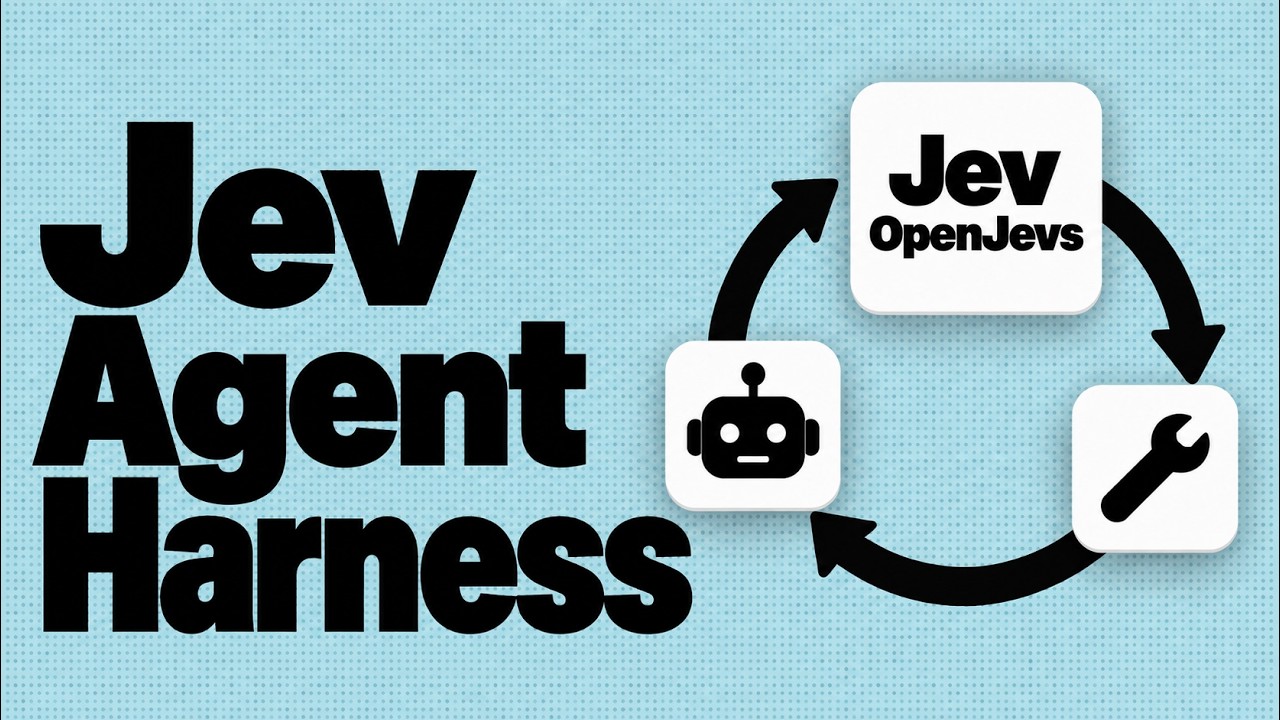
you don't want to use a model like this. All right. So let's start with the loop that every agent runs. A request comes in and it goes to an LLM. Along with that you basically have some kind of
tool registry going in there a system prompt perhaps a set of skills some guidelines of how the agent's going to work etc. And the LM decides straight away what action should it take, whether
it needs to use a tool. And if it does, it writes out a function call giving us the tool name plus the arguments as JSON. Your scaffold in your agent harness then runs that code as a
function. It gets the results and it appends that to the conversation and the whole thing goes back to the LLM. And then round and round this goes until eventually your LM's decided it's done
and it writes its final answer. along that road, it's probably going to use many tools. It's basically going to get information to expand its context and it's going to make a lot of decisions
along the way. Now, if you look at those LLM steps to see what's actually going on at each step, the whole sort of thing of asking itself which tool it should use, is it safe to actually run that?
And often because it's making those decisions itself, it never really stops to ask any sort of verification step or any kind of safety step in there to ask, is this safe to run? And for most
agents, if they don't have any sort of reflective step in there, they're really never even asking themselves, is this result good enough or should I go around again and try again? Each of those
things are clear decisions that you can use a decision model like Jev or one of the open jevves to actually improve the quality of the agent harness. On top of that, a lot of the times the decisions
that the LLM is actually making are just a small set of options. Do I go to this node next or this node? Which skill looks like the best one to use in this situation? Which skill do I ask for more
information in this situation? And each time you're paying for a full call to a large LLM there. And that's costing you both in money for tokens, but often even more. It's costing you in time of you
actually having to go through and do these things. And that's why a lot of the time when people are building custom agents, they often don't put anywhere near as many verification steps in there
as they should simply because that's just going to slow everything down. So, if you've watched any of my other Jev videos, you know that I've basically talked about the whole concept of Jev as
being like a smart if statement. You give it a state, which is just the thing that you're evaluating, and then you give it a set of typed questions about that state, and it gives you back typed
answers with probabilities. No text at all. Choice will pick one option from a list. Score rates the state on a scale that you define. A null is a yes or no or a true or false that's returned back
as a probability. And the cool thing is you're not limited to one question at a time. You can ask many questions about the one state all in a single call and get answers back in parallel and it
almost doesn't change the response time at all. So if you're looking at how to improve your agent harness, one of the key things you can do is look at that loop of where it's full of a bunch of if
statements that are dressed up as function tools or dressed up as asking the model for structured JSON responses back and you can convert those kind of calls to something that's much quicker
like a decision model. All right, so where does this actually belong in your agent harness? I'd say that there's six main places that you want to be thinking about here. So the first one is model
routing. I did a whole video about how you can look at this. You got a request coming in. Jev decides whether it goes to a cheap fast model or expensive model that's going to do much better reasoning
etc. If you haven't watched the video that I made about that, you can see the whole thinking process for actually putting that together. The second use is risk gating. So before a tool call
actually runs, Jeff can actually check whether it's going to be something destructive like deleting a database or wiping a folder or whether what it's actually going to be doing is quite
benign. Now we know that a lot of the coding agents have had this kind of check for a while, but it's been hidden generally in their harness. And when you were using it, you were basically paying
for a full tool call with the amount of tokens that it actually gets used there. So being able to configure your harness so that when certain tools get called perhaps like a bash tool, you actually
look at what the arguments are going to be going into that and you send that to Jev to basically ask it, hey, is this going to be malicious or benign very quickly. You've got a safety check that
can take milliseconds. And of course with the open decision models that can be running fully locally as well. Third up, you've got tool and skill selection. So generally what people have done is
they inject their entire tool registry that they're going to be using into the system prompt and that can chew up thousands of different tokens. So the whole idea of skills has reduced that a
lot by using progressive disclosure and this is one of the key things that I'm going to show you in the demos a bit that you can actually have lots of skills going on. categorize them, have
your decision model decide which kind of category it's going to need, and then just load the appropriate skills into a system prompt at that point. Fourth up, you've got things like ranking and
judging. So, this is another one that I want to sort of demo here. I think the whole idea of scoring retrieve trunks and grading on answers against a rubric. This can be a huge win for anything that
you're doing with rag or anything you're doing where you're injecting context into the context window. Fifth up, we've got things like triage. So, this is all your things like support tickets, email
issues, and one call here can give a proper probability of how urgent something is and start to help giving things an actual probability of priority here. And this one can be really useful
for when to basically get the model to go back to the human for things like human in the loop as well. And the sixth use that I'm not going to go into too much here is the whole idea of just real
time filtering. This can be really useful for anytime you're basically dealing with APIs, polling requests, anything where it's good to just filter what comes back from that before you
inject that into the context window. So the rule of thumb that I use for all of these actually comes from type safe themselves. If a panel of smart people could answer the question in just a few
seconds, then it's the kind of question that you probably should be using a decision model for. if they need to go away and formulate an answer and then write a complicated answer back, that's
when you should be sticking with the LLMs. In a little bit, I'll actually go through the use cases of where you shouldn't be using these decision models at all. So, how do you actually wire
this in? So, if we go back to that loop that we had there, there are four places to hook a decision in. And really, they're going to be the same in any framework, whether you're talking about
lang chain, whether you're talking about ADK, whether you're just using custom Python code to write your own loop. Here you've got before the prompt is built. So decide which skills or tools to load,
before the model called, decide which actual model you're going to call, before a tool runs, decide whether it's safe, and then after a result comes back, decide whether it's good enough to
use or whether you should go back and actually go through the loop again. So each hook here is the same small piece of code. Build a state from what the loop already has. Ask your questions and
then read the probabilities and answers that come back and then branch or make your decision for the path going forward based on those. Now there's also a second pattern that you can use where
Jev is the loops decider and the LLM is the fallback. So Jev picks the tool or the answer and only hands it to the LM when it's unsure or when something needs text to be written. Now, this pattern
can actually cut more LLM calls, but it's definitely a much bigger change to your agent. And so far, I found with this one, it just doesn't seem to work as well when you've got a lot more sort
of complicated things going on in there. Anyway, for either of these patterns, you don't need a framework. That said, the first pattern that I talked about here, lane chain has already shipped
that as middleware and Pantic has shipped their own version by making the type safe models something that you can just plug in and use in the agent loop. All right. So, before I show you the
demos, let me just go through quickly where I think this doesn't fit. Clearly, anything where you need text back, anything that needs any sort of multi-step reasoning, and anything where
you're going to need to connect several things together to generate an answer out, all of those are still an LLM's job. And in many ways, a lot of that multihop stuff is still going to be the
stuff that you're going to use the LLM for, and then have your harness process that and keep passing it back to the large LLM. The second thing you want to think about here is size. So if your
state is just getting too big and that you're trying to pass in 100,000 tokens to get some kind of response back from that context window, then Jev is not going to be a good fit here. Types
safe's own docs say the accuracy drops a lot on long inputs and so it generally seems to fit whether you're using the type safe Jev decision model or one of the open decision models. On top of
that, another thing obviously is that Jev itself doesn't use images. Now, some of the open models actually do use images and use images really well. So, at the moment, that's definitely a win
for the open decision models over the proprietary models. All right. Another thing that doesn't work well are compound questions. So, compound questions are often something that the
decision models don't handle that well. If you've got a yes no question, okay, that's fine. But if you've got something that requires multiple questions in there to be answered, then often the LLM
is going to do better for that kind of thing. Another thing you want to be wary about in here is while the decision models can be really good at spotting sort of weak spots, you want to be
careful about how you always rely on them. It does seem currently that a lot of these models can be prompt injected to basically have instructions that actually move the results out of that.
So often the way to get around that is to basically have a question first that asks, are there any prompt injections in here before you actually pass it on to the real question that you wanted to
actually ask. The other thing I find too is that you really want to think about criteria for making the decisions. So if you've got very clear decision spots where you're asking the same questions,
you can control the actual criteria very well in situations like that. If you're just asking some vague question about the output from the LLM and you haven't got a nice clear criteria in there, I
wouldn't necessarily be trusting the LLM to write that in a way that's going to make the whole system a lot better. You kind of want to define the instructions and the criteria yourself and then
benchmark any changes that you make to that over time. And then of course lastly, if you're actually running your agent locally, but then you're using Jev in the cloud, you've got to think about
the whole fact that it's a hosted API and do you really trust it for every state that you're going to send to the cloud? Is it okay that that leaves your machine? And I think this is where the
open decision models have really come along so far now. So let's jump into the demos and actually look at some examples of how you could do this for a couple of these key tasks and some of the
challenges that you might face along the way. All right. So, in the demo here, I've basically made a UI just so you can see what's going on a lot easier. But these are exactly the kind of decisions
that are going on in your agent. So, if we've got a bunch of skills, more and more now, people are starting to use large amounts of skills files. And remember, the whole thing that's really
cool about skills is that you've got progressive disclosure in there. So the idea here is that if this is the actual skill file, and it might actually be a lot longer going through this, you only
give the model this after it's decided that okay, it needs to basically use a coding write tests skill for this. Then you would actually go and give it this in the context window. So the difference
thing that we're doing here is that rather than just give it 50 skills in one shot, we can see for each of these 10 different categories, we've got five different skills in here. And if we're
injecting that in the system prompt for every time we call the LLM, that's going to burn a lot of tokens. So the idea is that the thing that we inject into the LLM is just the categories of skills and
then the Jev model itself will basically take the task that we've got. It will then decide which category to pick from. Then it will be given the list of skills for that category and it will then
choose the most appropriate one to actually do this. So let's look at this. So, if the task is basically someone saying, "Someone got an email pretending to be our CEO asking for gift cards. Is
this a hacking attack?" And you can see I'm running this through one of the bigger Jev models in here. But actually, you can try it out on a lot of the different Jev models. You can see if I
run this and route it, it goes through and it basically first decides that the category here is security and access. So, it's done that as a choice. It's basically returned this back. And then
in this category, it has a bunch of these in here. And we can see it decided investigate a security alert in here. And sure enough, the description for that is triage of suspicious login,
fishing report, or security alert in there. So you can see in this case, what we've actually done is a sort of cascade classifier where we've done one sort of classifier first to basically pick out
the class of the category and then we've done a second one to actually pick out the skill. In this case, because we're running this locally, it's done it super quick going through this. All right, you
can see that if I give it a sort of general question here, we've got certain things that we can actually do. Let's route it through. Sure enough, in this case, it's basically saying, do web
research, fact check a claim, right? It probably could have also gone for search the web, although I guess this does actually make more sense in that it's actually stating a fact and then asking
if it's true here. And from there we could load the skill file or use any sort of API etc that we actually wanted to there. All right one more in here you can see okay make me a short voice over
of this product description for a launch video. Now it's deciding that okay that relates to images audio and video and it needs to be a texttospech skill in there. So this is a way of using Jev for
sort of progressive disclosure with skills, especially if you've got lots of skills by classifying them first into categories and then putting them into actually which skill is being chosen.
You're able to get a very fast result here and then the skill itself can actually be sent to the large language model to work out any arguments that need to go into that skill, those kinds
of things. But this is able to help us reduce on token spend but also just speed things up like this. Another one that you can use in the same sort of vein of this is doing sort of
verification steps of things that come back from APIs to basically have the whole thing make a decision of whether whatever's coming back from the API is really good and can just go straight
through as a result whether you need to change the arguments that you gave to the API or whether you just need to call it again because you got a certain type of error etc. The next demo is combining
this with rag. So, one of the patterns in rag that works really well is go and get a lot of information and then rerank that information. And generally, there are ways to do that where you've got a
separate reranker model. And that can work really nice as a pattern. The only challenge is that for certain projects, you just can't do that because of time. You can't do that because you're going
to need more models. And especially if you're already using an embedding model on an API, you probably don't want to have lots of calls to the API for reranking for that kind of thing. So the
idea here is that we can ask it a question. It will then go off get a lot of different passages then give those to the actual Jev model which can decide okay these are the top five passages
that I'm going to send to the full-size LLM. And there are different ways you could do this. You could basically do it on a sort of yes no thing. You could do it via sort of scoring kind of things or
if you really wanted to just sort of pick one you could actually just have a choice of one to see okay what's actually going to go through in there. Now for me playing around with this I
find the scoring one seems to work quite nicely here. We then basically get a score. So in our question here is why are my web hook requests failing with an error? And then we can see sure enough
we're getting back web hooks verifying signatures. Second up, web hooks raw bodies. Third up was proxies. Fourth up was web hooks signing secrets. And you can see that we've got the five things
now that we can basically send back. And this is something that you could even use if you weren't using an embedding model. If you're just using something like BM25 to basically get different
sections out, you can kind of get a bit of the best of both worlds by having sort of a broad sweep that gets you 25 different passages back and then using the Jev model again. In this case, using
one of the open local ones here to actually go through and pick out the top five that you then send to your LLM. You can see if I try it with one of the other ones that it's then able to
basically go through, get out different parts of the context, pick out stuff that's most relevant, and then pass that through. Now, these are certainly larger chunks of text than what I had with the
skills before. So, it's perhaps not quite as fast as the cascading system that we had for the last one, but still fundamentally the same idea of where you're doing scoring and classification
using the world knowledge that's in that particular decision model to help it make simple but useful decisions for you. All right. So, just to finish up, you can see that there are lots of uses
of where you can use either the Jev model itself or the many open versions of this in building any sort of custom harness. I recommend if you're interested to basically think of these
things more, come through and read some of the Jev tutorials. This open router has got one up here. And when I'm actually using the Jev model, I'm going through open router. So for those of you
who are asking, if you haven't been whitelisted for the actual type safe API on their site, anyone can just come and use the open router one here. Another useful resource that's worth checking
out is Langchain has got a nice article about using jev in lang chain about different uses and stuff like that. They've actually made some middleware for doing this. But overall, I would say
just try it out. If you're doing any sort of custom harness or any sort of modifications to an harness, it's definitely worth it looking at putting this in your pipeline to be able to get
these really fast and really cheap decisions made for improving the results that your harness gets overall. Anyway, as always, let me know in the comments what you've tried out. I'm sure there
are plenty of examples that I haven't put into this video. So, if you got some interesting use cases, please share them because that would be really interesting to check out and see what other
interesting ideas people have got for how to actually use this kind of thing. And as always, if you found the video useful, please click like and subscribe and I will talk to you in the next
video. Bye for now.