Enjoying this issue?
Get tomorrow's AI & engineering digest in your inbox — hand-picked, summarized, and always spam-free.
TLDR
The Chief AI Officer role is still a moving target, varying by company type and AI maturity, but at WSO2 it breaks down to roughly 20% scientist, 60% architect, and 20% coach. The real measure of success, according to the speaker, is workforce AI fluency and adoption rather than token counts, and IBM studies cited show the role growing from 11% of companies in 2024 to 76% in 2026.
Key points
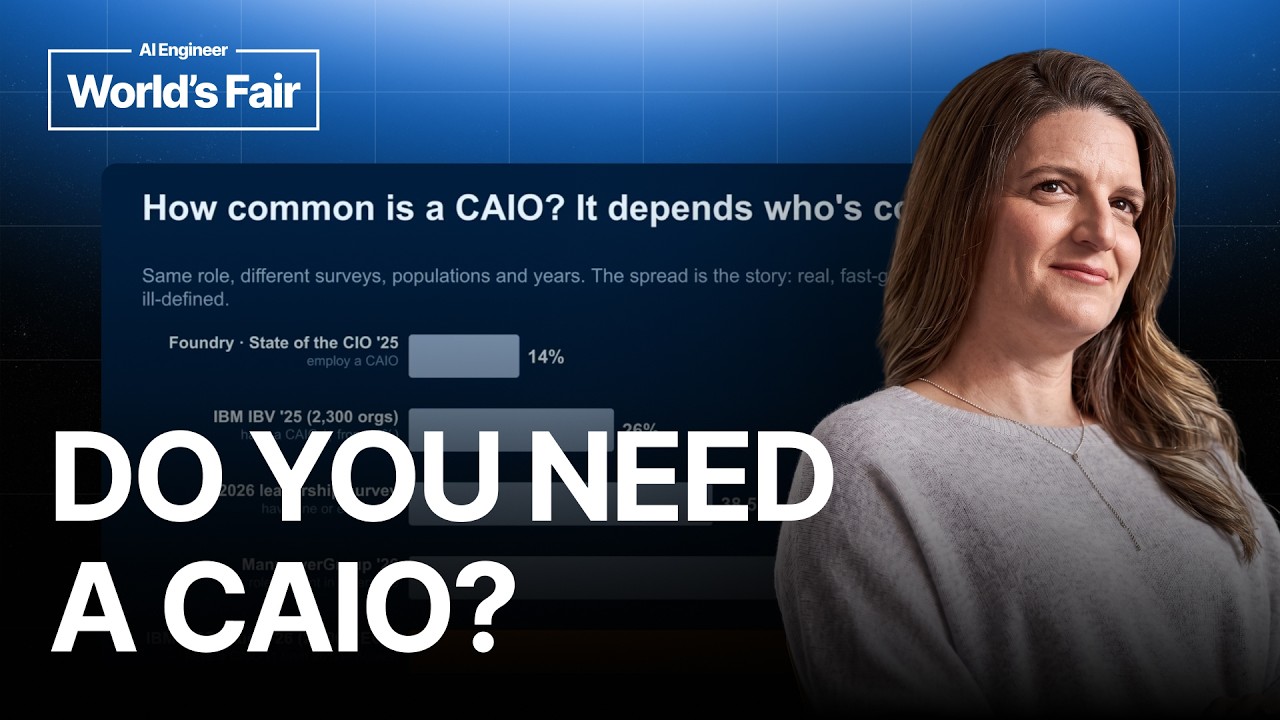
IBM studies cited show the role growing from 11% in 2024 to 76% in 2026.
At WSO2, the role splits roughly 20% scientist, 60% architect, 20% coach.
WSO2 added first-class support for agents, LLMs, and tools to all products last year.
The speaker measures success by workforce AI fluency and adoption, not token counts.
The speaker advises strong CEO backing and shaping the role to fit personal strengths.
Techniques
- agent lifecycle management
- AI fluency measurement
- agent-ready product design
Stop scrolling. Start reading smarter.
Receive the day's most important AI & engineering updates in one concise email. No spam.
Transcript (captions)
Hi everyone. How are you? All right. I'm so excited to see all of you here still awake and ready. Um, so today I wanted to uh share my experiences on the chief AI officer
role. It's very new. I get a lot of questions about it. I've been in this role for nearly two years and some variant of it for about the last five. And um I wanted to so to get started I
just would like to get an idea about the folks around here. Um how many are in companies that build and sell software products? All right, great. Um, and
um, how many folks are uh, have someone leading AI that is not the CEO or the CTO? All right, very cool. So, we'll we'll jump right in. This
helps. Um, so like I was mentioning, the stroll is new, but it's becoming more and more popular. And what I found is that it means drastically different things based
on two criteria. One is the company, the type of company you're working for and two is the level of AI maturity of that company. There's also another dimension which really is depending on
the skill set and the background of the person in the role and I've seen that also vary a lot and in some cases the role was created for a particular person that brings a particular skill set right
um in other cases there was a very specific need and people hired in for it right so we'll see because it's so hard to hire for this role specifically we'll also see that um there's a lot of
open-mindedness in the companies that are recruiting for it for exactly what the person might do based on the person they find and how well that fits and if they can complement it. So I've also
seen it sometimes breaking into two. Um but the really interesting things is you see like even these IBM studies one year apart uh so it was like 11% in 2024 26% in 25 and now 76%.
Um, okay. So, the tricky thing about this role is like it's so great. Okay, I have an AI officer, but there's AI in everything, right? It's kind of like
saying digital or I don't know, electricity. It it's in everything and it can be so many things and it can be really overwhelming, right? So, you have to have a lot of discipline to do it
well and to still have joy and not to get overwhelmed and overloaded. Um, so how can we do that? So in my experience, it's been about breaking it into three focus areas. Um I use the word
scientist, architect, and coach. I'll explain a little more. So scientist is more um you're exploring, you're experimenting, you're building. Architect, you're also building, but
you're also doing a lot more strategy. If the company is selling software product, you're really thinking about creating new software, you're impacting the product strategy. um if the company
doesn't build software product, you're creating you're adding AI in ways that affect not only the bottom line and like cost takeout and productivity but also the top line in terms of um new revenue
streams or getting to new markets and so on. Um I'm putting also there is one piece that is uh quite important here. So like I'm in a board-facing role, right? So I have to report out to the to
our board in both this company and the previous one I was in. And so for that there's also part of the job that's like responsibility for the what we're doing in AI and how that is helping the
company and our customers. And finally for coach the coach one of surprised me. Um I had spent 20 years in IBM research um running about a third of the global research AI organization and when I took
my first job in this role I forgot that you have to really spend a lot of time um evangelizing educating sharing overcommunicating about what you're doing about what how
AI can help about ways people can adopt it not only to your employees but also to your customers and now in this role I also spend a lot of time as like trusted advisor to many of our customers. So
people in my role at other customers or CTOs that are starting to adopt AI, right? They they want to learn about okay what's happening in other places. So I do a lot of calls with customers
and I'm never going to be like here buy my thing, right? Um that happens later downstream if they're interested. My discussions are always what problems are you having? This is how we think about
the problem. And I have no slides, but that's okay. Does it come back? Well, while you fix it, I'll say a few more words. Right. So, the conversation
I have with them is more of a a trusted advisor. Like, I understand what problems they're having. I see if our technology fits. If our stuff doesn't fit, I might direct them to another
thing that works much better for them and where they are. And sometimes they'll come back or they'll just want to have a discussion again. Um, we have many products uh that are also not AI
first. So, you know, we I might talk to some customers that don't use any of our AI capability, right? But they want to think about what they could do in the future.
Thank you. And then each of these focus areas has a range and I think this range really depends on the kind of company and the skill set that you're bringing to the
role. So for the scientists like even at one set you don't have to have a PhD you're just exploring heavily. I do believe in this AI world that's moving so so quickly, um, you have to always
have some of your team experimenting and understanding what's new and trying it out and seeing how it fits, right? I don't think there's a way around that because the tech is moving so fast. Um,
but on the other end is like the creator inventor side of the house for the architects. I've also seen I was surprised by this because I discovered it when I got an email um saying
something like uh AI education for chief AI officers and I'm like wait what like how do you get this job if you don't know about AI and then I realized that there are some
companies that they have someone in the role that really understands the business and they're really a steward so they have a budget and they're trying to understand you know people propose
projects and they're trying to understand which projects will bring enough value and they prioritize and they allocate budget and they project manage them and they report out right so
for that you don't need deep AI knowledge but you need to understand the business really well and be a very strong operator right on the other side is more like what I'm doing which is
like you're shaping the whole strategy of the company you're reinventing how we do things in terms of our productivity but also in terms of the products and the strategy in the go to market
uh and finally for coaching it also depends on the kind of company if you're in a company that's not really selling an AI product, you're spending a lot of time coaching inward. You're coaching
your uh the different teams, the the employees about how to use things. You want them to discover for themselves things like hallucination because you can explain until you're blue in the
face, but people don't believe it until they experience it. Um and then, uh as the company has more maturity, you're doing more coaching outward, right? So, working with customers, working with the
community and and things like that. So uh I also uh worked with Claude and Gemini to help me like analyze resumes of people in the role, right? And also job postings of people in the role and
match them to these slider directions and see like what it thinks. And these are some of the areas it found. So this validates that like really it's the person. So um the row is the type of
persona and their skill set and then the columns are the sliders, right? Um so I'm going to give some examples from my own journey because this is area is so fluid and new. So I think that's
the the most useful I hope thing to do. Uh so after IBM research I joined a biotech uh unicorn in the Cambridge area that was working in agriculture. So they were
using crisper for corn, soy and wheat to make plants that make more food and use less water. But to do those experiments took 10 years and a ton of land to validate like if your gene edit would
work. So you needed methods to help the scientists make better hypothesis of what edits to make. Right? So that was the way in the door for the AI and data part.
Um and then when I got there they were like oh you are like a computer person. They are more like they had amazing geneticists and amazing act people but not a lot of tech people from like
engineering. So they're like, "We're also going to give you it and please hire a CISO." And we had no data engineers. So like that mandate grew very quickly, very far beyond the let's
build AI together. Um but that company sold bags of seeds, right? So we're in IBM, I was building platform here. I was like we we end up uh to be a fully AWS shop. I bought data bricks, right?
Right. And then I spent my engineers time building new algorithms for gene discovery and um moving from uh box to Microsoft and you know things like that the IT
side which uh was interesting uh but uh not my joy and passion. So that was a very different experience and a very different skill set of what to do there. But also the AI there was
also fundamentally uh changing what the how the company operates and its ability to have great success. Right? So if you go back to the sliders and so on. So I would say like at WS2 which is
the job I have now I'm at about like 20% scientist I want to say 60% architect 20% coach right. Um and these uh sliders below are also showing like where I'm at in each of the dimensions. Right? So we
have a small research team there that uh we've done some very interesting work. We've really worked to change the strategy of the company that's very focused now on the agentic enterprise
fabric and I spent a lot of time coaching mainly outward. We have a very techforward employee base. are about 75% technical people uh on in the whole company and people are super super
curious right it's the kind of place where if you're not curious you probably won't stay for very long right um so then I don't have to do a lot of inward coaching I do a lot of outward coaching
um in my previous role the one I was just mentioning right it was very different so uh there the point was not to we didn't need to invent new algorithm or make new uh foundation
models right the idea was how can How can we infuse some of the AI techniques that are well known? How can we gather the data was a total mess, right? How can we clean and integrate the data um
and how do we like inject these things into the processes that they have. In some case there was more invention for the gene discovery part but in other places it was just about basic
operations. So for example uh the scientists had a hypothesis that if you measure the size of the embryo of the corn embryo that is an indicator of how likely the size was an indicator of how
likely you are for the next step to be successful in your gene editing but it was too costly for humans to do it right so they oh please can we use AI and um I did my masters in computer vision so I
looked at that I was like well yeah sure we can use AI but you just need like blob detection you don't need any machine learning that you just need basic computer vision and we use a very
simple algorithm and it worked really well right and that helped. Um and then in the other case for gene discovery we did some very interesting with birds and and things like this.
Uh so this is a bit like I was trying to put it a bit on a grid of how do we think about it and really in my view with my experience having been like at IBM and at the biotech startup and now
at WSO2 those are the dimensions I think about right like does the company sell software is the is the population mainly technical um and where are you in your AI journey?
So uh I get asked a lot what I measure. Um, someone asked me to measure tokens because to see how much AI we do and I said no. Um, because right it's so easily hackable like I'm not like okay
it's easy to measure it but I don't want to. Um so they asked me what do you measure instead and I said okay these are the things I look at AI fluency of the workforce like is it only a few
people that know AI in a center of excellence and anytime anyone has to do anything you have to get those people um are there builders across the functions right are there people who know how to
do enough to get their job done and to really augment it that are you know in marketing in different engineering teams etc or again are you holding all of those so now I have a small central AI
team that kind of works with everybody but I have an AI lead in every single product and every product team has folks working on the AI capabilities in it right um and then we have some products
that are AI first right so everybody there is working on AI level of adoption I think matters like are you just doing a simple task cleaning an email code completion or are you changing an entire
workflow for a better outcome or like we have a couple of our teams that have put agentic employees right so you have these agents that you can instantiate and they work alongside inside the team,
right? So that's a spectrum and different teams are in different parts of this spectrum. Uh tool availability like have you as a company do you have you subscribe to
some tools and are you reimbursing or paying the cost with team or enterprise accounts? Um and then geo visibility. So this is generative engine optimization, right? Can LLM find us? Can they know
what we do? Someone searches? There's a lot going on there. We're still working uh on that. I think with a lot of other people it's not so straightforward. Um and that's where also someone it was
interesting. Someone was telling me that just yesterday, right? They're like the web has become for agents. Like it's unreadable for humans anymore because everything is being written assuming an
LLM is reading it and it's so frustrating. He's like so I'm just going to have my LLMs read and summarize for me and I'm only going to talk to humans from now on, right?
Um for software products uh in the beginning like when we when I started in this role it was about like what should we build what should we extend and where should we partner um and then I we
wanted all our products to be agent and LLM consumable. So the docs need to be LM consumable. Uh last year we added first class support for agents LLMs and tools to all our products and this year
we're making sure every product can be used by agents. So everything needs to have an MCP server and skills and CLI etc. Um agent proof pricing. So we've all
heard this whole SAS is dead and if you price per se and whatever what happens when the agents come and blow it out of the water the consumption. So we are our pricing is all consumption based and
then dog footing our stack. I heard another interesting thing today about that. Somebody told me like, "Oh, I'm at so and so company which I won't name and they make us use our product and it
would be great except nobody takes any feedback, right, to make the product better." So hopefully we close the feedback loop and not only make people use our stuff, but they use it if they
like it and if it helps them. And then the third dimension is the market and ecosystem. So AI thought leadership is not about like articles you can pay for, but do you have earned media, which is
are you invited for talks? Do you uh have publications? Are you showing up in the press because you're doing something interesting for real? Right? Uh analyst recognition, customer adoption and use
cases is I think very very important, right? Like I stay up a lot thinking about what hurts for my customers and how we can make it better. Uh we are a fully open source company. So everything
we do is 100% open source. It's not open core. And um so for us also that's a really important signal right community participation and adoption and stars and forks and then finally AR from AI
products right some of our AI products are very new so there isn't a lot of AR but some of these other things can give signal to it as we get off the ground um and also I think um revenue is not the
only number that matters like tokens is not the only number that matters so this is and I think what you measure measure should change over time based on what you're doing and what your company is
doing, right? So for me, this is what I'm measuring now. Once these things like reach maturity, I will change this list of things, right? Um but think a lot about it because you
really get what you measure. You start measuring something, everyone's going to optimize for that. Um so just a few words about WSO2. So um we're about 20 years old. We're about
150 million in ARR. Uh our software powers uh a lot of capability in over 90 countries in six continents. Uh our main products are our history has been in API platforms, integration platforms, uh
identity and access management and uh internal developer platform. We have a product for that. And in the last couple of years since I came, we've added agent identity and AI gateway to govern your
uh AI interactions. We've added an agent builder to our integration platform. So that's what we do and everything we do is open source and this is our whole portfolio today. So you'll see on the
bottom the four platforms this is what existed like uh some years back and the way we started was saying we're going to extend out into what AIs need, right? So LLM AI APIs are APIs at the end of the
day, but they need to be managed differently. So we put an AI gateway in the API platform. The identity platform, we already know how to do very robust identity and access managements for
humans. So now let's do it for agents too. We added agent identity. This was all last year and this year we've released an agent platform um that lets you use those things but
also lets you uh put it all together and manage the whole life cycle of these agents. So I'll give a couple examples on the scientist side too. We have a small
research group like I mentioned I'm very proud we have these uh three publications this year. Two of them are with undergrads in Sri Lanka. Uh that is their first publication ever and one of
them won a best paper award. Um on the architect side, right, the idea was AI is like great shiny object but we want to infuse it in the whole digital fabric. So how can we extend that with
these capabilities like I mentioned before? So those are the things that we've added and agent manager is the the newest we've done. We've just released it. Um
uh in the interest of time I won't step but please feel free to explore the GitHub repo and the website. Um so just to close in a few more seconds the idea is okay there's no
silver bullet depends on the company you have to work very closely with others I suggest if you try something like this you have very strong backing and relationship with the CEO because you
are going to have to work very closely with a lot of other parts of the company and I've seen also some places where if it's a very AI forward company the chief officer like the chief product officer
officer and the chief AI officer are one person, right? Or um in other places that was surprising in companies that are not software. I've also seen cases where the head of HR became the head of
AI. I don't know how I feel about that. But yeah, I know. I'm like I Okay, so it's just interesting things are happening. Everyone's trying to figure out what to
do, right? because they said oh agents are work workforce our workforce so we manage them HR will manage them I appreciate that I like people feel like me in this room because that rumor
I heard it it was not the reaction um but uh so I'll just leave you with this to close um when I think about even for me like to take this role I was trying to think okay um you know what
I'm somebody had given me this advice like think about what are you good at on what you love, what the world needs and what you can be paid for and try to find something at the intersection. So since
this role is very fluid still try to find if you're interested in it and you're looking you have a match somewhere try to shape it in a way that it you are at the center and it makes
you happy and the things that you don't like see if you can like have someone work on them differently or maybe a different company is a better fit that has a better alignment with your
interests with your love and your needs and what you're good at. All right. Thank you very much. If you have any questions, I'm around