Enjoying this issue?
Get tomorrow's AI & engineering digest in your inbox — hand-picked, summarized, and always spam-free.
TLDR
Haiku 5.5's two-tiered pricing makes it cheap for high-volume tasks under 100k tokens, but five times more expensive above that, which shifts its cost-efficiency relative to models like GPT-6 Luna. Despite scoring 72.4% on OSWorld computer use, real-world demos show it still struggles with complex multi-step tasks and speed.
Key points
Haiku 5.5 costs $0.10 per million input tokens under 100k tokens and five times that above.
The model scored 72.4% on the OSWorld 2.1 computer use benchmark.
The speaker built a personal agent called Attekus that uses Haiku 5.5 for high-volume tasks.
The speaker switched from a locally running Qwen model to Haiku 5.5 API due to lower cost.
In a demo, Haiku 5.5 took 33 seconds to filter models on a website and gave up halfway.
Techniques
- computer use
- screenshot-based agent interaction
- OSWorld benchmark methodology
Stop scrolling. Start reading smarter.
Receive the day's most important AI & engineering updates in one concise email. No spam.
Transcript (captions)
This is Haiku 5.5, Enthropic's newest model. And the model has two-tiered pricing. Anything under 100,000 tokens is 10 cents per million input tokens. And anything over that threshold is five
times the amount. That's why even though Haiku offers more intelligence than Luna, when you go from token efficiency, which is the graph that you're seeing here, to cost efficiency, you start to
see that Haiku starts to drift away in comparison to Luna as it approaches higher intelligence. Now, as much as this price difference here between Luna and Haiku seems pretty big on face
value, when we start adding in other state-of-the-art models into the mix, you really start to realize that the price difference here is more or less negligible in the grand scheme of
things. Sort of like paying 21 cents to get the job done through Haiku instead of 7 cents for GBT6 Luna. And the premium that you pay here for Haiku is higher intelligence and a little bit
faster token generation. And a lot of people have a hard time figuring out the exact use cases for models that are in this entire range in cost efficiency here. So the first question is why do we
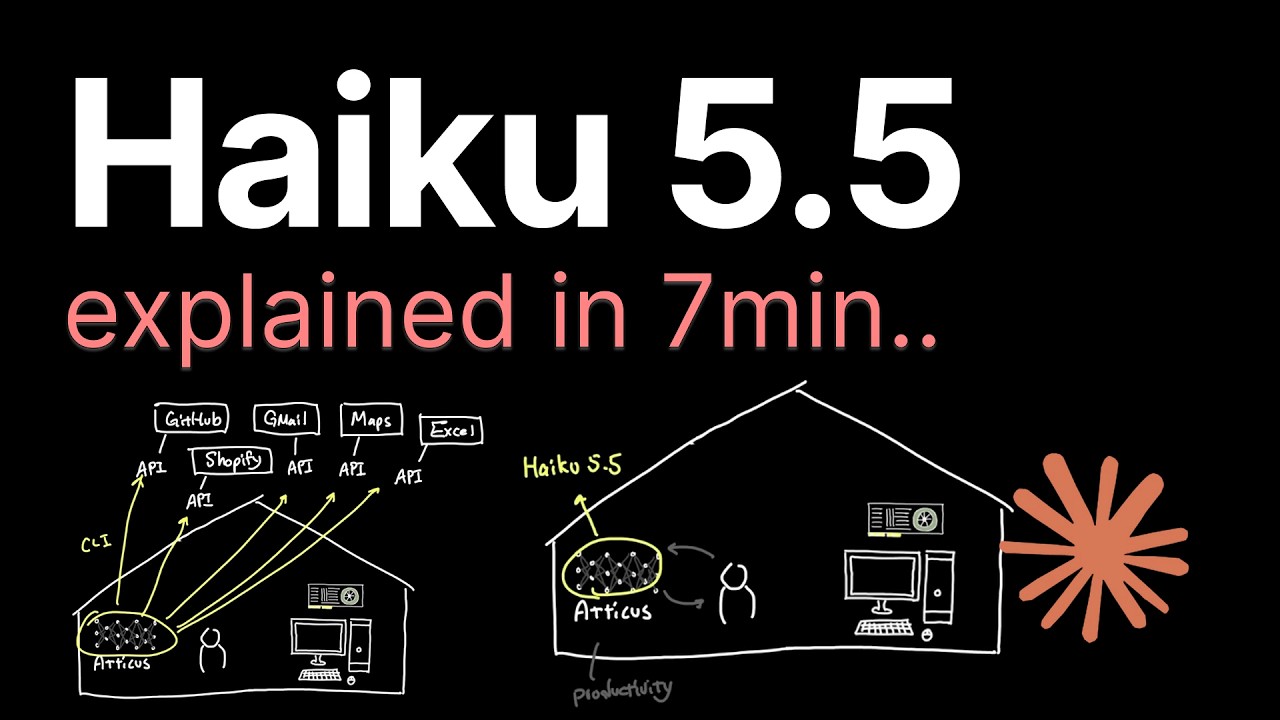
even need models like haiku in the first place? According to anthropic, haiku 5.5 is meant for high volume costsensitive tasks. A great example is a personal agent like Attekus which is something
that I built for myself for my own productivity here at home. Sort of like Jarvis from Iron Man. Here I'm reading and studying this research paper and I can just ask Attekus through speech to
pull up related research paper I should know about and without interrupting my work it'll pull up all the related work that I should read about in the background all without interrupting my
flow. And what's powering Attekus is Haiku 5.5 as the model provider and Attekus handles the speech recognition model that's currently running on my GPU locally and Attekus controls my computer
as you just saw. And I can also ask Attacus to look at my desktop to see the current code that I'm running on VS Code to pull up PyTorch documentation and snap it to the left of the window. And
as you can see, I can continue coding and it'll pull up the relevant PyTorch documentation on the left for me to reference. And models like Haiku 5.5 and GPT6 Luna are so cheap that every
interaction that I have with them through Attacus averages around 0.001. That's really the value that you're getting from these models that are in this quadrant. And while the current
best trajectory in the Peruda Frontier follows this black line, mixing in different models from different labs along the way, models like Haiku 5.5 and GPT6 Luna are really meant to scale more
differently and efficiently in the lower tier of intelligence. And the fact that Enthropic continues to push intelligence with marginal cost trade-off is kind of a big deal. And for me, ever since Haiku
5.5 came out, I switched Attacus' model provider from locally running Quen model at home through LAN and now through API since I could arguably be spending less using Haiku through API than burning
electricity at home where here in Michigan I pay 23 cents per kilowatt hour. As closed labs like OpenAI and Enthropic continues to push models in this quadrant, it really starts to make
people reconsider whether buying expensive hardware like RTX 1590 that continues to be more expensive that's currently retailing higher than $6,000 is really worth the price tag unless
they're on sale. Which is why MicroEnter could be perfect sponsoring this video. If you're running AI at home, machines like Mac Mini that runs headless in your network might be great, especially if
they're on sale like they are here until the stock lasts. If you really want to dig into unified memory, you could look at AMD Ryzen AI Halo or of course the Crown Jewel DJX Spark, which is the one
that I have at home running Quen models 24/7. Having a dedicated machines like AI at home is a great option for not only privacy and often times speed. And if speed is more important, you can also
shop for dedicated GPUs like Nvidia GPUs running from older RTX 3000 series and the newer 5000 series as well as AMD cards like this. With these machines, I can run my personal agent at home
without worrying about token costs and API usage limits, but truly token max all your projects into life. And October is microenter runs tech deals for you to check out. And if you happen to be near
Austin, Texas, you can sign up for a free 128 GB flash drive to redeem it in store when they open. Link in the description below. Another interesting thing about Haiku 5.5 is how it scored
on computer use. Where here ha 5.5 scored 72.4% 4% on OS World 2.1 computer use. Now, you might be wondering how the OS World benchmark even works and why it's such a big deal. OSWorld is a
benchmark that measures how well the model actually performs on tasks where the model can actually navigate on your computer. It creates virtual environments for the model to interact
with the operating system to do different tasks and pass or fail on more than 100 long range tasks like formatting a slideshow as you can see which would be taking around 62
different steps to get the job done. You can also have a longer range tasks like booking a trip on a website as it interacts with the browser and the environment keeps feeding new
screenshots and information along the way and the model then processes that screenshot and figures out the next action to take through prompt and continues oscillating back and forth
until the job is finished. Even in my personal example here at home, I can ask Attekus to pull up Excel and change it to be in dark mode instead. And following my voice prompt, Haiku will
take my instructions and actually click through different parts of the screen and Attekus will send screenshots after screenshots. And this interaction continues back and forth until it
eventually changes Excel on my computer to dark mode and gets the job done. Now, you could certainly argue here that a lot of applications offer API, which means I can just use cloud code in the
background to get the same job done. But we don't always have the same luxury of having an API and we have to actually figure out how to navigate different websites and often get frustrated by how
unintuitive many websites and applications are. And pairing an agent and running models like Luna and Haiku is a great way to circumvent that. Another use case is something like using
it to navigate websites like artificial analysis. Here, I'm asking Attekus to pull up artificial analysis website and go to Haiku 5.5's page and scroll down to the cost of intelligence section and
only show models that are under $1. And Haiku is able to follow my instruction pretty decently. But after clicking through the filter, it concludes that it can't filter by cost and terminates the
job early. So, after I send the follow-up prompt to Haiku and now explicitly asking it to turn off models that are more than $1, this time it gets a little bit further by checking off
Opus 5.5 and GPT6 from the list, but gives up halfway through. Not only that, the entire operation took about 33 seconds to finish, which for me would have taken a lot shorter. So even at 173
tokens per second, there's still a lot of room for improvement in not just in speed, but intelligence to actually get the job done all the way through. Now to extend an olive branch, it's possible
that because my monitor is 4K resolution, it ended up taking slower when it comes to speed. But use cases for models that scale like Luna and Haiku can really open up a lot of
downstream use cases as models get cheaper at the same time as being intelligent and faster.