Enjoying this issue?
Get tomorrow's AI & engineering digest in your inbox — hand-picked, summarized, and always spam-free.
TLDR
Running AI agents in production requires a clear separation between the non-deterministic planning done by an LLM (the 'brains') and the deterministic execution handled by a harness (the 'hands'). The harness, not the agent, should own all execution, approvals, and side-effect management, treating the agent's output as a plan to be compiled into a deterministic workflow. This pattern, which the speaker calls a 'late bound saga,' is the difference between a demo and a production system.
Key points
Production agents should be treated as applications, not components, with a harness controlling execution.
The harness must separate non-deterministic LLM planning from deterministic execution of actions.
Harnesses need durability to recover from failures in long-running agent processes.
The speaker demonstrated an SRE agent that plans multiple steps at a time and compiles them into a deterministic workflow.
The demo used Conductor, an open source workflow orchestration platform, to execute the agentic loop.
Tools mentioned
Techniques
- late bound sagas
- deterministic workflow execution
- agentic loop with planning and execution separation
Stop scrolling. Start reading smarter.
Receive the day's most important AI & engineering updates in one concise email. No spam.
Transcript (captions)
[music] >> Cool. Thank you all for joining this morning. I know it's been an exciting week. A lot of talk about agents, building
agents, coding agents and everything. And what I want to talk in the next 15-20 minutes is is about running agents in production.
Um And things that is kind of on the top of pretty much everybody's mind when it comes to building agents and running agents is you know, harnesses.
Before I get started, like I would like to ask in the audience, right? How many of our many of you are running agents in production today? Awesome. So, a lot of hands up. Um
I was in another conference couple of weeks ago and I asked the same question. I think I had like one hand, so this is pretty good. It seems like, you know, things are moving forward. Um
All right. So, when we think about agents, right? Like if we go back to kind of the hello world equivalent examples of agents, uh
it's always starts with, you know, an agent with a tool call and how well an LLM kind of decides to call the tool, maybe use some sort of context or a memory and and plans things ahead,
right? Um What What we start to kind of realize is is you know, that's a very small narrow
picture if you think about it. When you think about agents in production, it's not just always about chatbots. The early examples that we had seen were all about like, you know, hey, we are going
to build a customer service chatbot or some sort of chatbot. Um But when we start thinking about agents in a broader terms and picture, think about background agents,
background workers, agents that are running on schedule. Um I would like to have an agent that runs every hour to check uh what's happening with my schedule and if there is
something new that has popped up that I should think about. Uh event-driven agents, right? Agents that are listening on various events. Um to give you an example, I have a production system
running where my alerts are firing every now and then. I have a logs coming through hotel. I would like my agents to listen to
those events and react on it and see what's going on there, right? Um I could have long-running coordinators and what I mean by that is I have an agent running for a longer period of
time. I would like to have an agent monitoring that agent to see, "Hey, what's going on there? And should I nudge that agent to kind of move forward, take a different action?" And
things like that, right? Um also one more thing is about multi-agent systems, right? Agents talking to other agents. Uh the last thing you want is to have an
agent be responsible for multiple things and risk hallucinations. Uh So, more we think about agents, right? Uh the way I would like to think about is the agent starts to
feel more like an application, not just a component, right? Um If you go back to the old school thought of microservices, when we and probably we are still building
microservices, right? Um you are not going to ship a microservice in production that does everything, right? It kind of stops being a microservice at that point in time. Uh typically, we are
shipping multiple microservices. They are talking to each other through choreography or orchestration. And you have an application that is relying on that the set of microservices,
uh which essentially are single responsibility principles uh to kind of deliver the business goals. There is kind of a very clear uh
parallel to that when it comes to agent harnesses, right? If you think about a harness that is responsible for achieving a specific goal. So, let's say I have an
harness for doing my SRE work. Um, it's operating on multiple agents to see what's going on there, right? Maybe it's listening on events coming from my logging system,
talking to my Kubernetes cluster as an agent uh, to find out, you know, what's going on there. Uh, my metric systems, my customer service uh, dashboards and and
so on and so forth. Um, and what I want to drive there is that if you think about it, right? Your harness is the application and vice
versa, right? An agent alone doesn't kind of deliver the whole premise, but rather when you start putting things together and you build an harness that controls the execution of the agent,
delivers on the premise, that's where you start thinking about um, an application, right? And which is you have systems uh, which are your databases, your internal systems,
enterprise systems. You have humans, human in the loop. Um, you have tools through either APIs or MCP that is all kind of playing together. Um,
and as I mentioned, right? Harness runs more than just an agent loop. And this is an important thing that I kind of learned uh, while trying to build harnesses for real-world production use
cases. It's a combination of both deterministic and non-deterministic part of the application, right? Non-determinism is delivered by an LLM in terms of the
reasoning, in terms of thinking process. Um, and then there is non-deterministic and there is deterministic part, right? Which you do not want non-determinism
seeping into it, right? Think about payments. Um, or let's say if I have an agent harness that is responsible for monitoring my production deployment, how
I manage my Kubernetes clusters, I probably want to have a very well-defined workflow in terms of what are the sequence of steps that I execute when I want to restart my cluster. And
that's a very deterministic set of processes which every time it runs, I know exactly what it does. So, I want a determinism to be delivered by my harness when it matters.
Um and of course the harness is a long running process, right? It runs across the time. It can run um anywhere from few seconds if it's uh
something very quick like hey, check what's going on here to all the way running for days, months, uh even longer than that, right? Think about long
running processes, order management systems where you are waiting on third party services to deliver your shipment or waiting on humans to take actions and approve things and so
on and so forth. Or Harness is just waiting, right? It's waiting for events to happen. So, when that event happens you take an action and do something around it. So,
that brings in another important point, right? That when you think about long running systems, you need durability, right? You want to be able to recover when things fail because at the end of
the day this harnesses are running somewhere in your entire infrastructure stack, right? Maybe in the cloud, maybe on a sandbox but those things can go up, go down. There could be network
failures, partitioning, anything that could be happening. So, you need the harnesses to be durable. And one thing about durability here is it's a table stake thing, right? At the end of the
day durability is a cost of admission. That's not the feature that you're looking for in a harness. Um And as I mentioned, right? The loop
that the harness runs spans across agent um and everything else. So, now let's think about uh how the harnesses kind of operate,
right? Um If you think about a harness, right? And and a loop, essentially what it is doing it it has a state of the world. It knows what work been completed. Um
what has been recorded in terms of the side effects, right? So, like if I did a cluster restart, uh I know I have that recorded. Uh if I sent an email, I know that has happened. Um
I know what worked or didn't work, and then based on the current state of the world and the goal, I know what needs to happen next, right? And that's where the reasoning and LLM comes into the
picture. Um and what really happens here is that if you think about a clear distinction, and
this is the most important thing. If If one thing that I would like everyone to take away from here is this slide, which is that the responsibility of a
non-deterministic agent is to plan, is to plan what should happen next, not really to do things. Um and then Harness is the one who does actually execution. And And this is
important for uh various reasons, right? One being that Harness is a deterministic piece of code that actually understands what is involved in, you know, actually
executing a piece of work. So, as I mentioned, right? If I am trying to uh build a Harness that runs my uh DevOps or SRE uh agents,
uh when the agent says that, "Hey, this cluster is unhealthy and you should restart." Harness should decide how to restart the cluster, what involves in restarting cluster, and that has to be,
at least in my world, has to be very deterministic set of processes, right? So, that every cluster restart is exactly same. There is no other uh category there, right? Um
Also, if it needs to have an approval, for example, if I am trying to restart a production cluster, I probably want to have a human gate, uh probably send a Slack message to somebody to say, "Hey,
I'm going to restart this cluster. Do you think it's okay to do that or not, right?" And I do not want this to be left to a hallucination by an LLM that, you know, it doesn't need to do it. It
needs to be guaranteed in terms of execution. So, it has to be very deterministic when it comes to those kind of things. Uh ideally, I want this to be idempotent and if not, I want it
to be recording that, you know, it is not idempotent and this is what has happened. So, I can get take care of the side effects or I can handle the side effects separately, right? Uh
So, this is the most important thing, right? The clear separation between as we would like to call, right? The brains and the hands. Harness is the hands, the brain is the LLM.
Um So, yeah, if the agent writes the plan, uh Harness executes the plan, uh and I'll show you in a brief uh a short demo in terms of how all of these things
kind of matches together. Um But, is this a new concept? Like, if you think about it, this is not necessarily
a new concept. This has been around for a while, right? If you think about workflows as sagas, which we used to write ourselves and define exactly what happens. It was a very and it is a very
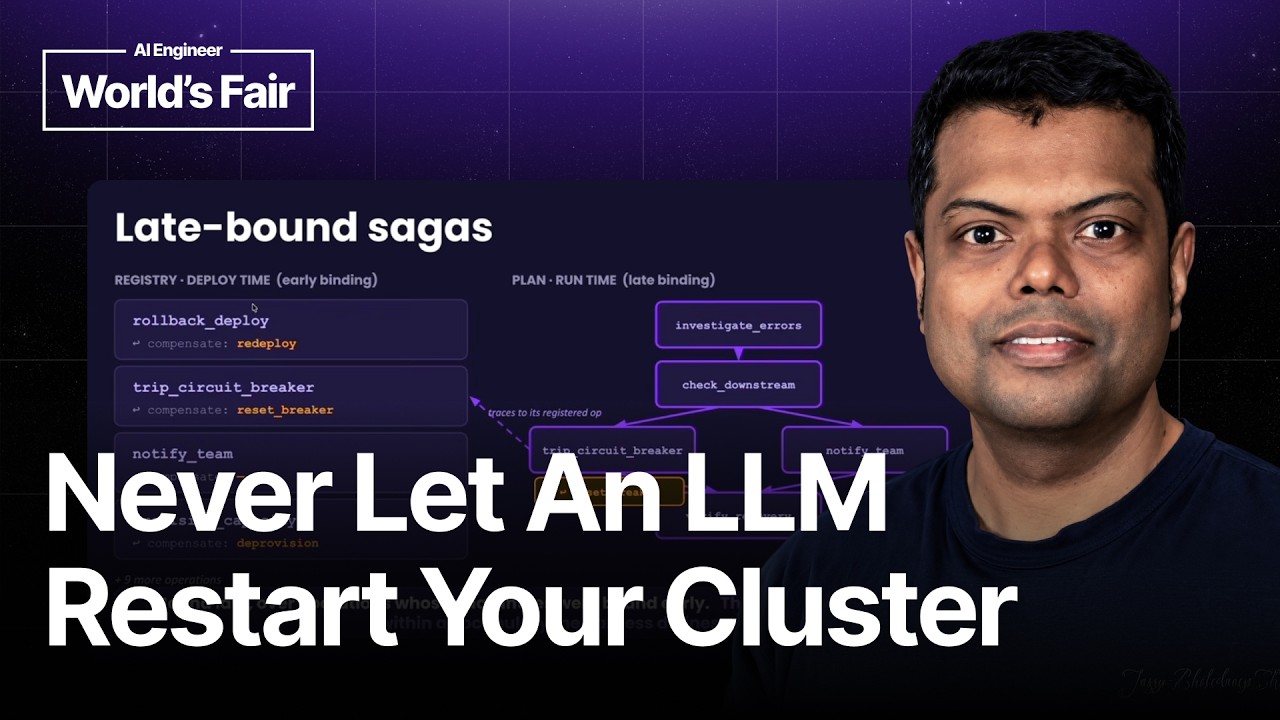
deterministic set of processes. When you think about agentic harnesses, they are essentially late bound sagas. And what I mean by that is that they have a very finite and deterministic set
of tools uh and the task that they can operate on. Instead of putting them together upfront, the agent is kind of proposing and building them at runtime. Um and
therefore, they are essentially late bound sagas, right? Uh but you get all the benefits of a traditional saga in a workflow out of the box in terms of visibility, what's happening, being able
to control things, and iterating upon like, you know, how far ahead in the future uh the agent is able to plan. You are able to kind of plan one step at a time
or multiple steps at a time. Um And yeah, if you think about it, right? It's it's more like a branching workflow. If only you could build a
workflow with every possible combination of a branch, um then, you know, it kind of builds that thing for you right versus with agents that kind of simplifies the work.
If you have n number of tools it can do n different combinations of executions which otherwise is going to be almost impossible to you know think ahead of time and and do it.
So let's take a look at it right. So what I'm going to do is I'll quickly show a completed run. Of what I talked about earlier right.
Here is one of my example agent that essentially is acting like an SRE agent right. What its job is to do is understand what's going on in the
current system and try to plan what should happen next and execute on those things. So it's essentially a remediation loop that
runs twice. In the first iteration it tries to understand the root cause of the problem, tries to react to that, observes the output of it and then runs
another loop and plans another set of steps to see what should happen next right. So as an input to my agent let's see what was the input given right here. So step number one is you know it
makes a call to LLM. So as you can see right like it's an SRE agent. Of course it's a demo so you know everything is kind of pre-planned and a can demo.
The output of LLM as you can see right are the steps what it should do. It's talking about so as you can see one more thing here right
is that instead of just doing one step at a time essentially it is proposing a sequence of steps to do. You should gather evidences, you should
analyze logs and if required based on the evidence that you gathered you should either roll back a deployment and then verify recovery.
This is then given to a specialized tool called plan and compile. So, this is the plan that agent gave. This gets compiled into a very
deterministic workflow. We are relying on a conductor as a workflow execution engine here. So, the output is a fully runnable workflow. This gets executed. So, like you know,
what I'm going to show you here very quickly is how that looks like. Um So, this is the first step of execution, right? If we look at it here as I said, right? Like
we did analyze the logs, look at the query of the metrics, decided to do a rollback and verify recovery and everything. So, step number one is completed. It
runs another loop. Um same thing goes here. Um In the next iteration, it decides that, okay, looks like, you
know, these things have been done. Let's check the downstream. And if required, verify the recovery and complete it, right? Um And then the next one runs and completes
the task. But here is an example of a loop that is self uh kind of uh planning, right? So, and
to show you very clearly what's going on here, here is a loop. Um At every step of the way, essentially, it is looking at the current state of the world. So, this is my agentic loop
that is kind of understanding the world, planning and executing uh one step instead of one step at a time, it is actually planning multiple steps at a time, executing that,
verifying, and completing the loop. Um Now, this can run in production as many times as you want. This can be running on the events. It can be running on a schedule. Um As I said, right? Like
this the whole thing could be running for a much longer period of time um as opposed to just running in a short period of time. All right. So,
that's towards the end of it. This is kind of overview of what we just did here. As you can see right in the second iteration, we decided not to do a
rollback because it was already done in the first iteration. But yeah, that's about the harnesses and agents and how they bring determinism to your production
application. The example that I showed you runs on conductor. Conductor is an open source workflow orchestration platform that supports building agentic loops as well
as agentic systems. It's fully open source. Orkes, we provide enterprise edition. But feel free to try it out. Here's a QR code. Give it a try.
Join our Slack and you know, if you have questions, happy to help. We have a booth here at Orkes. Drop by if you want to see a live demo. If you want to run your LangChain agents
or OpenAI agents or any kind of agents, Conductor can handle all of those things. Thank you.