Enjoying this issue?
Get tomorrow's AI & engineering digest in your inbox — hand-picked, summarized, and always spam-free.
TLDR
AI can now decompile and recreate software from scratch using verifiable loops, reducing years-long decompilation projects to days. This capability extends to any software, as demonstrated by the open-source Photoshop clone Photocraft and the recreation of Super Mario World. The speaker argues that the software moat is dead, and human creativity becomes the differentiator.
Key points
AI decompiled Snowboard Kids in 84 days, compared to 2 years for a human.
Photocraft is an open-source Photoshop clone created by pointing AI at the original software.
The speaker is using GPT6.1 Soul to recreate Super Mario World from scratch for the Mod Retro.
AI discovered many new mathematical proofs in a single day, outpacing human efforts.
Tools mentioned
Techniques
- decompiling
- pass-through mod
- asset swapping
- game rule rebuilding
- verifiable loop
- recursive self-improvement
Stop scrolling. Start reading smarter.
Receive the day's most important AI & engineering updates in one concise email. No spam.
Transcript (captions)
AI is getting so good at writing code and people are just starting to realize how disruptive this is going to be. Just look at this. People are taking characters from one game and mashing
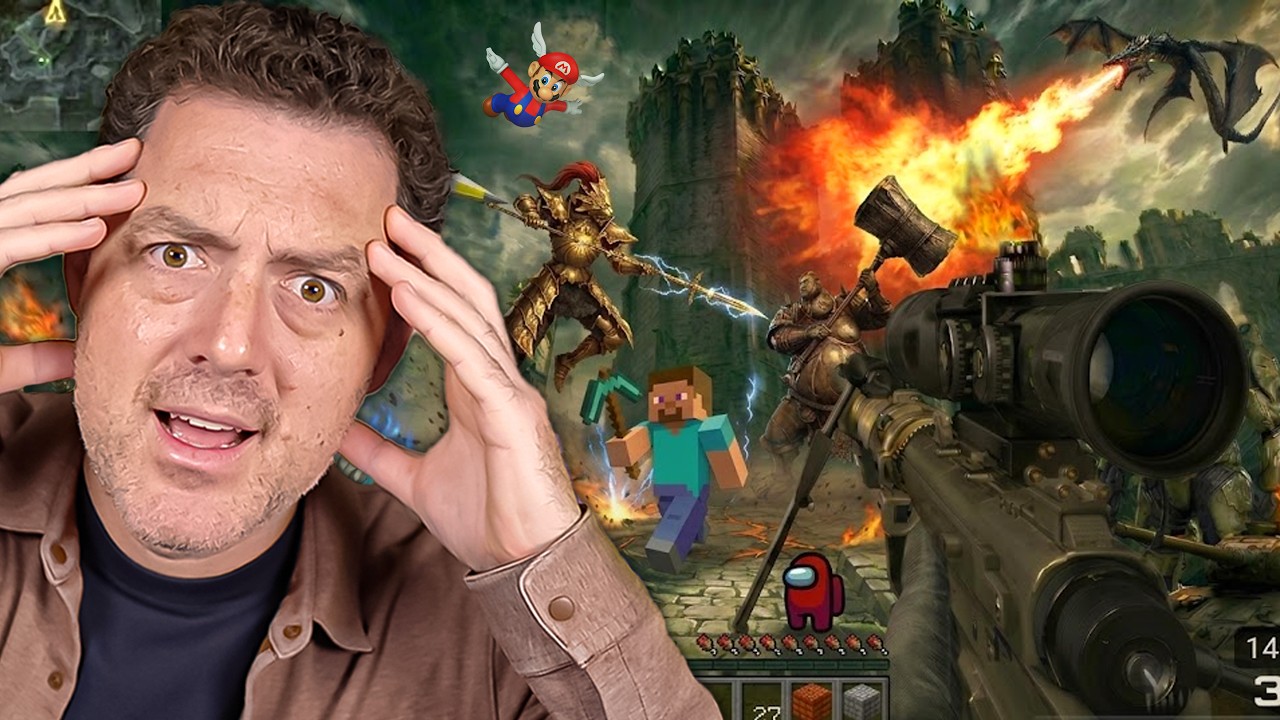
them up with worlds from another. Here's Super Mario in Elden Ring. And here's one with skate mechanics in Call of Duty. You can even put Spider-Man in a Batman game. Someone cloned Photoshop
and made it open source and absolutely free. So, I'm going to walk you through exactly how people are doing this, and I'm even going to show you my own version of Super Mario World that I'm
building from scratch for the mod retro. All right, so first, what does decompiling actually mean? A programmer writes source code, and that's the version that humans can actually read
and edit. Then, a compiler turns it into machine code that a computer can read really efficiently. And that's what computers actually run. So, if you were to take Grand Theft Auto, the game that
you actually get and put into your PlayStation, you really wouldn't be able to read it. I mean, technically you could, but it would take a very long time because it's not human readable.
It's machine code. And it could possibly take years of just guessing what it does and then verifying it does that thing. Decompiling games has been done before, but it has taken humans literally years
to accomplish. For example, Super Smash Bros. Melee has been in the process of getting decompiled by an entire team and an entire fan base. And that has been going on for years, but then suddenly we
have dozens of games being decompiled all within the span of just a few weeks. And that's all because of AI. So decompiling means taking that machine code and working backwards. Basically,
you know the output, you know what's supposed to happen, but you don't know the input. you don't know the actual code that can make that thing happen, like Mario jumping. And so, it's this
guessing and checking game. You write some code, you look, and you see, does it actually cause Mario to jump? If so, great. Let's continue on. And if not, let's try it again. But here's the
thing. With this method, the code is not identical. And the obvious question is if we're working backwards, why don't we get the original exact code at the end? All the comments, all the names, all the
methods, literally line for line copy. Why don't we get that? During the compiling step, some of that stuff is just thrown away. Comments are usually thrown away. Names can disappear. And
the compiler can rearrange things to make them simpler and more efficient for the computer to read. So here's a simple example. Imagine I have this method that returns 2 + 3. After compiling it, all
it really needs to do is return five because 2 + 3 equals 5. And so after compiling, it changes it to return five. And so then if you're looking at the compiled code to recreate it, all you
have to do is return five, not return 2 plus 3. But ultimately it doesn't matter because the end result the game is going to be identical. It behaves the same way. It looks the same. It plays the
same. And this entire process of decompilation is kind of the perfect use case for AI. It's heavy on code and it has a loop, a verifiable loop. It guesses what something might be like and
then it can actually check it against the source material and then it'll just continue on. An AI never gets tired. It never gets hungry. It never wants to sleep. So, it just keeps churning and
churning and churning until it gets an exact clone of the game. And that's the loop we've been talking about. And remember, we talked a few months about loops, software loops. It's again
something that AI just does incredibly well. You give it some verifiable goal and just let it continue to work until it reaches that goal. And so, how did it go from taking years to taking weeks or
even days? Well, you can give little chunks of it to a lot of different agents and run them all at the same time. And of course, AI is better at writing code than humans. It is much
faster at writing code than humans. And so when you add all of those things together, you go from it taking a team of humans years to decompile a game to AI just taking a few days. So here's a
perfect example. There's this guy Chris Lewis who decompiled this game called Snowboard Kids. And it took him nearly 2 years to do. Now he did it in just 84 days. And that timeline is shrinking
rapidly. And the way he was able to do it is by using AI. And what's kind of crazy is those two versions that were decompiled are not identical code, but they play and look and feel identical.
And that brings me to the game that I'm working on right now, which is Super Mario World. One of my favorite games of all time. I played it so much. It's for the Super Nintendo. Now, I went to
OpenAI's dev day, and they gave these really cool mod retros, which is basically a recreated version of the Game Boy. And of course, Super Mario World being one of my favorite games, I
wanted to play it on this Mod Retro. But of course, it wasn't made for the Mod Retro. So, I tasked GPT6.1 Soul with recreating the game from scratch for the Mod Retro, and it's doing it. Look at
this. It has been working for well over 4 days, and it basically does that loop that I mentioned. It looks at what the game should look like. It has a ton of documentation that it can find online.
This isn't necessarily decompiling, but it's close. It writes some code, checks against what it should look like, and then iterates. And again, it's been going for over 4 days now, and it feels
like it might finish in another few days. And now that OpenAI and Enthropic are putting out better, more efficient, and cheaper models like GPT6.1 Soul, it's so easy to recreate these types of
games. It's so easy to recreate any software. And I'm not burning through all of my tokens anymore. In fact, I'm actually struggling to burn through my tokens. I have resets backed up that I
haven't used. So, that's the process. And so let's talk about what's actually happening with these mashups, these different games where you can put Spider-Man in a Batman game or Minecraft
in Call of Duty. The first and simplest version of what's happening is like a swap or importing content. It's basically just changing what's on screen. You take one character and you
swap it out for the assets of another character. So Batman now looks like Spider-Man. And it's kind of like a skin. The character looks different but essentially behaves the same way as it
did in the original game. And that's really cool, but that doesn't allow Mario to really live in Elden Ring. Then there's something called a pass through mod. You basically keep these two games
running and build a connection between them. So there's this example where Minecraft is put into GTA. The Minecraft engine handles its own blocks and creatures. The mod lines up the cameras,
combines what the games draw, and passes information between them. So, when TNT explodes in Minecraft, the connection tells GTA to create an explosion in a specific location. Walls need to line
up, the physics need to match, but this all happens with this mod. And so, you're getting these two different games to agree on what's happening in the mashup. It's fascinating. And so in this
particular approach, both games are running. Then there's another version where you literally bring over a mechanic from one game to another. So imagine Skyrim with the type of parkour
system you get from Mirror's Edge or a shooter like Call of Duty, but you can skate around on a skateboard. So the thing you're going to bring from one game to the other is the behavior. So,
how fast you accelerate, how high you jump, how you land or collide with a wall, you have to make those rules work in the new game's engine. And so, sometimes you can take the mechanics
from one game and literally take the code and just plop it into another game and it will just work. Other times you're using AI to look at the mechanics of one game, so it doesn't actually have
the code and then recreate it in another game. And again, that second method wasn't really possible, at least not realistically before AI. And then last, you can actually rebuild a game and its
rules. So, this is definitely the most intensive approach, but also the most easily unlocked by AI. You're literally writing a replacement for the software that runs the game. You study the
original, work out what it does, and implement the parts that you need in the new game. It gives you more control. you can mash games together in a more realistic way. But of course, this is
the more timeintensive version of it and requires almost exclusively using AI to accomplish. So those are the different ways that people have been mashing together video games. And I suspect
we're only going to be seeing more of this. But that brings us to the broader question of software in general. If you can take one video game and just look at it and use AI to recreate it without
actually seeing the code, why can't you do that with all software? And the perfect example of that is Photoshop. Adobe Photoshop is a very expensive piece of software that people have been
buying for decades. And so what somebody did was point AI at a local version of Photoshop that they had on their computer, said, "Use it and recreate it from scratch." In fact, I did something
similar to this a while back. I had my own AI recreate Excel just by looking at it. It would click, it would find out what that click did. Maybe it was adding a formula to a cell and then it would
just recreate it. It was not looking at the source code, but it was recreating the actual output, the actual way that the software behaved. And somebody just did that with Photoshop and put it out
for free, open- sourced. It's called Photocraft. And then again, if it can be done with Photoshop, why not Adobe Premiere? Why not any piece of software? That's why I truly think software is
solved. That doesn't necessarily mean that there's no value in building a company around software anymore. But if your only moat is the actual software, I think you're going to be in trouble. You
need to offer services beyond that. Whether that's training, enterprise features, customer support, ongoing maintenance and updates to the software. This is what really matters now because
I can just point my AI at any piece of software and just have it build it from scratch. And it's so cheap to do. And it goes back again to that concept of a loop. AI is best when you give it some
end goal and just say continue until you reach that goal. That is why loops became so popular earlier this year with software. That's why claude code and codeex and cursor all have the concept
of slashgoal or slashloop. You set up a highle goal and just say continue till you reach it. This is also why yesterday was probably the most important day in mathematics history. Math is the same
thing. You know the end goal generally. You know what you're trying to accomplish. You just don't know how to get there. And so what you can do is you can tell AI to continue working on math
problems and literally take every possible path to try to solve a math problem. And it again never gets tired, never wants to take a break, never gets hungry, just continues to churn and try
and go through all the different permutations on the way to the solution to the math problem. And so yesterday, OpenAI published a ton of new proofs and research in the field of mathematics.
And so there's this guy on Twitter, Will Depu, who tasked GPT6 Pro and Fable 5.1 to rank all of the math discoveries in the last 3 years and categorized them in three ways. One, were they human
discovered? Two, were they discovered by AI prior to yesterday? And then three, were they discovered by AI just yesterday? And look at this. The green is what was discovered by AI just
yesterday. Red was discovered by AI in the last 3 years and blue discovered by a human. So we can see the days of human solving math alone are gone and you can continue to extrapolate from there. Math
solved, software solved. Why not science? Why not material discovery? Why can't we just point this at curing cancer? There is no reason we are doing that. And that's what's so exciting
about AI right now. Everything is changing so quickly. And so I think what I want you to take away from this is that anything that has a verifiable outcome, something where you know
whether the answer is right or wrong, even if you don't know how to get there, is basically solvable by AI. What a wild time to be in. And then let's bring it all back to what we've been talking
about a lot lately, which is recursive self-improvement. the ultimate version of a loop. Instead of improving a game or cloning software, you can literally have the AI pointed at
itself to improve itself, whether that's efficiency or speed or new ways of doing things. And then every time AI discovers a new way to run itself better or faster or cheaper, it can apply that to itself
and then continue that loop again. And then all of a sudden you have this absolute explosion of intelligence. The models get better recursively and every one of those discoveries amplifies the
ability to find the next discovery, the next way to make itself better. This is also the reason why the frontier labs are talking about pacing the frontier, talking about slowing down the progress
of AI because we're right at that point right now. We're at the point where AI is so good, literally recreating software from scratch, literally solving math problems that have gone unsolved by
humans for hundreds of years. It's doing that and then it's applying that all back to itself. And we don't necessarily know the implications of AI recursively self-improving. And we need to make sure
that we keep these models aligned. But we're already seeing some of the benefits of recursive self-improvement. For example, Google has this project called Alpha Evolve, which basically
looked at the underlying code that runs all of Google and was able to find massive improvements in its architecture, literally saving Google billions of dollars per year. In a world
in which all digital media and software is being created by anybody really easily, creativity and knowing what's going to resonate with other people is becoming more important than ever. Just
because you can create a million beautiful images doesn't mean that a million images are going to be felt emotionally by other people. And I think that's where humans are going to become
more and more valuable because that's the part that isn't verifiable. The only way to know whether a piece of art is going to be meaningful to humanity is to put it out there and see how people
react and to have a human perspective while you're creating it. And I know actually a lot of people disagree with this, but I do truly believe it. Human taste, human creativity is more
important than ever. You can put Mario in Elden Ring, but what about the next Mario? What about the next Elden Ring? You still need human creativity to come up with a compelling story and a fun
game to play. So technically again, somebody can just create a million versions of a game, but how do you actually know which of those million is going to be fun? And so there's this
also flip side where let's say you do create something novel and it resonates strongly with other people. Why doesn't somebody else just copy it and make a thousand different versions of it? I
mean, yeah, technically that is true, but that type of thing has been happening in other forms of art for a long time. In fact, that's kind of the entire history of art. Think about
music. Music is being remixed and resampled all the time to create something new. In fact, most things are not truly new. It's just a remix or a derivative of something that has come
before it. And now with AI, we're just able to create so many more derivatives that again, I think when you actually have some signal, it's going to become more important than ever in a world full
of noise. And I've been predicting this has been coming for a while. In fact, I made a video that went very viral called SAS is dead. And if you want to be even more informed about how this is playing
out, go check out the video right