Enjoying this issue?
Get tomorrow's AI & engineering digest in your inbox — hand-picked, summarized, and always spam-free.
TLDR
Arize AI's skills and CLI allow coding agents to directly access production traces, evals, and annotations to automatically identify agent failures and suggest fixes. The demo showed a financial agent with 44% bad summaries—the coding agent surfaced this from traces, proposed evaluations to catch future issues, and ran experiments to validate changes. The key takeaway is that observability data enables coding agents to automate the entire debug-improve cycle, not just spot checks.
Key points
Arize's CLI and skills give coding agents direct access to production traces, evaluations, and human annotations.
The coding agent discovered that 44% of agent interactions resulted in bad summaries and a high rate of hallucinated answers.
The financial agent was redundantly calling tools and experiencing silent tool failures.
The coding agent can build new evaluations and run experiments against past traces to validate fixes.
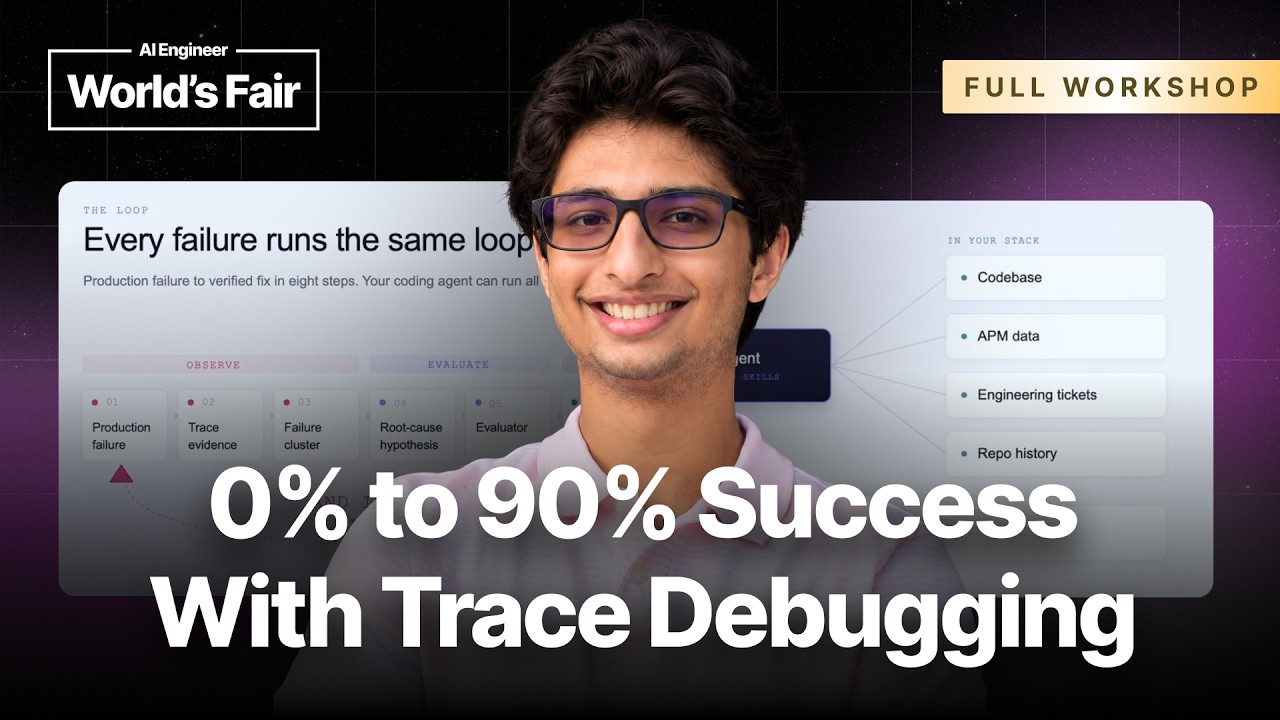
An earlier iteration cycle improved success rate from 0% to 90% by fixing a tool and normalizing inputs.
Tools mentioned
Techniques
- traces
- evals
- LLM-as-a-judge
- experimentation
- human annotations
Stop scrolling. Start reading smarter.
Receive the day's most important AI & engineering updates in one concise email. No spam.
Transcript (captions)
Good afternoon everyone. My name is Encore. Uh I'm going to be teaching you how to make your agent cook. Again, not food related. I don't know. Uh but yeah, we're going to get into it. Um so what I
mean by that is actually before we get into that, let's go ahead and start with a quick question and a poll with everyone. Um, I'm sure a lot of you are building agents or have even shipped
agents. I'm just curious how many of you currently are shipping based off vibes. And when I say vibes, it's not a bad thing. I mean like, hey, you're checking your answers. You're looking at it.
You're making sure that it's potentially doing the right thing just based on the input and output. You're making sure that it's correct or not. How many of you all are doing that?
Okay, pretty good reasonable amount of you. And then how many of you guys actually have like set eval set up like you know like oh you have LM as a judge or codebased evals or some sort of eval
setup. Okay, a little less. Not too much less though. That's pretty good actually. And then how many of you that actually have your eval setup trust it enough that you
know you're good enough? You have a full coverage of your evals and you're ready to you're continuously ready to keep going and moving forward. Wow, that's that's pretty impressive.
That was a solid hand up, which is kind of what I expected. I mean, it's very hard to really trust your emails because they're hard to build. You don't really know what you're
looking for. It's not a deterministic use case. And it's very hard to determine what we need to actually evaluate to make sure our agents are working properly. And that's kind of one
of the biggest issues is a lot of people are going to start off in a very good spot, which is based off vibes. It gets you going. It makes sure that your agent's doing what you expect it to. But
realistically, you can't really ship based on this feeling of, "Yeah, it's correct." Because when you're in production, you're not going to know where things are broken, what's going
wrong, unless you have actual eval set up to find out where things are breaking and how you can actually directly fix it. So before we get into eval, what I want
to kind of take is a whole step back and talk about how you can like what your eval would be on top of. And that would be on top of traces. And why we need traces is if you've ever used
traditional software engineering, you have something that you do call traces. It's for APM monitoring. It's making sure your systems are reliable and are working. But realistically, what you you
can actually go ahead and debug those and it's very easy to do because you have a very deterministic flow, right? You can even see right here, this is very easy to follow and this is more or
less what like code looks like. You have a handle submit method. You check if it's valid. If it doesn't, it errors out. If it is, then it goes down the next list and continues down that
process. So, it's very easy to figure out where things are b are breaking based on a just based on that sort of uh path history. But in an agent, unfortunately, with your code, really
all you have is that one line of code, which is just going to be agent.run and then the query. And ultimately, what it's going to do is kind of up to it. Will it call a tool? Will it go ahead
and do some analysis? Will it do some internal thinking? What is its next best step to do? and its actual best course of action. We don't know until we actually see the traces. You won't know
what your agent's doing. So that trace kind of helps you define that. And so as a kind of a decent example as to what a trace would look like would be this. You have your agent call. You go
ahead and see the LM calls. You have your documents you're retrieving, your tools that you're retrieving. You basically have every step along your journey that you would see of what your
agent's doing. And here you can even go ahead and see, hey, we have for example this tool.get order status. It's the wrong tool occult. The user asked us, hey, I was
supposed to get a refund here. Where's my refund? If we respond back, hey, your refund was issued and they know that that was their status based on their order status. That's not what they were
looking for. They were looking to understand why hasn't their refund arrived? So we need to potentially call different tools, do different actions, and there's so many different varieties
even just knowing that there's an issue here. But we'll dive into that in a little bit. So when you actually go ahead and understand, okay, we have a trace. Now I
want to go ahead and debug what's going wrong with my agent, we're going to start with where first you're going to identify those issues, right? Those production failures like we just did in
that last slide. We found out that tool was wrong. But what's your next step? You want to go ahead and find out, okay, not only where did it go wrong, can I get a nice sample size of that sort of
information that I can then use for experimentation and iteration to improve the agent when I actually want to go back and test against those cases. Then what actually was the issue, right?
Sure, the tool call was wrong, but should the LM prompt change? Should we add in guardrails? Should we change up the tool? Was the tool just doing the wrong things? Right? There's so many
different areas that we need to test and go against. And so we can go and test against those build out evaluations to continuously monitor those use cases. So for example, if you find out, hey, we
need to make sure that we set up a guardrail here. How are we going to do that? We want to and then we want to make sure that guardrail is doing its job. So we set up a evaluator on top of
that guardrail making sure is that guardrail doing its job by prohibiting certain information from leaking. Finally, you actually make those changes.
run that experiment that I was talking about in the beginning and finally ship it to production and do that whole loop over and over again continuously. Now, this is your standard go-to process for
actually improving your agent. It's pretty long, pretty manual, and pretty tedious. It does it does work, but we want to kind of iterate and improve that. How
can we do that? We want to make sure that we're not spending hours, days finding the issue, finding the trace, finding all these different issue points, coming up with
the potential solution, going through that full eight-step process manually. We want to pull all of that together and bring it into minutes. The best way to do that would be right here. We're going
to pull in all the data from all our different sources into one specific area. We're going to start with, you know, pulling our ap our arise traces so you can get all the information of what
your agent did. You're going to pull in your evaluations to see where things actually went wrong. You're going to bring in your annotations from any humans that could theoretically tell you
a little bit more information as to, you know, where it could go right, how they can improve it. You bring in your actual APM traces which could be hey is the system up or down. you bring in your
codebase so you can understand all right based on this specific area where it failed the tool call what changes can I make in my codebase so that we're c we're we're going down the right
pathways we're calling the right tools we're fixing our tools that are broken and so you'll bring in all of these into one final space which is which is our coding agent whether you use cloud code
cursor codeex it doesn't matter all of those you can connect all that data into and it can automatically do all of that work for for you. So, I know this may sound really
complicated and I promise this also probably doesn't help to make it look simpler, but it is very simple to get it set up. It's going to be just a couple steps of just, you know, setting up your
CLI and skills and you're ready to go. You get access to a bunch of information, a bunch of different tools that your agent can then do, which could be for example here, which are like,
hey, you can get your code instrumented. What that means is you can get all the traces from your agent into whatever platform you choose like Arise. You could go ahead and pull down those
traces, build out data sets, run experiments, run evaluations. You have the full gamut of the experience all from within your coding agent. So, what I'm going to do here is we're
going to go ahead and look at a specific issue. And I want a little bit of kind of uh voices from this side of the room uh where we can get some idea of like hey what do you guys think could be the
actual issue. So I'll give you a little bit of background. This agent right here is a simple financial agent. I've asked it should I invest in this company? I think I chose Tata Motors. Um anyways
and ultimately it gave me a response which said yes you should. I don't think it's directly in the screenshot, but I promise you it told me that. Um, and ultimately that's not really what we
want to do because I'm not registered to give any financial advice, nor is this agent, and I don't want to get in legal trouble. If you guys can help me figure out
maybe, hey, what do you guys think could be the issue in this agent? So, what she said was, "Hey, maybe the agent needs to ask a lot more questions back to get a little bit more information before I can
give a solid, concrete answer." That's a very good guess. Anyone else have any ideas? Okay. And how do you suggest we potentially improve that? By the way, he said it should ask, again, pretty
similar. It should ask more questions before making that recommendation, but how do you suggest maybe we can go ahead and do that? >> More context, more asking questions,
more details. >> Okay, so maybe some prompt changes to add in some context to get more context. One more. >> Sorry.
>> Where's validation? >> Where's validation? Yeah, that's true. We don't have any sort of ground truth to compare against. We don't know if any of this is correct.
So there's no validation that any of the answers are even correct. You're right. There could be so many different issues. And truthfully, oh yeah, go ahead. >> Question. Does the agent know the user's
financial background? >> It's a great question. In this case, no, it does not. And yeah, it should definitely get a lot more information into that. Uh he asked, by the way,
should the user does the does the agent know any information about the user's financial background? Um and yeah, it definitely does not. And there's a lot of areas that this agent could be fixed.
And there's genuinely genuinely not one correct answer, right? But and I genuinely don't even know what the right answer is to this because this agent is still messed up right now. And we're
going to go ahead and try to fix it today in this demo. Um, and so what we're going to do is we're going to go ahead and set up the CLI and skills, get that set up so we can actually get our
coding agent to go ahead and understand what's going wrong with our to go ahead and pull down the traces, understand what's going wrong with our agent, look at the evaluations we already have run,
look at the annotations that exist, maybe even do some of its own analysis, and potentially come back with some future suggestions just like many of you have done today for how to actually
improve this agent. So that hey, maybe we could have it ask more questions. Maybe we could add a guard rail so it only responds to certain questions and doesn't give financial advice where it's
not warranted. So there's lots of different ways that it can come to do those fixes. To get it started, what I'm going to do is I'm going to go ahead and pull open
let's see, do I have it here? Yes. Let's go ahead and pull open a new session. Um, okay, cool. I'm in the right space. All right. So, generally what you'd want to
do whenever you want to set up the CLI and skills, super easy. It would just be a couple steps to get that set up. Um I apologize. Oh, here we go. I know what I'm doing, guys. Uh here we go. So,
we're going to start by setting up the CLI. You would just go ahead and copy this one line of code to get that set up. So, I'd go into back into my terminal and install that. Of course, I
already had that installed right before this, but just goes just very simple and quick to set up. Then what you do is you would create your actual profile, which would help you connect it to wherever
your data stored. In this case, it would be arise. And you create that profile so it can go ahead and pull in those traces and visual and get that sort of information from those evals and
annotations. Once you have that profile created, you'd go ahead and set up your skills. You could do this in a multitude of ways depending on your coding agent. For
today, we're using Cloud Code, so I use the marketplace to set it up, but it's pretty easy to set up however you want. From here, let's go ahead and we're just going to ask it. And again, uh just as a
warning, I am using dangerously skip permissions. Please don't do this. This is not actually good practice. This is just for a demo, so I don't have to keep pressing yes. Um, but we're going to go
ahead and talk to Claude and have it go ahead and take a look at these traces. So, I'm going to go ahead and see if I can find the prompt I asked earlier, which was just use this skill and pull
down the traces from that specific agent. Find out what issues exist that we can determine from any, like I said earlier, right? What any issues that exist from any of the evals, any of the
annotations that we've done. do your own analysis and tell me what eval maybe I can build out in the future to make sure that I don't run into any of these issues again. And so this is going to
take a couple minutes. Um, in the meantime, I'm going to go ahead and first go and show you kind of how those traces look and how you can actually start triaging it if you want to do it
manually a little bit. But while this is running in the background, let's go back into the actual uh run into the actual agent that has those
sort of queries that we've asked. So, we'll go ahead and ask it a pretty similar question. Um, you know, tell me if I should invest into, let's say, Nvidia this time. It's a little bit more
of a well-known stock. And we're going to get that and it's going to try to tell us some sort of information. And as that data comes in, looks like I've run this earlier. So, and you can see it's
coming in. Um, but from an earlier run, we can kind of see what it's done already where you can see that query we asked, you can see the output that it'll finally generate, which we'll see how
similar it is in a minute from this previous run. Um, and you can see all the steps that actually happened in your agent, right? So, you can understand, hey, we had a supervisor agent, a
financial data agent, you can see the LLM calls, you can see all your different tool calls. you get a lot of information right away that you can start using just like we done in the
initial slide to see where those issues could lie. Now, let's see. Did Claude finish up? Looks like it's still running. It's doing its thing. We'll let it cook. You know, it's kind of the
point of this. Um, while it's cooking, anyone have any questions as to like, you know, how you can set up any sort form evals, any sort of traces, anything along those lines? Anyone
wanted to learn a little bit more about Yeah. >> Great question. Yeah. So, you would go ahead. So, what it does, it actually goes ahead and downloads a lot of those
traces um into the into your local system. So, what it'll do is actually let me go ahead and show you what it how it actually goes ahead and accesses the system itself. So when you give it
access to these skills, what you're actually giving it access to is the CLI underneath. And what I mean by that is you're going to have all these different CLIs that it can integrate with. So you
can go ahead and set up and find the data sets. You can pull down data sets. You can have it interact with the essentially interact with the UI where it can set up evaluations on the
platform on your behalf. So you can monitor continuously monitor when your agents are failing, build out data sets, run experiments. It can basically do anything that you that you would be able
to do in the platform. Sometimes it'll download, sometimes it'll make API requests, but that's generally the uh idea here. Great question. Any other questions in regards to CLI
tracing? Okay, let's go ahead and see what Claude's done. Oh, still crunching away. Um, so as we can see here, let's let's walk through what Claude's done so far.
So, we can see that we've gone ahead and gotten the spans. It's digging into the evaluations to figure out where those issues are. Um, it looks like it's not quite there's
definitely found one very big issue with some numeric groundedness. I know someone mentioned that earlier as a potential issue or something related to that. Um, we're also seeing some tool
calls directly fail. Um, and let's see. We also see, yeah, so we're getting a lot of different errors. Oh, looks like it just finished up. And so you can see here we
get a full list as to like, hey, what's going wrong with our agent and what we can do to kind of fix it. So while it's finishing up that, you can see here one of the biggest alarming things right out
of the gate is about 44% of our agent interactions are resulting in a bad summary. That's really bad. I did not know that. So, we definitely need to fix that one.
Another big issue is Oh, did not mean to scroll there. Another big issue is, hey, we're also just getting a lot of fabricated answers, which is just as bad as this the
summarization being wrong. So, it sounds like it may be related, it may not be. We can kind of debug that. We're also seeing a relatively high rate of us just redundantly calling tools. It's a waste
of our time, our resources, and our money. So clearly, we're doing a lot of bad things that we need to go ahead and fix. And that's just from the eval from Claude's own analysis. It's able to
even go ahead and figure out, hey, there's other issues that are coming along. We're getting silent tool failures. It's telling us it succeeded, but ultimately it's not giving us any
actual responses. We're getting the agent hallucinates when tool fails instead of disclosing it. So again related but hey that means maybe we need to not just do uh you know
some eval built on top of this to understand when the tool is failing but we also need to make some prompt based changes to make sure that the the agent doesn't hallucinate here and you have a
multitude of like different things that it'll go ahead and tell you as well as the evals it can build out. So what we could do is we can actually go ahead and tell it, hey, let's go ahead and build
number one, which was the tool success silent failure eval, and fix numeric groundedness so that it'll make sure that whenever it does respond, it's always grounded to some sort of actual
reference point and it's not making up these numbers. But we're also going to head and make sure you test this against a data set uh against the spans that caused the
failure initially using and then we're going to go ahead and use another Arise skill which would be here the Arise uh data set skill, the Arise
Oh, there we go. Arise um evaluator skill as well as the Arise experiment skill. So here it's going to be able to let me just go ahead and run let this run
and build out evals. All right. So again I'm being pretty vague here but essentially I'm just telling it go ahead and make the changes that you recommended as well as go ahead and run
these experiments for us. So now we can actually compare against where it failed to make sure it passes against that right and so in this scenario we can see okay it's going to go through and take
its time. Um I'm going to go ahead and show you a previous run because again this will take some time and while we want to let it cook I don't want to have you guys staring at a screen where
Claude's just discombobulating or whatever it does in its free time. Um, so let's go ahead and look at where I've actually gone ahead and asked Alex or sorry
Cloud Code to go ahead and answer some of our previous issue that I ran into. And one of those was related to hey, I've had some times where I'm trying to get some answers about uh
stocks that aren't necessarily from the United States. And so we're having errors where we're talking about like South Korea or looks like they're all South Korea based, but let's assume
there's other answers here. Maybe Japan or China and whatever, right? And you want to see and you want to be able to understand, hey, I want to be able to compare stocks across different markets.
And clearly people are asking that, but we don't support it. And so what Claude did, it went ahead found those areas where that issue existed. Like I said, it looks like it was all South Korea
here, but it found those areas. It built out a data set for me, which I can then go ahead and test against to make sure it works. And then it went ahead and ran experiments. And it made a couple
changes. So, it started with the initial one, which was the baseline, which was buggy, which as we expected would result in 0% uh passing rate, which is what happened when we initially got the
actual productionbased traces. It also made a quick fix where it normalized it by adding in that uh country name. It didn't work. Why? Because the tool I was calling was also
outdated and I needed to update to the stable version. So then it made a third iteration. And you can see that on this chart here as well where we were able to see, hey, the first iteration didn't
work. It went back, made a fix, and finally got us to the final iteration where we're getting about a 90% success rate. Clearly still not 100%. We still need to make some changes, but hey,
we're doing a lot better than we were earlier. So, this is like a great way to get you going so you can actually start from, hey, I know there's an issue to here's a fix. Now, I know we have quite
a bit more time. I want to check in. How is everyone doing? How do you guys feel? Do you guys have any questions about how you can go ahead and get this started? Yeah.
Great question. So his question was how where do the experiments actually run? Where do the evaluations run? Where does everything run? Um so you do have a little bit of customization there. In
this scenario, uh what I did is I had the experiment run on my local machine, which is I think what will be the case most of the time. And then what you what I did afterwards was I went or you can
host it on a cloud or wherever you'd like to experiment on. And then you can go ahead and actually run the evaluations on Arise itself. So in this case, I built out LM as a judge, which
would then go ahead and let's see if I can see the evaluator here itself. So you can see we built out two different evaluators, a codebased and an LLM based. I actually had Claude go ahead
and do this. It built it out for me in the platform. And this was the final LLM as a judge because it actually kind of failed in getting the codebased data to set up. So that's why we have two. And
so you can see the LM as a judge. It went ahead and built it out for us with this prompt and got it going so that we can actually compare. Hey, did the agent work properly?
Any other questions? That was a really good question by the way. >> Yeah. >> Very very good question. Um so eval can be set up however you like. We
have of course people can people can definitely use whatever sort of models they want. No one wants to be limited to just claude or just open AAI especially in today's modern age where you can see
AI models literally ship every other day and then you want to be like okay I want to use that one now right and also some people have a preference for slightly cheaper models some people have a
preference for making sure their evals are topofthe line because ultimately they know their agent's only going to be as good as their evals so they use the highest end models for their evals even
if they're not necessarily using those in production so it kind of varies you have full customizable control over cut. And so what you can see here for example, you have a full list of
whatever sort of model provider you want to use and you can connect those even if you want to use any sort of local um open source models as well. Yeah,
good question. So her question was if we have if I spin up a smaller agent to go ahead and make some of these bug fixes, how does this compare to that? Realistically, you don't have to use
cloud codeex. You can use whatever sort of agent you want. The benefit of what we've provided is a skill that you're able to go ahead and pull down the information from your traces to make
those fixes. So, you're not making those fixes just based on, hey, I know this is wrong and the output's incorrect. You're making those fixes based on, hey, I know this is wrong. Here's where it failed.
Here's why it failed. Here's how we can go ahead and fix it. because you have not just the information of your codebase, you have the information of any of your other APM tickets, whatever
or APM logs, any of your other tickets that exist in your Jira systems, etc. as well as your actual arise traces, which would be like here's the pathway the agent took, here's where it messed up,
your eval, your annotations, etc. Any other questions? Yes. >> Are these features available in Phoenix? >> Great question. Yes. Uh we do have so he asked is are these features available in
Phoenix. Phoenix is Aris's open- source version. We do have I believe skills and MCP as well in Phoenix which you can go ahead and hook up to your agent and it can go ahead and pull down the same sort
of information. Of course there are going to be some nice to haves in the enterprise edition where you have access to these online evals in a certain way that are much easier to format and set
up. You have a little bit more dashboarding and a few other features. But yes, the the skills in CLI you can connect to your coding agent. >> Yes.
>> Agent said that summary. So how would you classify something as like a bad agent know that's a good summary or a bad? >> Very good question. So her question was
in what I showed earlier there was a eval or there was a response from Claude that said hey there was a bad summary. How do we know what is a bad summary or a good summary? In that case, what I
actually had set up, it was actually based on one of the evals that I had previously set up. And so, we can actually go ahead and look at that evaluator here. We can go ahead and look
at let's see some I actually don't remember which one, but I'm going to go ahead and pull open this one and hope this is the right one. Um, so as you can see here, this is
basically the summary eval that I'd created. It's basically taking a look at the information we've gathered throughout our entire agent, all the sort of
context we've given to that summary agent and making sure that it's referencing the right points, it's answering the question accordingly, etc. Um, and so that's how we've gotten to
determine whether or not it was a good summary or not. >> Uh, what if we set up a skill in the first place to see if it can do a good summary?
give it given us a good summary all the time just like we set up a skill instead instead of running. >> Yeah, great question. So, she's asking
why can't we just set up skills that you know ensure that it gives a good summary and yes absolutely that is what you want to do. You want to make sure that you update your prompts, update your skills,
update your coding workflows so that your agents will give the best summaries. The emails are only there to help you determine where there are issues, monitor those issues, make sure
they don't repeat, right? And so you set up that skill, great, it works for the next two months, two months later because there's a model regression because people start asking questions in
a different way. You end up getting different results and you don't want your e you don't want your performance to degrade because of that. So you want to be able to monitor and observe that.
That's the point of the evals. Did that help? Beautiful. Um I don't know for how much time we have left but go ahead >> later agents are assessed
and soc. So your question was if I've run into issues with linting with the agents >> agents seems like more
>> good question. Yeah. So he's basically saying hey um have you seen the issue where hey you've given access claude to all these skills and all these sort of traces and
all this sort of information but ultimately most of the time I've seen with cloud code or any of these other sort of coding agents they end up focusing on linting rather than any
other sort of issue am I correct yeah that's a very good understanding and that's kind of why we built out these skills which kind of focus on ensuring that they hyperfixate on the actual
issues that have been given to them, right? So they'll get all these trace information so they'll understand, hey, it's not going to be a linting based issue because you can see that it's
calling the wrong tool and that's not going to happen because of linting and it does have some reasoning capability to understand that. Um, and so genuinely I haven't seen that so much when using
the skills. Awesome. So as it Oh yeah. Does does the system make it easy to understand? Sorry. >> Great question. Yeah. So, how so his
question was, does it make it easy to understand how much it costs to run those evals? Absolutely. So, one of the best parts of running evals is in the platform is you're going to be able to
get full trace history of what your emails did, which also comes with the added benefit of, you can see right here, a nice little cost. And so, you'll be able to understand how much your
emails are actually costing you because yes, of course, anything anytime you're running another LLM, it's going to be additional cost to you. So, you want to make sure it's not. And of course,
what's really nice about building out evals, whether it's in the UI or via the coding agent, you can have those set up basic requirements like, hey, we want to sample specific amounts so we don't run
it across 100% of our traces and 100% of our calls. Um, you can make it focus on specific areas. And of course, you can always dictate that in the coding agent or on the platform itself.
Um, so as a kind of refresher as to everything we kind of covered today, again, it that's the wrong one. Oh, I think I have it over here. Um,
so essentially what I really want to give you as a takeaway, these AI agents, they're great. They will do basically everything you ask
them to, but again, they're not magic. Like he said, they can definitely focus on linting. They can definitely get caught up in small little areas, but the best part of them is they will automate
your full workflow from beginning to end. So whether it's that starting from observing where the issues lie, finding those issues, being able to actually pull it down, understand where
the issues lie, create those data sets, build out exact fixes, test them to make sure that they're working. And finally, you can then go ahead and
be the manual human to make sure that hey, it didn't just go back and fix the linting changes, right? And we can make sure that it actually made changes that actually help improve the agent and not
go for degradation. That's kind of the general gist of what I wanted to show today. Um, any other questions on this before, you know, I can maybe show one last thing of seeing.
Oh, still finishing up what I was trying to do earlier. I was hoping it might be done after this. took about 14 minutes. But um while that's finishing up, any other
questions on how we can use our agents to automate our workflows and improving your agents? Yeah. >> Great question. So his question was, are we primarily relying on Claude or any of
these coding agents to actually go ahead and give us the evaluation if things are working well or not? Um, yes, you can definitely rely on Claude to build out everything. You can also manually do it.
You can also ask Claude to do the specific evaluations you want. So in this case, when you saw that nice clean table, that was actually defined by the evaluations me and my team had set up
prior to this. Um, we'd gone ahead and looked at, hey, these are specific areas that we know are potential limitations in most agents that work in this workflow and we set up those as generic
ones, which is why we got a bad summary. We had some, hey, is the agent healthy? Is it giving the right are we getting tool calls correct? Right? We know those are general areas, but what Claude was
able to do was look at our actual traces, understand based on those traces, what are the actual issues we're falling into today. Right? we have our live agent in production. I'm not going
to be able to go through all of those manually and find those, but Claude can or Claude cursor codeex, whatever, right? And that's where like one of the biggest superpowers that you're able to
give these coding agents to be able to do that for you. I saw another question here. Good question. So his question was is there any sort of benchmark data set that we
can see or any sort of like visualization that can tell us hey this is a higher quality LLM to use for evaluations more expensive less expensive um realistically no [laughter]
that would be sort of something you'd have to do for your own analysis you'd have to figure it out because ultimately one of the things that I like to say is if you're going to use out of the box
eval to judge your agent you're going to get out of the box results and that's not what you want when you're building customtailored AI agents which are built to be personal
for you. Um, and the same goes for benchmarks, right? Benchmarks are great. They'll show you, hey, this this is a good agent. This is a good sorry, this is a good LLM. But realistically, what
you want is, is it a good LLM for me? And that's going to be tailored to your use case. So, if you're building for finance, maybe you'll use a specific one. If you're building for, you know,
law in finance, it might be even this slightly different model, right? So, it really depends on what you're building it for. Cool. I think that's more or less it
more or less it from me. Um, if anyone has any other questions, I'm happy to answer them. But yeah, thank you guys. [applause]