Enjoying this issue?
Get tomorrow's AI & engineering digest in your inbox — hand-picked, summarized, and always spam-free.
TLDR
Containment rate — the percentage of conversations handled without a human — is a misleading metric for AI agent effectiveness. Druid AI's six-pillar scorecard, which weights governance and business outcomes above technical metrics, reveals that an agent with 80% containment can outperform one with 96% containment when the lower-containment agent is designed to hand off valuable leads. The framework provides a continuous evaluation process, not a one-time test.
Key points
Druid AI proposes a six-pillar framework with 26 components to measure AI agent effectiveness.
An agent with 80% containment scored 83% overall, while one with 96% containment scored lower due to weak governance.
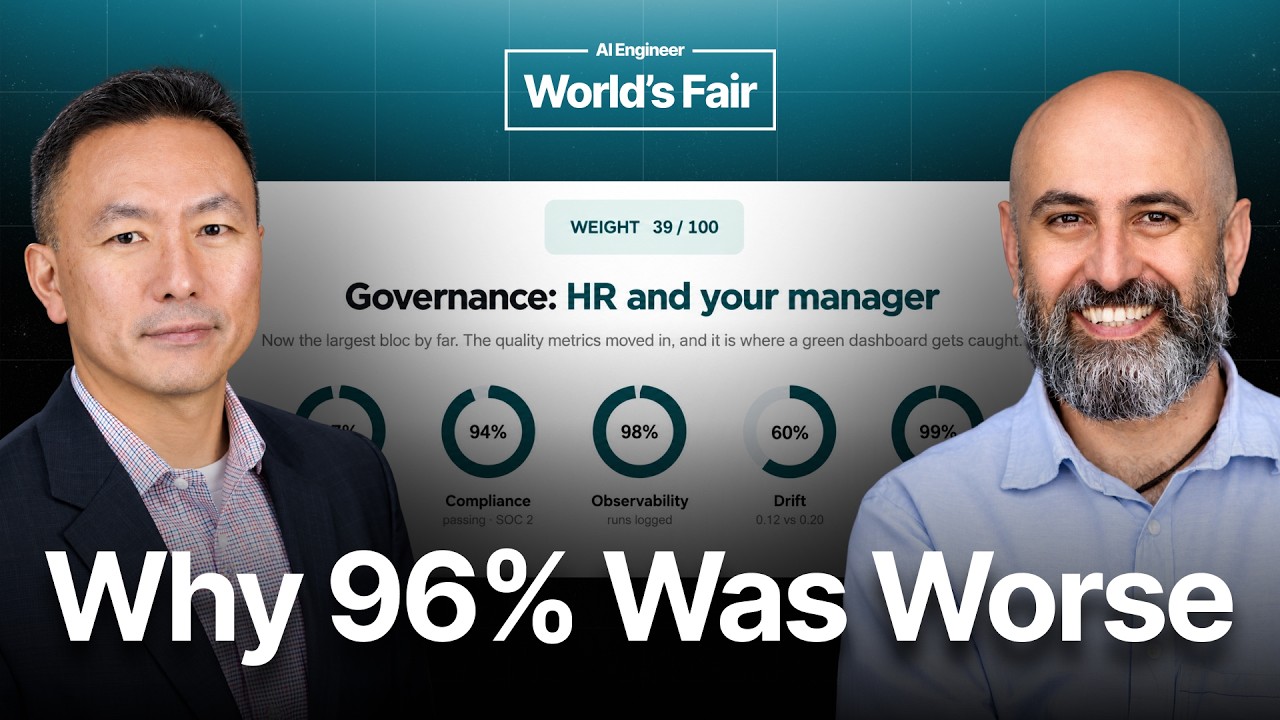
The framework weights governance at 39%, mandate at 26%, platform at 12%, and outputs at 9%.
The 2026 AI adoption benchmark shows optimal containment varies by industry: financial services 80%, healthcare 87%, HR/IT 93%, higher education 99%.
Agent evaluation should be run weekly against a human baseline to detect drift.
Techniques
- six-pillar agent effectiveness scorecard
- weighted scoring of 26 components
- weekly drift monitoring against human baseline
Stop scrolling. Start reading smarter.
Receive the day's most important AI & engineering updates in one concise email. No spam.
Transcript (captions)
[music] Morning. I'm Michael, head of developer community at Druid AI, and this is Dan, our co-founder and chief product officer.
Quick context on who we are. Uh, Druid is a conversation AI startup with hundreds of customers across EMIA and Americas and we've been around for a few years. And because we sit with so many
customers putting agents into production, we hear the same question over and over again. How do we actually tell if our AI agent is effective? Which numbers matters? Which artifact should
we inspect? There was no clean answer out there. So we built our own reference model and measurement framework and we use it to help our customers evaluate their
agents. And one of the ways we explain it to our customers is a simple analogy uh interns, right? Who doesn't love interns? So that's exactly how we'll walk you through today on this session.
So here's a scenario. Uh let's take a business scenario, right? You're a manager at a banking customer service center and hire two interns for the summer. Same team, same job description
for both interns. By August, here's what their dashboard says, right? Intern A contains 80% of conversation, escalates 20% to their senior bankers. Intern B contains 96%
and escalates four almost nothing and dashboard is green. Now you have one return offer to give. Who gets a full-time job offer? At first glance, intern B looks like the obvious hire
here, right? Intern B hired handle almost everything alone. Didn't keep pulling their senior bankers into a conversation. But surprisingly, offer to intern B is
the wrong offer. Here's what had actually happened with intern A as an example. The customer is authenticated at 7 a.m. on a mobile app, asked what it would take to uh ask what
would it take to pay off a mortgage early. The agent can answer the math, pull the balance, run the calculation and give a complete response contained in every definition. But that
question is a signal. The customer is rethinking their mortgage. That's a refinance. That's a real revenue on the table here. So the bank writes a rule, answer the customer, then route the
context to senior banker. That design handoff is part of agent A's 20%. The metric doing this is a containment uh the percent of conversation handle without a human. It's easy to measure
and it's on every dashboard. This is the exact gap our customer kept hitting and it's why we built a reference model and a scorecard and Dan's going to walk you through that
framework. >> Thank you. Thank you, Michael. Um this is the framework that we build because our customers and prospects asked us
how do you know that the agent our agent it's delivering to the job? How we know that the agent is effective? So we build this framework sitting on six pillars
splitted in two groups with governance across all these pillars. The configured group, it's what the agent is built off, what exists before
the agent runs. Under the runtime, it's what the agent is doing at the runtime. What tasks creates, what tasks execute, and what is the output
across all these groups. It's governance. From the business perspective, what is the expected boundaries? And under governance,
we observe and we monitor error tolerance, risk, very important, compliance, observability, accuracy and hallucination and tone and
sentiment. all together 26 components that are observing and analyzing the agent behavior
as a whole. So with that framework, you stop debating whether the agent feels ready and you move the discussion
based on the facts and you level the field and you can take a decision based on mathematic rules. So let's dive into it. Each individual component
it's scored on three levels. It's get zero if the respective component is missing doesn't exist. It it gets one point if we can measure it. We can absorb it,
observe it and we can measure it not to that not necessary automatically. So I can observe it and measure by hand equally good like it is the risk defined what is the risk I can read it I know it
and the best gets two points in score if it's managed managed means it's tracked it's observed and analyzed over time because everything it's in a dynamic What
happens yesterday might be different today. And to accumulate all these different metrics, we wave them based on the
importance. And you observe that the governance cluster is the most important because I am analyzing the effectiveness of the agent from the business per perspective.
they produce the expected business outcome. So the governance group gets 39%. Further on the mandate and we will see what it means gets 26%.
Platform 12 outputs 9 and so forth. And you will notice that the technical aspects are measured are contributed but are weighted lower because we focus on the business effectiveness of the agent.
Based on this metrics, we will see that a green containment that at the beginning looks the winner, it's based on a fact and can be a very different outcome when we measure all
these components. Let's look a little bit inside each cluster. governance super important and many times
it's forgotten to be approached from the very beginning. We focus on the technical aspects and then we tend to observe the business effects afterwards with this framework. We start with that.
It helps a lot in the envisioning phase as well. Choosing what functional area to approach with AI and I see in my projects literally departments competing who should come first because they have
a mandate from a board you should absorb AI. So all of them are looking to do it and the framework helps them to decide. So anytime I'm defining an agent, I start setting his boundaries. What is
accepted tolerance? And you might say zero. I want to be perfect. I want to be 90%, we know that AI is not always perfect, but sometimes 50% is
good as well. In autonomous agents, I want to have a higher target because there is no human in the loop. Should be perfect or cancel the job. But in a humanto AI collaboration,
I know that the final decision is to a human. So AI is creating content and then human decides. So 60% error tolerance might be good risk.
It is the risk defined. I am in synergies with all the other departments. So I know that my agent should run under this risk uh uh blueprint. I need to look somewhere and
have these risks defined. And uh if you look at the numbers the agents we measure in here are good 97% because there is risk compliance defined for this agent.
Compliance it's good. We evaluated the agent is compliant with sock 2 and back policies. So got a good score. Observability it's also good. I look the agent is logging everything
from input reasoning decisions and then call integrations everything is logged good score on there drift good score we are still in the boundaries in the base established for
with the first go live date it is measured and tracked accuracy 3% hallucination part of them automatically determined
other set manual annotation but altogether accuracy it's measured and tracked and tone and sentiment because these agents are conversational agents I observe and
extract the tone and sentiment from the conversation so all together you see how many seven very important metrics measured agent mandate super important I know we
have the system prompt which says the boundaries but it's just this is just a part what is the agent definition what this agent should do the other things unlimited scope should not be done by
the agent so hallucination control what's the business impact Why we are doing this agent? We are not just experimenting technology. I expect this agent to achieve 70% contract renewal.
This is an ROI. We will measure it at the end to judge the business success. What are the policies boundaries based on what facts my agent should reason? Isolated context. These are the
documents. These are connected systems. security, what systems this agent is allowed to engage with. Super important. I want to sleep at night knowing that my agent is
only accessing these three endpoints. I don't give give him access to an MCP server with 4,000 tools and I don't know what he's doing. Isolated context. And secondly, who is allowed to engage with
my agent. And last but not least, I want to stay in the budget. I don't want to have the surprise that one week later, my agent consumed 20K
with whatever resources he engaged with. So all these five pillars creates the agent mandate. platform capabilities. We want the agents to work together.
We don't want the agents to reinvent the wheel. If one agent is performing good because he is managing right the memory, humans handoff and orchestration on his skills, I want all the agents to behave
the same. So I am measuring that as well. very important handoff. I don't want each agent to handle his own handoff. I want to have a central action center
where people are engaging with all agents in my organization. So I am evaluating if each particular agent is talking with this superior uh service. I'm getting more into technical topics
which are contributors to the overall score but all of them are under governance and the business purpose. So yes there are skills defined but how granular, how discoverable they are, how
orchestrated, how thin or how large it's the uh the prompt combining multiple skills are the skills coming from a central repository are built on the spot or are
human coded. What tools are available? You will see at the final judgment that the performer agent is not the one with the largest number of tools.
It is with the effective uses of tools. So very important this aspect as well. And with this I concluded the definition. But what happens at the runtime? I need to log.
I need to create tasks based on the mandate and then execute the tasks. Are the tasks written? Is the input logged? Is the required context present? How do I know
it's the success criteria created together with the task? Because if I look and I see that the agent renewed the contract, I want to measure if that renewal was successful or not. If I
don't have the success criteria linked with that individual contract, it will be impossible to judge. So the agent should explain everything he's doing. This is what the task topic is.
And at the end, I want to validate the output. there is one single score that evaluates if the agent was successful or not. So in summary,
combining all these metrics, agent A scores 83%. If you remember at the beginning, his containment was 80%. Escalated 20 times.
Agent B escalated just four times. However, observing and measuring the governance, the mandate, the final outcome, the final score, it's in favor of agent
A. And if you look at the clusters, in each individual cluster, A was better than B except the skill. B had more skills but was lack in explanability in tracking success and compliance with
the governance. So all together this framework gives the true winner Michael back to you. >> Thank you. Thank you Dan. So those seven pillars and the scorecard
uh that's the framework and this is a framework that we've used uh with multiple of our customers and it's been working out really well for us and what customers typically tell us is that hey
they finally have a some sort of framework that they can use to measure the effectness of the agents that deploying and be able to have a discussion intelligent discussion with
their business stakeholders. So here's where going back to the inter uh intern metaphor breaks right in your favor. Uh when you hire a person, the interview ends, right? But when you hire an agent,
it never ends. You rerun it every week on a live traffic against a human baseline instrument, evaluate, improve, retest. Again, going back to what Dan said earlier, the drift, right? The
green line you see on the right here is the um the vanity dashboard as flat 92% all year. The teal line is the wheel score sliding from 83 to 60 because you're measuring it on a weekly basis.
So same agent, same green dashboard but different metrics across the time. So now one of the things especially if you once you start to engage with the business stakeholders let's say your CFO
or something you know the first first question comes out is the is the ROI right and the and the fear sets in the fear is that only measurable thing about an agent that you're working on you're
deploying is like whose job is it does it take away from right and that fear survives because the we mostly haven't measured the alternative alternative. So here's a reframe that we try to
typically work with our customers. A good intern lightens your workload. The routine works moves off to your desk and you get sharper at the work that's left. Right? Same test for an agent. What did
it take off of your plate and what did that free the time to allow your business to do? Right? The agent hands a balance check at 7 and 9. So the banker spends next morning with the customer
who's rethinking their mortgage. The agent made the banker better at banking and that's the column belongs on your scorecard and that's some of the things that we try to work with our customers
as well. Now a a confession to make about the opening the intern was never hypothetical that 8020 split was a 2026 root AI adoption benchmark for financial
services. So everything you just heard is backed by our anonymized aggregate AI agent production data. Uh the same metric containment four different industries four different right answers
financial services at 80 healthcare at 87 HR and IT at 93 and higher education and 99 containment rate. Now when you look at the data higher ed isn't better than banking. banking just design more
handoff in their agenting AI design that's what you wait the outcomes per agent against one universal number the numbers different across different industry this is the druid 2026 AI
adoption benchmark uh we gathered 15 months of the production AI agent data and uh it contains many useful data uh across different industry as well it's free to download and if you Look at the
next slide here. this slide uh this is where you can um QR code you can scan it you can uh download the report and it's the framework that we developed is really about defining the mandate
contract the boundaries score the whole agent run it weekly uh against the human baseline and that's a framework that we typically uh work with our customers to kind of so we wanted to present it you
all kind of share the framework free to use and uh one Last thing is uh we're located at the booth LG11 right across from OpenAI Microsoft booth. So feel free to come by and I would love to have
some conversation with you all. Thank you very much. >> Thank you. >> [music]