Enjoying this issue?
Get tomorrow's AI & engineering digest in your inbox — hand-picked, summarized, and always spam-free.
TLDR
Using ternary quantization (~1.6 bits per weight) and mixed precision per tensor, a 27-billion-parameter model compresses to 5.95 GB and runs on an 8 GB GPU. The uncensored behavior comes from editing the residual stream to remove the refusal direction (R hat), achieving near-zero refusals on the author's tests. However, refusal counts are author-specific and cannot be compared across models, so users must verify with their own prompts.
Key points
Ternary quantization (e.g., Bonsai files) packs 27B weights into ~1.8 bits per weight, fitting 8 GB GPUs.
Uncensored models remove the refusal direction (R hat) from the residual stream via weight editing, based on RDT's paper.
Heretic automates this ablation using Optuna TPE to optimize refusal rate and KL divergence.
Refusal counts on model cards are author-specific and not comparable due to different test prompt sets.
MTP (multi-token prediction) can speed up generation by up to 40% but consumes additional GPU memory and reduces context window.
Tools mentioned
Techniques
- Ternary quantization
- Mixed precision quantization per tensor
- Residual stream refusal direction ablation (R hat removal)
- Multi-token prediction (MTP) and speculative decoding
- IQ quantization (IQ2XS, IQ3S, Q4KM, etc.)
Stop scrolling. Start reading smarter.
Receive the day's most important AI & engineering updates in one concise email. No spam.
Transcript (captions)
A 27 billion parameter model normally needs about 54 GB. This one is a 5.95 GB file, small enough to load on an 8 GB GPU. Its model card says it refused zero of 100 test prompts where the original
refused 95. Run these only on your own machine and treat this video as education. A model with its refusals removed will answer what you ask, so you own the request. Hugging Face has many
uploads tagged uncensored, obliterated, heretic, or aggressive. Each one quotes its own refusal count. It isn't obvious which file fits your GPU once you add the cache. I stumbled upon a list of
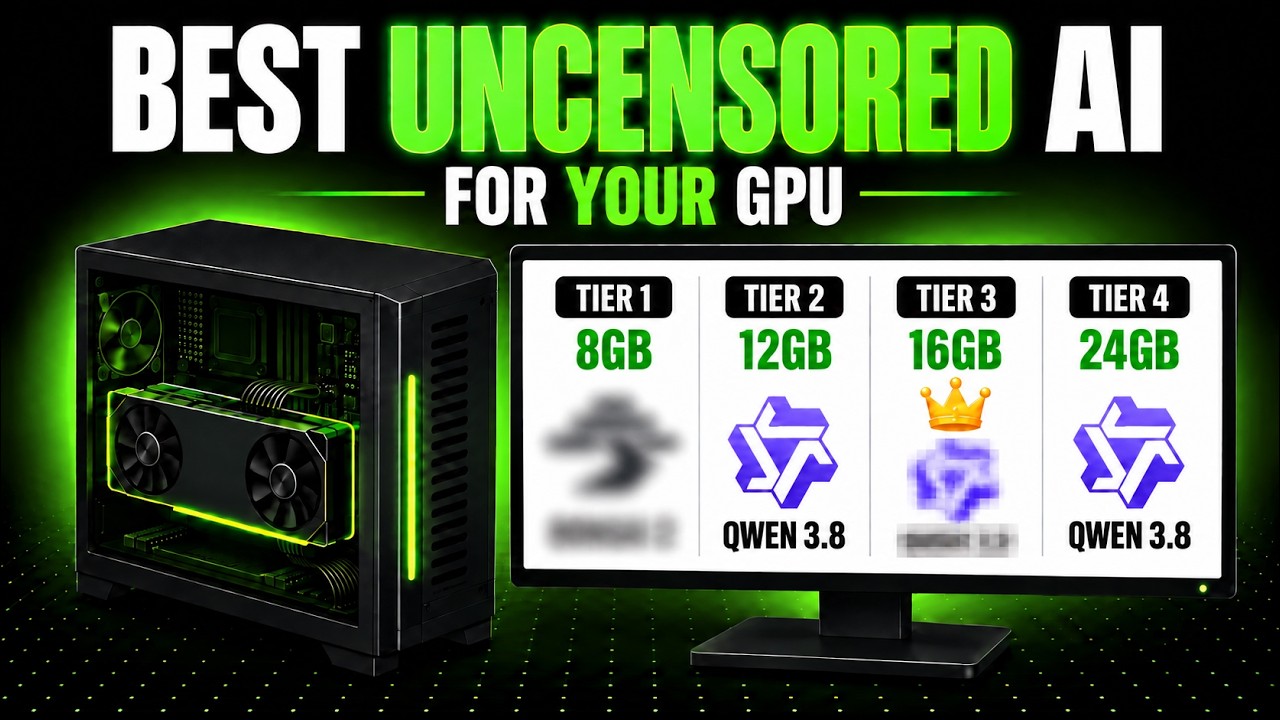
pics someone posted on X, and I checked each pick against its hugging face page. By the end, you'll have a pick for 8, 12, 16, and 24 GB. The question for the first half is simple. How does a 27
billion parameter model fit in 5.95 GB? And what did the author remove to reach zero refusals? File size is the number of parameters times the bits per weight divided by 8. At 16 bits, a 27 billion
model needs 54 GB. The BF16 file in the Hi repo is 54.7 GB. Take Q4KM. The Llama CPP readme lists it at 4.8944 bits per weight. For 27 billion weights, that's about 16.5 GB. The Q4 files on the model
cards are 16.8 GB. Because the KQ quant mix varies from one block of weights to the next. So a Q4 file of a 27 billion model is a 24 GB GPU file. It leaves about 7 GB for the context cache and
everything else. On an 8 GB GPU, the same file doesn't fit. Now solve the formula for the bits instead. The 5.95 GB bonsai file is about 1.8 bits per weight. The 7.21 two 1 GB file is about
2.1 bits. Those bonsai files are turnary. Each weight takes one of three values, which works out to about 1.6 bits. The files above run at 1.8 and 2.1 bits. The sources don't explain where
the extra bits go or how the model keeps working at that size. My list calls them one bit, but the model card and the fork say turnary, so I'll say turner. A second method is mixed precision. A
tensor is one block of weights. The zerobs server xgsqrco builds give each of the 851 tensors its own quantization type, meaning its own number of bits. The four files run from
2.50 to 3.50 bits per weight. The model card says its IQ3S file at 11.80 GB is within 1% of full precision on Wiki text 2. A uniform IQ3S at 12.42 GB is within 1.9%. These are the model cards own
measurements on them. Choosing a type per tensor gave a smaller file and a smaller loss. The weights are only part of what your GPU holds. The model also keeps a context cache. For each token in
the window, the cache stores the keys and values that the attention layers worked out. The model reads them back instead of working them out again. So, the cache grows with every token and it
also sits in video memory. The Bucoid model card gives a worked example on a 16 GB GPU. The Bucoid build has a file of 13 to 13.3 GB. The model card says about 110,000 tokens of context fit
without MTP and about 80,000 with it on. MTP is short for multi-token prediction. It's an extra part of the model that guesses upcoming tokens to speed things up. So turning on MTP costs about 30,000
tokens of context on that GPU. The MTP file is also a little bigger at 13.3 GB. The model card doesn't say why the window shrinks, but the MTP part takes memory, too. I'll show how MTP works
later. Quen 3.8 has a native window of 262,144 tokens. It has 64 layers in 16 blocks. Each block has three gated delta layers, then one gated attention layer. An
attention layer looks back at every earlier token, so it keeps a cache that grows with the text. The model card doesn't describe the delta net layers, but layers like them usually keep a
fixed size summary. Instead, only the 16 attention layers keep a growing cache of keys and values, which is what KV stands for. That's my reading of the architecture. It suggests long context
costs less than on a pure attention model. I don't have the exact cache size per token, so use the bucoid numbers as your guide. Now, we answer the second half of the question. What does
obliterated mean? It starts with a paper by RDT and colleagues. They found that refusal in chat models runs through one direction in the residual stream. The residual stream is the vector that
carries each token state from layer to layer. Those states are called activations. To find it, they recorded activations on 128 harmful prompts and 128 harmless prompts. Then they
subtracted the mean of the harmless activations from the mean of the harmful ones. That difference is one arrow called R hat. Remove the part of an activation that points along R hat and
the model mostly stops refusing. Picture a stick leaning in the air above a floor line. Split its length into two parts. How far it reaches along the line and how high it stands above the line.
Obliteration removes the along the line part and keeps the height. The picture breaks in one place. A real activation has far more than three dimensions, but our hat is still one line. The model
keeps every other direction as it was. Instead of subtracting at runtime, the paper edits the weights that write to the residual stream. It removes the R hat part from each one. After that, the
model can never write R hat. On the 70 billion llama 3, refusal fell from about 99% to about 4%. Mmlu, a general knowledge test, moved from 79.9 to 79.8. Across the models tested, truthful QA
fell by 1.0 0 to 3.5 points. The paper tested 13 chat models up to 72 billion. It did not test Quen 3.8 or Gemma 4. Maxim Leon's write up gives the same recipe in four steps. First, you record
activations. Then you take the mean difference. Pick the best single direction and edit the weights so they can no longer write it. The paper's drops were small on its test. Labin
measured lower scores on every benchmark he tried and recovered most of them with extra training called DPO. So the cost depends on the model and the test. We's model card shows where the edit lands.
It ablates layers 17 to 52 and leaves earlier layers alone. The vision and MTP parts stay unchanged. So the edit touches one band of layers. How hard to ablate and in which layers is a tuning
problem. Heretic is a tool that automates it. It edits two matrices in each layer and both write into the residual stream. They are the attention out projection and the MLP down
projection. The MLP is the layer's feed forward block. Each matrix gets that layer's own refusal direction. It uses an optimizer called Optuna TPE, which tries settings and learns which ones
work best. The optimizer tries to cut two numbers together, the refusal count and the KL divergence from the original model. KL divergence measures how far the edited model's next token
predictions have moved from the originals. A low value means the model still behaves like itself on normal text. So it measures how much the edit changed the model. In the readme's 12
billion Gemma 3 example, Heretic reached three refusals in 100 prompts at 0.16KL. Manual obliterations scored 0.45 to 1.04KL. Heretic runs in about 20 to 30 minutes
on consumer GPUs. The author of the OS software model card merged a Heretic Laura into the model. A Laura is a small set of weight changes that you add on top of a model. The merge changed 34 of
the 851 tensors, the blocks of weights. The model card reports a KL divergence of 0.0135. So that's the answer. This file is small because it uses about 1.8 bits per
weight, and the author cut its refusals by editing 34 tensors. Refusal counts need care. Each one is the releaser's own test on the releaser's own prompt set. The model cards show no independent
replication. So 0 of 100 on one model card can't be compared with 0 of 465 on another. The clearest example is the 24 GB pick from Jonathan Kleti. Its model card says it still declined 12 of 100
harmful prompts and the base model declined 98. So uncensored there means substantially reduced and the count is above zero. I like model cards that publish their misses. The Kleti model
card shows a nonzero count next to its baseline so you can see what the edit left behind. Many pics mention an MTP head. The idea behind it is speculative decoding. The Llama CPP docs say that
computing N tokens in one batch is cheaper than computing them one at a time. A small draft proposes several tokens ahead. The main model then checks all of them in a single batch pass. The
share it accepts called the acceptance rate decides how much faster you go. Suppose the draft proposes four tokens and the main model accepts three. That pass gives you those three plus one from
the main model. So four tokens instead of one. If it accepts none, you still get one token, but the draft work was wasted. That's a madeup example, but it shows why the acceptance rate matters.
The original speculative decoding paper reported two to three times speed up on T5XXL with identical outputs. Quen trained 3.8 8 with multi-token prediction so its own
head can draft. The model cards don't explain how Quinn trains that head or wires it in. The model card speed claims vary a lot. Kleti says up to 1.3 times throughput in some cases. How how CS
claims up to 3.02 times throughput on documents through a fast MTP sidecar which is a small extra draft file. Bolding builds says about 40% faster at generating tokens. All three are the
author's own figures. The head also costs memory. The Bonsai V2 file grows from 7.21 GB to 7.66 GB with MTP and the Bucoid build loses about 30,000 tokens of context. Next come the tiers and
first a rule about speeds. Every speed on the list is a base model run reported by the post author or another owner. None of them test these exact builds. Same file size means same memory use. It
doesn't prove the same speed because the MTP path could differ between builds. Treat the speeds as a rough guide. Start with 8 GB. That covers the 3060 Ti, 3070, 4060, and 5060, plus AMD's
RX667,600. On the author's 3060Ti, the base Bonsai 2 model ran 42.8 tokens per second with a 96,000 token window. My first pick is the 27 billion Bonsai 2 Heretic from OS
software. The files are 5.95 GB for PTQ10 and 7.21 GB for PQ20. Vision files add 931 megabytes at BF16 or 629 megabytes at Q8. On an 8 GB GPU,
the 5.95 GB file plus the 629 megabytes vision file leaves about 1.4 GB. That's little room for a long context. If the cache needs more room, use a shorter window. This build must run on the Prism
ML fork of Llama CPP. The fork warns against mixing its GGML libraries with stock Llama CPP. So, install the fork in its own folder. The model card reports zero refusals in 100 test cases against
95 for the original. It says safety alignment is substantially reduced and the model is for research. It showed 150,612 downloads in the last month when
checked, close to the 147,000 on my list. Three 8 GB entries on my list carry numbers that the model cards I read don't show. They are the Bonsai Obliterated PTQ10,
the crack build, and the Gemma 4E4B Heretic. I leave them out. Older 8 GB GPUs like the GTX 1070 and 1080 take the Gemma 4 E4B aggressive build from How CS. The base Gemma 4 E4B model ran 42
tokens per second on my 2016 GTX 1080. The repo has 13 quantized files from 4.43 GB to 8.13 GB. Q4KM is 5.34 GB which matches the 5.3 on my list. A vision file adds 990 megabytes and the
context is 131,000 tokens. The model card claims zero of 465 refusals. The creator also says Gemma 4 didn't get as much manual testing time at longer context. So keep the window short and
test it yourself for 12 GB. The list covers the 3060 12 GB, the 4070 family, and the 5070. It also covers AMD's 6700 XT and 7,700 XT. On my 3060 12 GB base 2 with the MTP head ran 50.1 tokens per
second. Bolding builds 27 billion bonsai 2 obliterated v2 with the MTP head is pick one. The standard file is 7.21 gigabytes and the MTP file is 7.66 GB. Both use PQ20 so both need the Prism ML
fork. The model card claims about 40% faster generation with MTP and an MMLU drop of 0.56 points. It also reports 0.941 on a benchmark called strong reject. and I can't say from the model
card what that score means. The 84% to 0% refusal figure on my list isn't in the model card text I read, so it stays unconfirmed. Pick two is the Obliterated Quen 3.8 build from Hi AI. It's a single
file and it weighs 10.1 GB. The format label is GSQRCO. Then IQ3XXS. Put that on a 12 GB GPU and you've got about 1.9 GB left for the cache. It
shows more than 2.1 million downloads a month. The model card recommends research in controlled environments. Zerob Server X's Heretic GSQRCO is P 3. The IQ2XS file is 8.45 GB and
the model card aims it at 12 GB GPUs. The IQ2S file is 9.28 GB and the IQ3XXS file is 10.12 GB. That matches the 9.3 to 10.1 on my list. The model card describes the base as refusals 0 to 1 in
100. The larger IQ3S file at 11.80 GB is the one the model card recommends for 16 GB. The fourth entry is a 12 billion Gemma 4 Heretic at 7.4 GB. That size isn't confirmed on a model card, so
check its file list yourself. For 16 gigabytes, the list covers the 4060 Ti, 16 gigabytes, 5060 Ti, 16 gigabytes, 4070 Ti Super, 4080, and 5080. It also covers AMD's 6,800,
7,800 XT, and 970 XT on my 5060 Ti. Base Bonsai 2 ran 67.3 tokens per second. Pick one is Bucoid's Kane 3.8 heretic Aura in IQ4XS. The model card says it uses Heretic's
arbitrary rank ablation and the sources I read don't explain that method. The file is 13 to 13.3 GB and the MTP variant is 13.3 GB. My list says 14. The model card gives quality as two numbers
against BF16 99.34% perplexity correlation and 0.028 mean KL. It gives no refusal figure. So the ranking on my list has no refusal number behind it. Pick two is the Quinn 3.8
aggressive MTP from HOH how CS. My list says 12.8 to 15.7 GB, but the model cards table doesn't match. It shows IQ2M at 10.32 GB and Q2 KP at 10.68. It also shows IQ3XS at 12.18 and Q4 KP
at 17.92. So Q4 KP at 17.92 GB doesn't fit a 16 GB GPU. Of the files I checked, the largest that fits is IQ3XS at 12.18 GB. The model card claims zero of 465 refusals, and it shows 2,82,141
downloads in its tracking period. The third pick reuses the Bonsai Heretic file with Vision on. The 7.21 GB file leaves about 8.8 8 GB for the cache and the vision file. The model card doesn't
mention an MTP head for this file. Also, no number here says how much of the 262,000 window that space holds. The fourth pick is a mixture of experts model. The 26 billion Gemma 4 with 4
billion active obliterated. My list says 13.4 GB. The repos files run from about 9.88 GB to 27.9 GB and the listing doesn't confirm 13.4. In a mixture of experts model, each layer's feed forward
block is split into many small blocks called experts. A router picks a few experts for each token. Models of this kind usually work this way. The 35 billion Quinn 3.6 with 3 billion active
model card describes 256 experts with eight chosen per token. So about 3 billion of the 35 billion parameters work per token. There's a catch for your GPU. All the weights must still sit in
memory. So, the model does less work per token, but the file isn't smaller. Last is 24 GB, the tier with the most picks on my list. It covers the 3090 3090 Ti and 4090 plus AMD's 7,900 XTX. On the
author's 3090, Base Quinn at Q4 ran 41.3 tokens per second with the MTP head. Owners report 61 on a 3090 Ti and 76 on a 4090. The first pick is Jonathan Kleti's 27 billion Quen 3.8 uncensored.
Q4KM is 16.8 GB, which matches my list. The model card also lists IQ2M at 10.6 and IQ4XS at 15.3. It lists Q5 KM at 19.5, Q6K at 22.4, and Q8 at 29 GB. On 24 gigabytes, Q5KM leaves about 4.5
gigabytes and Q6K leaves about 1.6 gigabytes. Q8 doesn't fit. Q6K leaves little for the cache, so I'd start at Q4KM or Q5KM. The author made it with heretic and it keeps the MTP head. It
shows more than 2.3 million downloads. The 12 of 100 declined prompts from earlier still apply. The Hway AI obliterated build is picked two. It has the same Q4 to Q8 sizes as the Kleti
build, 16.8, 19.5, 22.4, and 29 GB. Its BF16 file is 54.7 GB. That makes sense because the base model and the quant types are the same. The sizes tell you about memory. They don't tell you about
behavior. The third pick is the aggressive MTP from How CS. Again, Q4 KP is 17.92 GB, so it fits 24 GB. Q6 KP is 25.92 GB, so it doesn't. Its Q4 is a different mix from Q4KM, which is why
17.92 and 16.8 differ. Two more entries on my list add little here, so I'm skipping them. One is a ZB Serve Arcs Heretic build. If it's the GSQRCO family from the 12 gigabytes tier, its model
card gives 0 to one refusals in 100. Its largest file is 11.80 GB. The other is the Fable Cold Fusion Coder Merge whose 2.09 million downloads are unconfirmed. The sixth pick is the 35 billion Quinn
3.6 with 3 billion active aggressive from HHow CS. Its files run from 11 GB at 2bit to 44 GB at 8bit. Note that 44 GB is above the 35 GB a flat 8 bits would give. The model card doesn't
explain the gap. My list says 11.9 million downloads all time, but the model card shows 861,927 last month, which is a different measure. Use the same arithmetic on it.
At about 4.9 bits, 35 billion weights come to roughly 21.4 GB. That leaves about 2.6 GB on a 24 GB GPU. So a 4-bit file barely fits. How CS's KP files run larger than plain KM, so expect a bit
more than that. Sort my numbers into three groups. File sizes come from the model pages. Refusal counts are each releasers own. Speeds are base model runs, mine, and other owners. Before the
verdicts, here is the fit rule in one line. Take the file size, then add the cache in any vision file. The total must stay under the memory of your GPU. The Prism ML fork says PQ2020 is preferred
on Metal, CUDA, HIP, and CPU. The readme text I read doesn't mention Vulcan. The model cards for the other files name no special build, but check each model cards run notes, especially for MTP
files. The hardware lists come from my list and were not checked against vendor specs. The fit math here rests on file size and the model card's own cache numbers. Now, I'll give the decision for
each GPU size. If you have an 8 gigabytes GPU, start with the Bonsai Heretic 5.95 GB file. Install the Prism ML fork first. If you have a GTX 1070 or 1080, use Gemma 4 E4B at Q4KM 5.34 GB.
With 12 GB, I'd start with Bonsai V2 with MTP at 7.66 GB because it leaves the most room. If you don't want the Prism ML fork, check the Zerob ServerX IQ2XS file at 8.45 GB. Its model card
aims it at 12 GB GPUs and its base is described as refusals 0 to 1 in 100. On 16 GB, choose by what you need. For long context, start with Bucoid because its model card shows about 110,000 tokens
fit without MTP. If you want a smaller file, use 0B ServerX IQ3S at 11.80 GB. Its model card reports a loss under 1% on Wiki text 2. At 24 GB, I'd start with Kleti's Q4KM at 16.8 GB. If you want
more quality and have the room, move to Q5KM at 19.5 GB. Its model card publishes its misses so you can see what the edit left behind. Whatever you pick, a zero is the author's test. So check
any pick on your own prompts. One question stays open. If one shared prompt set ran on every model card here, would the zeros still be zeros? Until someone runs that, treat each count as
the author's claim.