Enjoying this issue?
Get tomorrow's AI & engineering digest in your inbox — hand-picked, summarized, and always spam-free.
TLDR
The core idea for trusting AI agents is to keep the outer workflow deterministic with a Directed Acyclic Graph (DAG) while making each agent node adaptive with an inner Directed Cyclic Graph (DCG). Trust is earned through a staged 'hill climb' process that starts with full human supervision, moves to random sampling of outputs, and finally to humans handling only exceptions — all gated by statistical evaluation against a defined policy. The real insight is that the evaluation loop — defining 'what good looks like' and measuring against it statistically — is what makes the transition from supervised to unsupervised operation possible.
Key points
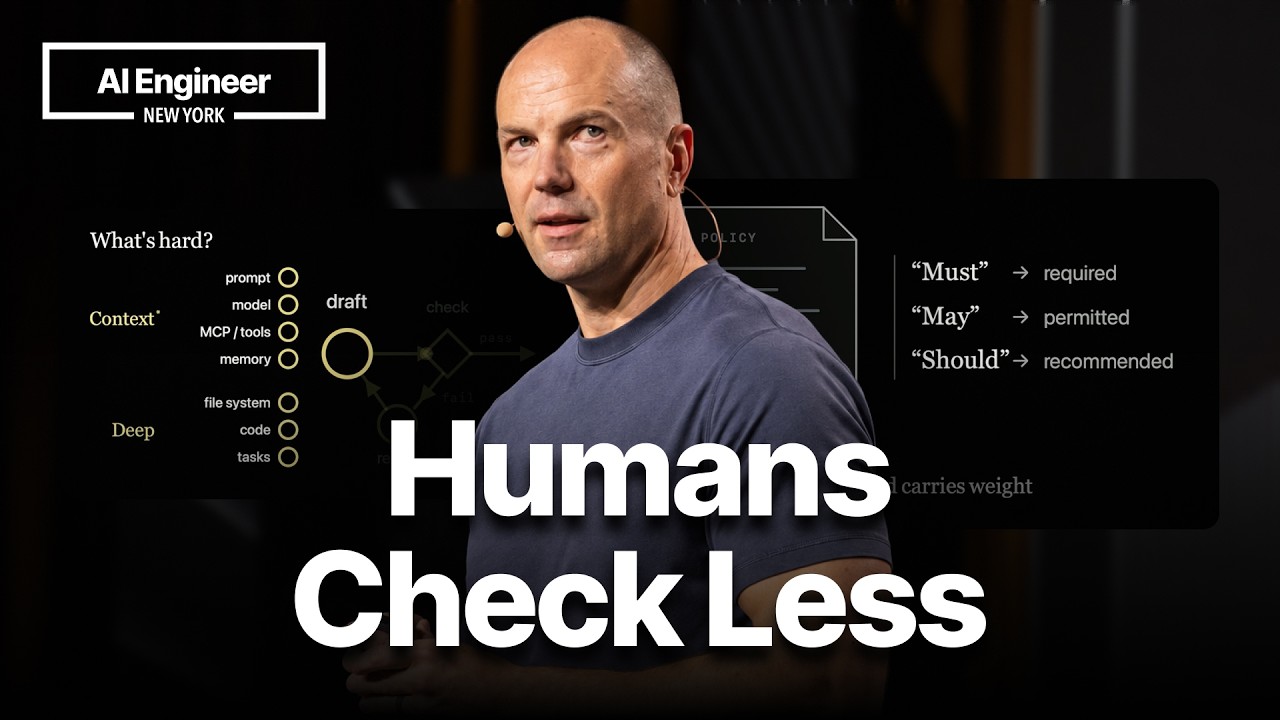
Policy defines the rules for work using language like must, may, and should.
Workflows are represented as DAGs for the outer flow and DCGs for inner agent loops.
Agent output quality is evaluated through repeated statistical analysis, not exact comparisons.
The hill climb process progresses from full supervision to sampling to exception handling.
The design recipe is to keep the outer flow deterministic and the inner flow adaptive.
Volume shifts create new bottlenecks when agents accelerate parts of a workflow.
Tools mentioned
Techniques
- Directed Acyclic Graph (DAG)
- Directed Cyclic Graph (DCG)
- policy-driven workflows
- hill climb process for unsupervised operation
- statistical evaluation of agent outputs
Stop scrolling. Start reading smarter.
Receive the day's most important AI & engineering updates in one concise email. No spam.
Transcript (captions)
Hi everyone. My name is Evan Cormos. I've been delivering, designing, building software for 20 years. The last 15 in enterprise financial services.
I am a player coach at Coinbase. And we're here today to talk about trusting agents in policy-driven workflows. So, let's start with the policy and it's
pretty boring. Um, I'm going to go over here for my notes. So, our starting point center centers around the policy and
this sets the rules for how work gets done within the organization and including especially risk and compliance. Think of policy as the original
institutional intent or the original system prompt. So, ideally we have this written down. Um, it's a little bit boring, so stick with me.
Um, using language like must, may, and should. And the again, these help define the rules and decisions about how the system operates
in the organization. Separate from policy, we have the actual running system. So, the first thing we're going to do is separate these two
uh these two both the build state and the run state in two different moments in time. So, typically we're either defining or
chaining changing our policy but this the system is constantly running and it's constantly moving and changing. So, we could then sort of imagine a
compilation event that Oops, sorry. I'm skipping ahead there. It's constantly changing. So, it's evolving quickly with these
product-driven changes. So, everything is expected to still be roughly bound by the policy, but ultimately um we separate this from the run state and the build state.
So, inside the system, what does it look like? We have a familiar model if we have any enterprise uh folks in the in the room here. Um people, process, and technology.
But, where really do agents fit into this model? Um so, I see them as an operational model cutting across all three. They work with people, execute parts of
the process themselves, and they use and are made up of technology. So, for our talk today, we're going to be focusing here where agents meet
process. What work we give them, what boundaries we set, and how we build trust in their outputs. So, let's dive into your workflow.
And it's high-level and seems basic, but if you haven't, there are good reasons to map this out. So, maybe a change has to be approved before it goes live, or a customer goes
through has to go through verification before their account is opened. We expect work to flow in a specific and gated direction. So, I believe it makes it agents make it
worth revisiting what we can do in parallel. So, previously some work used to cost too much or be too complex to coordinate in this way.
But now we can run independent reviews alongside each other, bring the results together, but keep the required checks in place. So this is a directed acyclic graph or a
DAG. It is a way to represent this workflow or process, the steps, the dependencies for a flow that moves forward without looping back on itself.
Apache Airflow, if you're familiar, is an example of open source software that represents workflows, their dependencies as DAGs in Python code.
So this Python code, this these DAGs can be used to define and manage a number of policy driven processes like, for example, commercial lending.
We could also use a DAG to represent the workflow to list a token on the exchange in a specific region, if you're into that. Or we could use a DAG to represent a
regulated flow of delivering software, which is a hot topic. And one we'll spend a little bit of time on, I think that we've seen a lot of adoption within
agents, within software delivery, and ultimately we're looking to leverage that same efficiency and scale in other areas of the business and close that the the
adoption gap. So let's stick with the software delivery example for a little bit. What happens inside one of these nodes
of the process? And I'll give you a hint, it's a loop. >> I'm oversimplified, but we have a basic version of what's happening within the Let's Let's say this is a code review
process, right? So, we're going to essentially do a number of steps and essentially once we realize the work we recognize
that the work is good enough, we're going to allow it to pass on to the next step. And that's essentially the function of the code review node. The work doesn't always uh end up okay.
So, sometimes we have to take the feedback from the code review and iterate on it um until the work is a good enough to pass. So, this is a representation of a
directed cyclic graph or DCG. So, as far as open source software, uh something like LangChain LangGraph would be what I would um
say is helpful to manage the state of DCGs. Um and this is an oversimpli- an oversimplification. These graphs can be very complex.
So, zooming back out, the inner flow um of the node, we have people and agents working together. On the outer flow, we have a policy boundary.
But not everything goes to plan. Um so, we have to handle exception flows. We don't want the work to get stuff stuck, and we don't want to design for every edge case, either.
Um the exception flows will monitor and see kind of what happens if you're shipping code that gets canceled or doesn't meet security standards, that's something you would should want to know
about. Volume shifts across the flow once we start to add agents into the mix and we've seen this with software delivery and we'll see it in other processes as
we bring agents into those processes as well where now all of a sudden if you're reviewing code faster you need to design it quicker or you need to do the security scan that's
faster. So we see the volume shift across the flow. And this is where it's really important that we have visibility into the process overall from a a metric standpoint
because as we start to supercharge and and parallelize and add more efficiency to the process we start to develop more and more bottlenecks and so the operational
visibility of the process is extremely important much more important than the authoring and the building of your workflow tool. Um so we want to visualize the process.
So we want to add parallel capacity by still keeping the controls and so this is where we'll add more additional capacity. Okay. So we're doing some work we're
checking it we're using the feedback again to refine it until the work is good enough to move on. But why is that hard? Oh it seems like a pretty easy thing to do.
But as I mentioned before these graphs get actually pretty complex and we'll dive a little bit more into why this is difficult. And if you're familiar one challenge
with AI engineering is the variability of inputs and outputs and I believe that higher quality inputs will result in better outputs at a lower compute cost.
But what are quality inputs? >> So, we would generally speak to it as context model maybe. We can nitpick that, but
this isn't our area of focus today. We're going to focus more on outputs. But, we can't really talk about quality of outputs without the quality of without talking about the quality of
inputs. So, ideally we've established a trusted context for our agent. Um and there's some references on that, but one thing we can do in this model is
inject the DAG state into our agent and let it know kind of where it fits into the bigger picture. Okay, so now we've added even long time horizon
goals and that's emphasizes the need to optimize the cost and efficiency of this loop. So, the check is where we decide whether the work is good enough to move forward.
We need to define what good looks like. That's the hard part. And we need to have a reliable way to evaluate it. Otherwise, more passes don't necessarily
uh mean better results. The loop is really only as trustworthy as the check. So, if we want to talk about quality, let's talk about the check and let's talk about quality.
Okay, um I think building with AI is an opportunity to improve product quality overall. I like some of the conversation about durable software. Um
So, I'm a believer in quality and in traditional software um we we built confidence mechanisms in place
uh to give us confidence that the software is of high quality. And that's done with a variety of uh mechanisms, but primarily systematically with test cases, unit tests,
um checking these as a part of our delivery flow to ensure that when we make code changes, mistakes aren't made that break other things, right? So, this is a confidence mechanism that we've put
in place with traditional software. The agents are probabilistic, and so the same request can produce different answers. More than one answer may be acceptable.
And we still need evidence, but exact output uh comparisons alone really aren't good enough. Uh we need to build a representative
data sets and evaluate them um and define what good looks like. We need to run uh ev- these evaluations in repeated uh
series, and this is a statistical analysis, right? Um where we actually look at the outputs uh and in volume and not just as a direct comparison.
So, in combining with evals is sort of your run time logs of what happened, or sorry, traces, uh wh- which are sort of your run time logs of what happens. Um we've built this confidence mechanism
to complement um traditional software. And ultimately, this is what we're going to be talking about a little bit more in in terms of driving confidence in the output, not only putting this mechanism
in place, but how do we begin to turn it on? So, where does the agent belong? Um back to the lending example, like we can do KYC,
financials in parallel and sequence like credit memo, risk review, documentation, decision, all these things in our our DAG. Um looking at each node, we want to ask some certain questions like how
valuable would it be to have an agent drive this node versus a human drive this node? Um and we can sort of look at some of these basic questions like can we check it against the policy easily?
Can it run in a bounded loop? Can we trace it? Can we fall back to a human? Um if we can answer yes to these type of questions, and we we can kind of have a good idea
going in that this particular node may be better suited for automation. Um but throughout the DAG, we should look to drive agent assistance. So, what we're really talking about is not whether or
not AI is involved, but whether or not AI we expect to take over at some point. On the decision, you would probably agree that we probably need that to be human-driven. This is essentially the
check against the policy. Um so, this is going to be a little bit more difficult, I think, to hill climb. But what do we mean by hill climb? All right, how do we turn this on?
So, day one, um we start supervised and as we have agents and humans working together as a part of the process, we can
um manually um verify the output to ensure that it is high high quality. Um this is where we refine our data sets and ensure that we have the right confidence mechanisms in place. We've
defined what good looks like with the domain subject matter experts and that they're beginning to verify it. When measured confidence reaches a policy threshold, we can move towards
sampling. And what that means is humans are looking at a slice of the output and not necessarily all of it. Um we begin systematic more systematic evaluation through traces
Um in order to ensure that what we're what the humans aren't seeing is still meeting the quality bar. And then finally, once we clear the confidence threshold, humans handle more
of the exceptions of the process, but still acting as participants in refining the data sets and ensuring the quality outputs. Okay, so a few takeaways from this.
Um DAG and DCG, basic graph theory, but ultimately, how do we build these processes that exist today and where people are working them
and bring agents into the mix. And the recipe really is to keep it deterministic on the outside and make it adaptive on the inside. The next is quality through evaluation.
And this is really establishing a complementary confidence mechanism. So, it's not a feeling about a model. We can actually provide research and statistics about the quality of our
agents. So, this builds confidence and inherently trusts output. Quality is a team sport. AI engineers own the pipeline
to taking product signals from all directions and deliver applications that are well built and utilize ML operations behind the scenes.
Finally, agents accelerate across the operating model. I've included some references on the final slide of things that I've spoken about today.
This concludes my presentation. Thank you very much. >> [applause]