Enjoying this issue?
Get tomorrow's AI & engineering digest in your inbox — hand-picked, summarized, and always spam-free.
TLDR
Arca, an AI-native financial services firm, says it runs client work on long-horizon agents that own outcomes end to end for roughly 10 days, reading emails, market events, and internal UI actions as signals and pulling human staff in only at decision points like plan approvals and trades. The firm draws the line between using AI tools and being AI native at the point where agents prompt people more than people prompt agents, and where new business goals can be steered by adding them to agents' goal sets. The design pattern is concrete and production-shaped, though everything here is Arca's own account of its system.
Key points
Arca's long-horizon agent work spans roughly 10 days per client goal with many hand-offs.
Background agents watch emails, documents, custodian events, and market movements as signals.
Human actions inside Arca's UI, such as rescheduling calendar events, also trigger agents.
Agents pull in specific people, like traders, only when human action is required.
Arca's thesis is that agents prompt people more than people prompt agents.
Tools mentioned
Techniques
- Signal-based event routing to interested agents
- Long-horizon agent memory persistence
- Agents pulling in humans for specific tasks
- Agent-to-agent communication
- Scheduled agent self-wakeups
- UI actions as workflow signals
- Using collected human reasoning as evaluation data
Stop scrolling. Start reading smarter.
Receive the day's most important AI & engineering updates in one concise email. No spam.
Transcript (captions)
[music] >> My name's Aman. Uh I lead AI at Arca. Um and today I'm going to talk to you about Arca's long horizon agents that run our business.
Arca is an AI native services firm. We provide our clients with financial services like financial planning, tax planning, asset management, investment advice.
Um and we serve a range of clients. Some of them are like technology executives that um have amassed a lot of wealth and need a real plan to retire early. But also that family in New Hampshire that
made their first million dollars and and want to buy that house finally. Um I said we were AI native. There's a lots of There's lots of definitions of this
this term these days, very overused. But what we mean by AI native is that agents run our business. Not that they assist the business from some co-pilot corner. They They execute
the decisions that shape the outcomes that our business has for our clients. Work in this industry, it's interesting to know what it looks like. In financial services,
the work is more long horizon and less long running. And what I mean by that is this is less agents grinding tokens for like hours or days on end, right? This is more
one client goal that spans 10 days. It's very stop-start. There's many actors in between, many decision points, many hand-offs. Um and ultimately that goal lands like
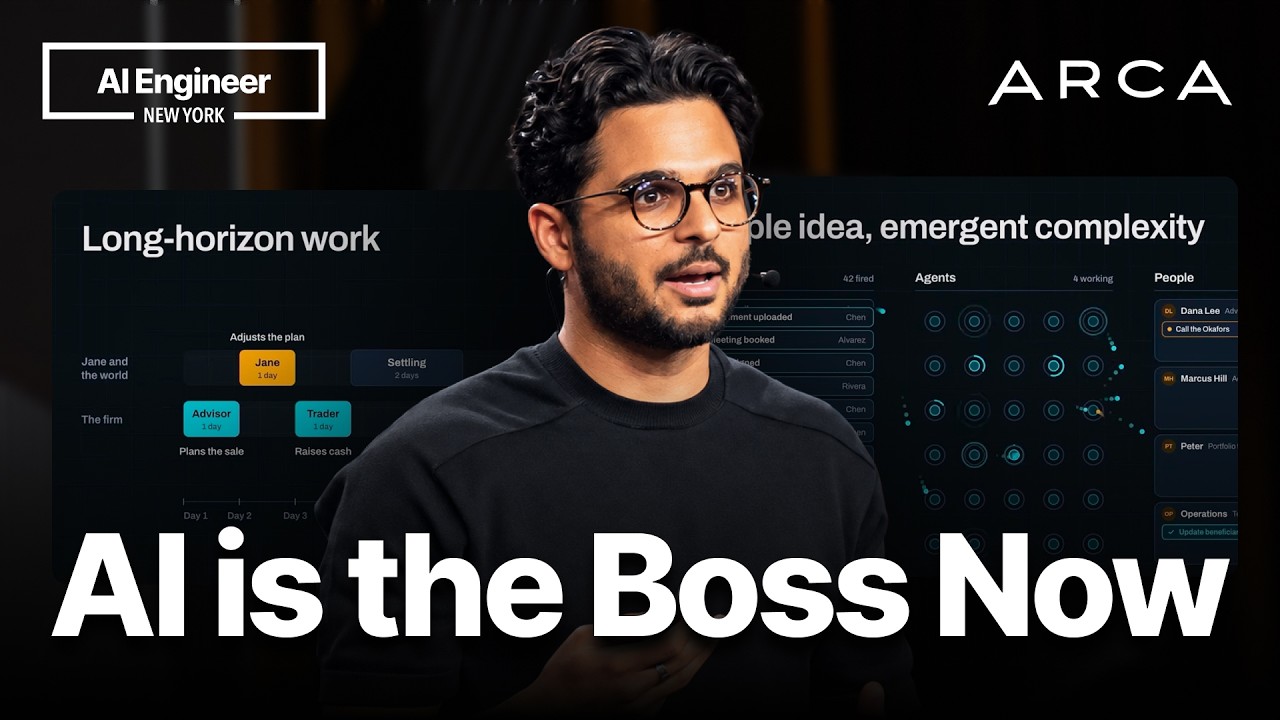
10 days later. That is the kind of work that that we're working on. And so here's an example. Jane's our client, fairly wealthy, but has a big tax bill. Oh.
Um has a big tax bill in uh in in April 15th, right? So, we're going to help Jane figure out what is the most tax optimal way for this cash to be to be raised to pay the tax
bill. So, there's the advisor that will do all of the the statement analysis and the analysis of of how to make this tax optimal.
There's the the trader that would actually liquidate the the assets. They the assets themselves will take like days to settle, and then the ops people will come in and kind of like
trigger the ACH. That will itself take days uh to land. So, this is kind of the work I'm I'm talking about in this industry, which takes like days to settle.
And of course, if you do this at scale for several several clients, the amount of time our firm takes to do this sort of work exponentiates, right? So, at Arca,
we took a different approach. It's helpful to know that Arca is not a SaaS company. We are not selling software to other businesses, to other firms. We are the
firm. We're an applied AI company that happens to be running a services business in this industry. And so, the approach we took was, all right, we're going to have agents own
this whole long horizon outcome end to end. And for that, we gave them a couple of key components, I'll give you a sneak peek of. We gave them signals from the
external world that keeps them really aware of what is happening. So, that email will be read by agents. We give them all of our operational context on what to do about that email. What does
this industry do with this situation of taxes? Right? We gave them a harness that gives them all of the tools and uh the guardrails, and more importantly,
persistence of memory over the the kind of long horizon period to carry that work out. And of course, we gave them the ability to collaborate with people.
So, that work with um with agents compresses a lot because all we did was we took humans out of the critical path of of this work. Nobody has to babysit
this this uh this goal over days. Agents are are on it. In this talk, I'd love to describe to you how we actually do that. Let's follow the journey of this email. Jane owes on the $100,000 for taxes.
This email, much like many other signals in our in our platform, will be will be read by background agents. So, there's like phone calls our firm is making, there's documents that are coming in,
there's meetings being had, there's events coming in from our custodian, there's market movement that's happening. These are all signals that our background agents are continuously
evaluating to progress work. So, this email is one of those signals. And when the signal is is by agents, they actually get to the work, right?
Um we have a harness that gives them the knowledge to know what to do about the situation. They have deep client memory, so they know, "Hey, let's never touch
Jane's Apple position cuz uh she said that in a call like 8 months ago, right?" Um we of course have a sandbox for all of the financial computation that needs to happen for this analysis.
Um but largely, I think harnesses today are are coalescing on a standard shape. So, um it's more interesting what happens outside of outside of this harness.
So, after they've done the work, they produce this plan. This plan by itself cannot be executed without people. So, in our product, we build a space, agents build a space,
where they put out this plan, and there's you can chat with the agent to like kind of know what's happening with the plan. There's mult- multiple people that can be chatting with the agent. And
more importantly, this space is where also they pull people in when they need people to execute some work. So here in this case, we would approve uh the plan and the email out to Jane.
And then there's this whole dance of has Jane replied? What does her What does her answer mean for the plan that we had, right? And then all of the these other questions
that will have to be answered throughout this whole like long horizon work. At Arca, we were like, of course we're not going to have people babysitting it. So we let our
agents watch the world. So people don't have to, right? So we give them tools to be able to register interest in anything happening in our world. So they're able to say, let me
know when Jane responds. Let me know when that ACH lands. Right? And this is powered by our signal system in the in the background where agents are routing
uh signals to agents that are interested in it. And of course, if the signal never lands, agents can like wake themselves up on on
a schedule as well to keep track of work. But then, of course, the real world is very messy, right? People are waiting for that email, but
Jane never responds to that email. Say we we meet her in person and we learn some information that affects the plan. So the person goes in and they they add
this information into our UI. But this act of adding information or doing work in our UI is also a signal that will wake up an agent. In fact, when
people work in our in our product, when they reschedule a calendar event, you know, that's a signal. When they mark a task complete, that is a signal.
So this system lets us be both aware of everything happening in the external world and the internal world as work is progressing so our agents can participate in work.
And of course, agents are communicating with each other as well. So, this signal read by a background agent will let it notify another agent about this so that it can update the space to say, "Hey, we
just need a need $80,000 instead of the $100,000." So, the work has changed because of because of these signals. And the last piece of the story is that agents are able to pull in the right
people at the right time. So, uh the agent on the left has read our operational context to be like, "Okay, this the next step here is to pull in
the the person that trades these uh these assets." And so, that person now gets a task and gets pulled in to participate in this long-horizon work. What we've done overall, if you take a
step back, is we've given our agents the primitives for driving long-horizon work. What do people do at work, right? They They need to stay aware of what is happening, so
we've built this very intense like signal system for our agents to be aware. They need to know what to do next, so we've given them all of this operational
context. They need to do the work, so it's our harness that lets them actually perform the work and keep track of it, right? It's long-persistence
um memory systems that that hold the state. And bringing in the right people at the right time. This is a pretty simple idea on the face
of it, but there's a lot of emergent complexity. You can imagine at any point there is hundreds of these signals coming in, and they are, you know, tasks tasks are
being added on people's plates, they're being pulled in, background agents are communicating with each other, right? So, over the last 6 months, we've we've been working on getting this system to
be really good. We've been closing all of our context gaps so that agents are fully aware. We have been working on the precision of
tasks, so pulling in the right person at the right time. Work that needs to be tracked for the future is tracked in the agent's memory. Work that is doable now becomes a task,
right? So, we've been working on on our ability to hold state over long horizons as well. And because we are the firm and not just a SaaS company,
we've been changing and standardizing how work happens in the firm in the first place and operationalizing that context into our agent's state.
And because these are our colleagues that use our product, we collect rich reasonings from them that become evals for for our system to improve. So, I guess there's there's a question
to be asked here, like why do this, right? What does this unlock? What is the takeaway here, right? For for us, this is our whole thesis. Is that we want our platform to be so AI
native that agents drive the business. Agents run the business. They they are making the decisions that shape our outcomes. And so, at Arca,
when people log in, right, they see a list of tasks that have been prepared for them by agents. They've already read that email. They've like looked at the document that came
in. They've done like 90% of the work and they're pulling you in just when it's time for you to act. So, building this system lets us get to a point where at Arca,
agents prompt people more than people are prompting agents, which lets our agents drive the work that our our firm does. And because agents are driving the work
the firm does, agents can drive the business. Let me give you an example. Remember that email that Jane sent us? This is a bit of a failure, right?
Because we should have just been proactive about this in the first place, right? So, Jane should never have to send this email. So, say at
you know, our AI native business, we take on this new goal. Our new goal is proactivity. Every January, prepare each client's tax situation and proactively reach out to
them before anyone even asks. This is a new business goal for our business to drive. And in an AI native firm, all we have to do is make this
goal part of our agents' set of goals. And because they have the primitives to be able to drive work through people for the business, they start driving this goal, and just like
that, you have you have these analyses being done in January, and these these one-click approval emails with the full plan for every client showing up on our users'
plates. And because they're aligned with the goal of proactivity, they can one-click approve and drive the business towards this this new outcome.
So, this is sort of I think the key difference between a a company that uses AI tools versus a a company that is AI native.
In an AI native company, you know you've built one when you can steer your business by steering your agents. And that is our ambition at at Arca, and
we are we're hiring. Um so, please uh please check out our website. Please reach out to me if this is something that you you're you're interested in working on these sorts of
problems. And um thank you for listening. >> [applause]