Enjoying this issue?
Get tomorrow's AI & engineering digest in your inbox — hand-picked, summarized, and always spam-free.
TLDR
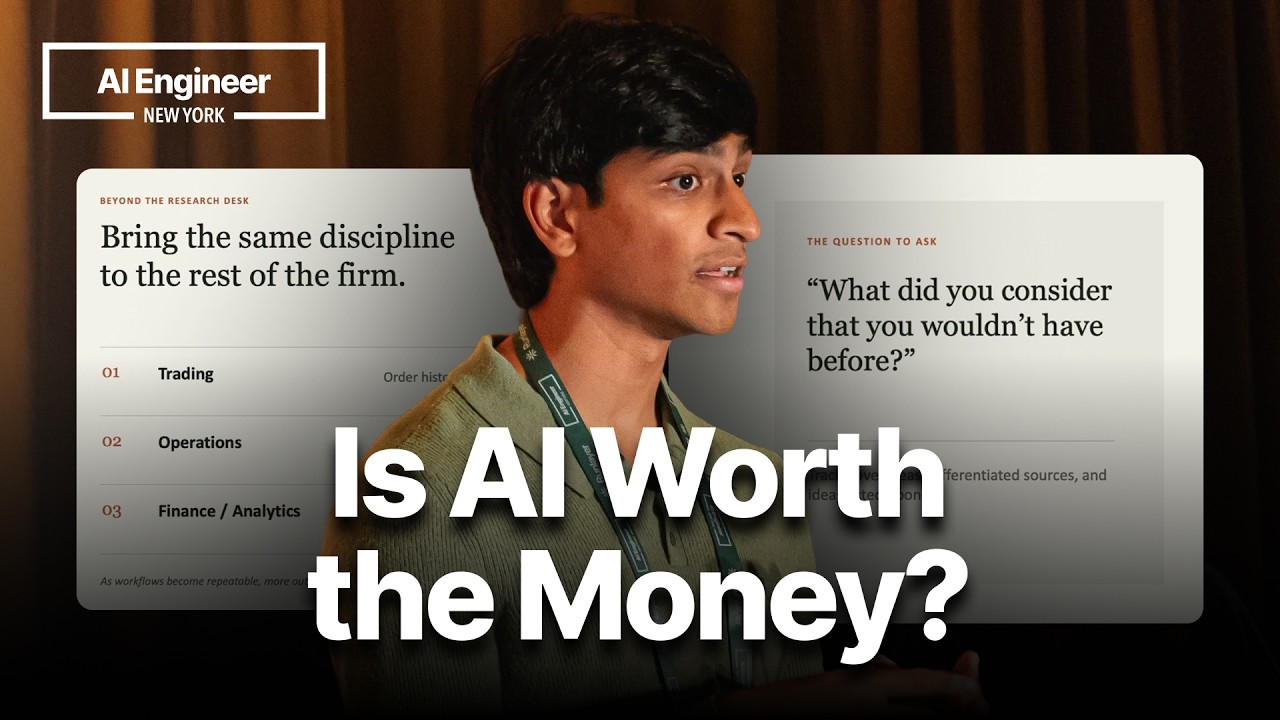
Contour Asset Management measures AI's ROI in its fundamental research process through live A/B tests comparing analyst workflows with and without AI tools, tracking a metric called 'cost per useful insight' to quantify time spent versus idea generation quality. The approach acknowledges that P&L impact takes months to materialize, so the immediate focus is on process improvement and freeing up analyst time.
Key points
Contour runs live A/B tests comparing analyst workflows with and without AI over a three-month earnings cycle.
They track a 'cost per useful insight' metric by measuring analyst time spent per day and eventual P&L outcomes.
AI agents monitor abandoned ideas and alert analysts and PMs when market timing becomes favorable again.
Alternative data sources like credit card panels and expert call transcripts are integrated via MCP/APIs into a unified platform.
Hari notes that AI adoption incurs hidden costs from debugging broken connectors and model calls, which should be included in ROI calculations.
Tools mentioned
Techniques
- A/B testing for research workflows
- cost per useful insight metric
- agent-based idea timing tracking
- alternative data integration via MCP/APIs
- unified compliance and operations platform
Stop scrolling. Start reading smarter.
Receive the day's most important AI & engineering updates in one concise email. No spam.
Transcript (captions)
[music] >> My name is Harry. Um, I am the head of AI at Contour Asset Management, which is a hedge fund based in the city. It's been around for a little over a decade
now, um, but I've been here for the past year-ish. Um, we're a fundamental long short shop, um, around like 15 20 people, 6 billion AUM.
Um, and mostly [snorts] invest in the TMT space. Um, so a lot of our investors are pretty tech forward by nature, but want to
bring a little bit more, um, AI workflow into the investment firm itself and see, okay, we've had all these processes done for many years in a very similar way. How can we kind of
shake things up and use AI to our advantage, especially when it comes to the research process, but then also bring that into trading, operations, compliance,
finance, pretty much all parts of the firm. So, came in in the past year and basically my mandate was, how can I show impact across all areas of the firm,
largely starting with this research process, right? And as probably all of you guys in this room can understand and appreciate, it's a really big challenge to show,
hey, we're spending this amount of money and time on AI spend and impact. What are we actually gaining from it? Both from a P&L standpoint, which is to come,
um, but also just from a more operational and are we getting good ideas perspective, too. The ROI capture from our investment is a
really big challenge to understand and capture, but I want to talk a little bit about some of the ways at in the investing landscape we're able to start to think about hey, we've put in this
amount of money into our AI spend, what are we getting out of it? Cool. So, a few things that we are thinking about
here and intentionally trying to keep this a little bit vague and more in terms of the operational and process parts of it, but down to dive into any technical stuff either at the end of the
session or afterwards as well. So, what we're trying to do is basically bring out live AB tests for some of the research workflows that our analysts
have. So, we have around 10 analysts that each cover different parts of our coverage, right? Which is how it works at a lot of these um hedge funds, especially on the smaller
side, where you have maybe one person that covers 30 to 40 names. And they've had their uh existing processes in terms of how they think about their investment
thesis, how they actually come up with new ideas, and then validate and test out over the long term whether those ideas actually came to fruition. But now in a AI and more agentic world
when it comes to investing, the challenge is would you have come to the same type of conclusion with the AI tools or without the AI tools as well? And a process that we've done in the
past few months that I think has been pretty successful has been actually creating live AB tests by recording and documenting their entire process that they would have done in a pre-AI world
and how they're doing it as we roll out more workflows and tools in the company itself. So, for example, what we did is for one specific name
when it came to our three-month cycle. So, from one earnings report to the following one, we tracked if they didn't use any AI tools. And this is at first just hey, if
you're not using any LLMs, what does your workflow look like? But then, as we've introduced more um tools at the hedge fund itself, like okay, you have some tools that help you
do expert call interviews better, or ones that help you field a consumer survey that's done by an agent instead of a human. What are your takeaways without things
like that? And then we're documenting, okay, you've done this process without AI, but also without these additional tech workflows that we're building out. What are the
data sources that you're finding? And what are the conclusions you're coming out with? Then we run that same process involving our PM
including some of these AI tools. And we're building them one by one with different things that we're coming at with, right? So, for example, when it comes to expert call interviews, one
thing that's been pretty helpful is you have expert calls that are run with an agent, and then you synthesize the notes yourself. How does that process work when you do
it with an agent work versus if you have the agent synthesize the notes for you, and then you come up with your conclusions at the very end of it, right?
So, it's kind of thinking about the question of how long would it have taken to source some of this information manually versus if you were able to do it in a
more agentic manner. This This is definitely a big challenge when it comes to the investing landscape because a lot of the work that we're doing is just based off of idea
generation. So, you're coming up with the new ideas and new theses, and you want to see, okay, can they be proven out in a short-term scale, which is a little less
of what we do, but at least in like the 3-month window, or are they things that take 6 months or a year to manifest in terms of an actual um impact to stock price, right?
So, the challenge with something like this is you can't show ROI immediately. It's more so from a process-based manner, right? So, are we improving the
process of how we're conducting consumer surveys? Are we improving the process of how we're updating our models? And one by one, we're trying to bring out a little bit more of um
uh ROI measurement when it comes to okay, are we actually changing the way someone's working or we just adding more thrust to their process? So, talked a little bit about these use
cases, but maybe just to touch a little bit more on them. The main goal when it comes to um fundamental investing is thinking of a thesis, but also as I've
learned, it's to not be so anchored to a thesis that you come up with initially and actually trusting some of the data, but also the expert and other insights that you're getting to
remove some of those anchors as well, right? And this is where I think that there's a lot of impact measurement when it comes to AI tooling that can be built. So,
example, um we have manual idea generation agents that are being run to take different ideas that are being come up with per name per analyst and adding more layers in terms of okay,
you've come up with a few different data points from different alternative data sets or you've talked to an expert in the industry to formulate some of that idea.
Let's layer on a few more conclusions or parts of the process to think about when it comes to how are you actually how are you actually understanding what
that idea is going to materialize in the next few months or if it's something that it takes even longer to take to take into account into the market. Additionally, we're
thinking a little bit more as to one of the biggest problems that we're seeing is you take an idea or you have an idea, you might work on it for a couple of days, and then that idea might
not be interesting to the PM or something else takes precedence, and you lose that idea. And it doesn't come back for months, and then maybe you miss like a key price window.
So, having agents that are also tracking through all of the notes that you've been taking, even if you only worked on an idea for a day, tracking it against the market and
trying to see, "Okay, is this now an idea that's interesting, and should we flash that as a point to not just you, but the PM and the trader as well?" And bringing out more quick work when it
comes to you've had a bunch of different things you've worked on, and maybe it's been weeks since you've looked at it. Now, let's get back to it because it's interesting again, right? I think that's
a big problem that a lot of hedge funds have had, where you have a bunch of different things that you can be working on, you have to prioritize, but the timing is actually the most important
thing as to when you want to strike when it comes to an interesting point in the market, right? So, building agents that are not only doing idea a generation, but thinking about timing and when you
should enter exit a position, even if it's not something that has been top of mind for you, is something that we've been really thinking about as well. Um and I guess the last point that I
want to make here, thinking a little bit more about the alternative data options when it comes to investing workflows, right? A lot of funds spend quite a good sum of
money when it comes to acquiring really new and novel data sets, right? And I think in this age, there's a bunch of different providers that are coming out with very nuanced solutions, even when
it comes to things like satellite mapping or really granular credit card data. Those things are helpful, but they're only helpful when they're all brought
together, right? So, if you think about something like a Yipit, which provides credit card panel data, that lives in isolation, but now with MTP and API access for things like Gipit, you can
feed it into our agents, which is kind of what we've done. So, it takes into account things like your expert call or notes transcripts, but also layers in different data sets when it comes to
credit card panels or spend data to see how those two things interact. Where before those have been differentiated, now we're trying to curb that issue as well.
Additionally, I think a challenge with measuring ROI is the time aspect of it. So, you spend a lot of money when it comes to acquiring some of this tooling when it comes to
research, model updates, AI spend. But, there's a lot of time when it comes to what is an analyst spending their day on, which is the main thing that we're thinking about, right?
So, what we've also done here, which I think has been pretty useful, is develop metrics when it comes to hey, these are the insights that have been generated by an analyst per day.
What was the time spent on that? So, tracking time spent on each name. And what were the eventual P&L outcomes from some from a decision like that?
That is something that is good in investing landscape because you have a very very obvious success metric when it comes to P&L. But, it takes a lot longer than other
industries to actually materialize, especially from a more fundamental shop, where you're not trading by the day, but you're making a few trades a day that are expected to materialize over
months-long horizons, right? So, understanding where analyst time goes is really valuable. And tracking things like a cost per useful insight, which is the metric that we've come up
with, really helps us understand, okay, you spent your time to generate these ideas, and those are all being tracked per day. Where do those ideas eventually land?
What were the interesting ones? And what were the tools that were taken to come up with an idea like that? So, that largely touches on the research side of workflows when it comes to
measuring um our ROI from not just AI spend, but general tech investment. But, we want to also improve this across the entire firm, right? It's
really important to make sure that we do quality research. That is how you get ahead. But, if you have better and more involved trading, as well as stronger ops and finance, that just helps the
firm at large to free up time to improve processes, right? So, for example, on the trading side of things, we're doing a lot more when it comes to measuring our entry and exit
times. Thinking about how our position is spread across multiple different industries and multiple names within an industry. And having AI agents track those names to make sure that our
traders are on top of it and understand, okay, these are interesting insights. So, bring them much more into the analyst world because their time should not just be spent on
executing orders. It should also be spent on bringing idea generation, feeding ideas to our analysts and associates as well. Additionally, on the op side,
this is something that I think a lot of um general companies can appreciate, but it's been pretty interesting to see it from a hedge fund landscape. Many of the
workflows that are being done are basically set within Bloomberg or set within your um order keeping agent. And those, while they've come up with some cool AI tools
to help improve the process, it's really challenging to integrate those together, which is something that we're starting to do here. So, how can you take all parts of the ops and
compliance workflow and marry them into one one specific tool that our ops and compliance um functions can use. So, they're not just
reliant on external providers to give them piecemeal solutions to hey, this is how you can do order reconciliation, or this is how you can uh track vendor info.
The goal that we're trying to create here is obviously minimize repetitive work. That's what everyone here is thinking about. But, specifically from financial operations, that is something
that can really be consolidated into one platform. Where right now you have to kind of go into many different platforms for different pieces of the order flow. So, bring those all
into one is um is a pretty big priority for us. And I think not necessarily to the point of this talk, a way to really capture ROI, but to understand how can you take
people who are working in trading and ops right now, and use their skills to improve the main goal of the fund, which should be to create create new ideas, understand the market, and focus on
timing. Okay. The the last piece that I want to talk about here is thinking a little bit about the existing spend that we have um when it comes to different data sources
that we're working with, and how we can kind of up-level that when it comes to hedge fund workflows. So, right now a lot of hedge funds will spend on
either they're spending on different piecemeal solutions like an AlphaSense for for data, a Yipit for alt data, or they're spending with um uh
holistic solutions that use um third party. So, something like buying a Roqoo membership, or investing in like Kensho, right? Those are really great solutions, and I think the the
goal of this eventually that we're trying to build in house, is how can you kind of bring all these tools that different analysts use at a hedge fund into one platform, but also up level the
spend that we have right now. So, for example, with an existing, let's say, AlphaSense subscription, which is a big um model and call plus data provider.
Before, a lot of analysts will just use the AlphaSense portal and pull from there and work within their existing models. Things like Rogo will kind of take that
one step further by allowing you to have all that data within your model itself, and you can have a platform that you chat with Rogo agents for. What we're trying to do is still use
things like an AlphaSense or Yipit tool, but bring them into our own platform internally that learns from our analysts analyst habits and is programmed specifically for each individual analyst
and their model pattern, so it's not all as one. And how can you increase the value of your subscription? A lot of these companies, obviously, are having like
MCPs and APIs that are being pulled out, but the goal should be to learn continuously from all of the different types of data and the model updates that we're getting from this as well.
And then, to wrap up here, I think the the last point of the ROI equation, too, has been a pretty interesting one on my end when it comes to, "Okay, you're bringing in new tooling to people who
are very tech forward for investors, but you understand that there are going to be places where this breaks down, where model calls break or the connector breaks down every couple days, and then
it's your job to fix it, right?" So, part of the ROI equation that we've been taking into account at Contour is trying to understand, "Okay, there are these pauses that we're
getting, but also what is the time that that being taken away trying to fix bugs, that someone from the tech side cannot fix itself, right? So, that's something that I think is pretty
important to consider when it comes to, "Hey, we're involving AI in investing workflows." It's all really exciting, and people are very into the concept of it, but we also need
to understand, okay, when it comes to time spent for, let's say, valuable insight, what is the time detracted to understand how these tools work as well. And that's something where that time is
decreasing as we go forward, but it's a metric that we're still considering. Um so, I think to wrap up, in investing workflows, measuring ROIs definitely a huge challenge for us, but
it's really important to be involved in this space because as AI adoption increases, especially at a lot of these smaller fundamental shops, having one unified layer that's doing a lot of
different tasks across analysts is going to be really, really valuable. Um I think that's all the time I have, but if anyone has any questions after the talk, would love to connect. Thank you.