Enjoying this issue?
Get tomorrow's AI & engineering digest in your inbox — hand-picked, summarized, and always spam-free.
TLDR
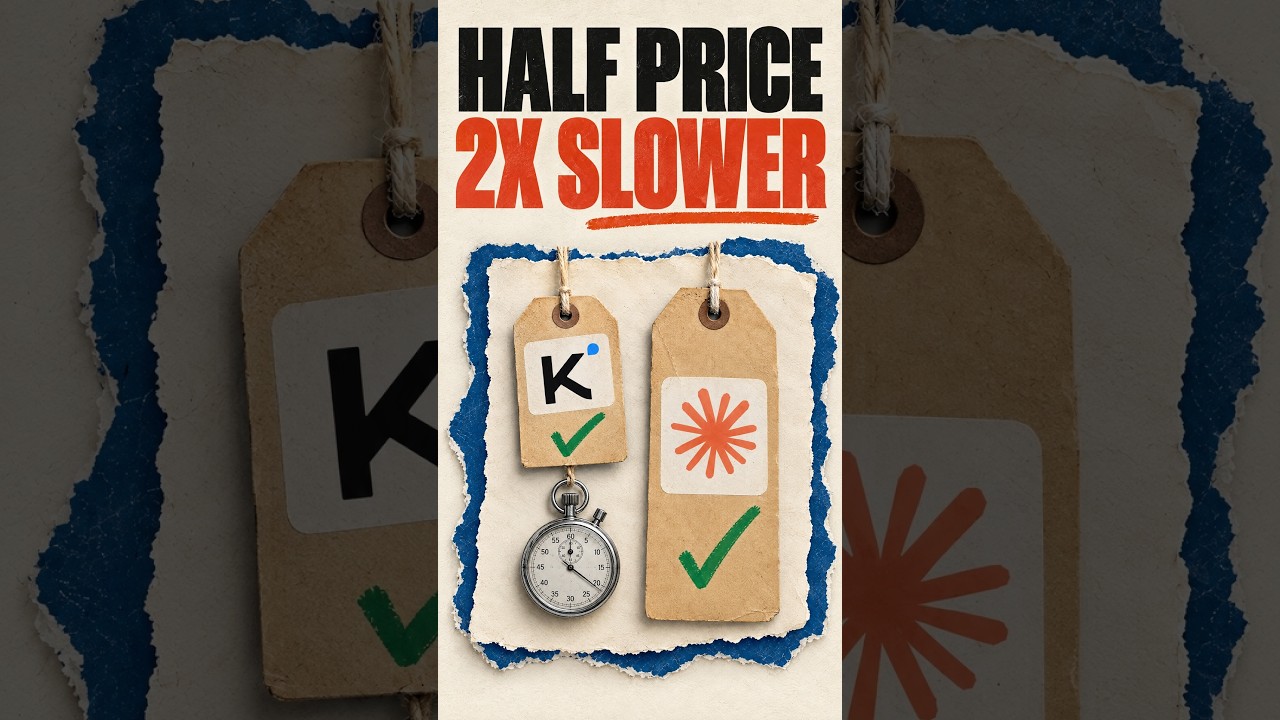
Kimi K3.1 Pro matches Claude Opus 5.5 on a code-fixing benchmark at roughly half the cost on low-effort settings, though it takes twice as long. The cost difference disappears on max-effort runs, and Kimi's efficiency comes from a 2.8 trillion parameter MoE model that activates only ~104B parameters per token. For agentic coding tasks where latency is not critical, Kimi offers a meaningful cost advantage, but speed-sensitive users should stay with Opus.
Key points
Kimi K3.1 Pro passed the same hidden tests as Claude Opus 5.5 on a Python bug-fixing task.
On low effort, Kimi cost about half of Opus but took twice as long to complete the task.
On max effort, the price gap between the two models disappeared.
Kimi uses a Mixture of Experts architecture with 2.8 trillion parameters but activates only ~104B per token.
Moonshot has committed to open-sourcing Kimi K3 weights by November 4th.
Techniques
- Mixture of Experts
- router-based expert selection
Stop scrolling. Start reading smarter.
Receive the day's most important AI & engineering updates in one concise email. No spam.
Transcript (captions)
Kimi K3 one pro did the same coding job as Claude Opus 5.5 for about half the price and both passed every hidden test. The half is my math from Atomic Agents per task costs. So how does it get that
cheap and what do you give up for it? Naja Dudka and Andrew Daishov at A atomic agent gave both models the same Python package with planted bugs, missing features and hidden tests and
ran each one repeatedly. Same result in every run on low effort. Ki was the cheap one, but took about twice as long, and on max effort, the price gap disappeared. It's one small task, so it
won't settle every coding job. Half the price sounds like a smaller model. Moonshot's K3 model card says otherwise, 2.8 trillion parameters in K3. One pro is reported to be the same size.
What keeps each token cheap to run is how little of that size it uses at once. For every token, a router wakes a small group of experts and leaves the rest alone. Picture a hall with 896 desks. A
token walks in, 16 lamps switch on, plus a couple that never switch off, and those desks do its math. The next token lights a different set. The picture breaks here. The desks are just blocks
of weights, not specialists. Apart from the always on ones, the router picks them fresh for every token. Moonshot's K3 technical report says about 104 billion parameters work on each token.
So Kim keeps its full size but does a much smaller model's math per token. Opus' size isn't in any of these sources. So this explains Kim's side of the gap, not Opus'. And nothing here
explains why KI slower. Atomic Agent counted the model calls on max effort. Call it four times as many as Opus. And the open weight part, you can't download it yet. Moonshot says the weights are
due by November 4th. For now, it's Kim's own apps and API. Until then, the open part is a date on a calendar. Atomic Agents Verdict is the one I'd give for agent jobs where waiting's fine. Run
Kimmy on low effort and pocket the difference. If speed matters, stay on Opus. Whether that half price holds up on your own code is your next test.