Enjoying this issue?
Get tomorrow's AI & engineering digest in your inbox — hand-picked, summarized, and always spam-free.
TLDR
Four Claude-based automation systems have been built and sold by community members for prices ranging from $2,000 to $15,000. The most lucrative and in-demand system is a 'company brain' that connects a business's tools and knowledge, sold by one member for $15,000 (17 sales) and another for $2,000 (30 for one client). The key to selling these systems is pitching business outcomes like time savings, risk reduction, and revenue growth rather than technical features.
Key points
Jodie built a voice note to document system for a construction company and charged £4,500 (≈$6,000).
Luis built an intake and follow-up funnel for a semi-retired doctor, charging $2,200 and saving 15 hours weekly.
Charles built a creator OS using cloned voice and likeness, charging $3,600 plus $197/month retainer.
Janette and Kieran both sell company brain systems, with Janette charging $15,000 (17 sales) and Kieran $2,000.
The speaker advises pitching business outcomes like time and risk savings, not technical features.
Tools mentioned
Techniques
- voice-to-text transcription
- automation
- CRM integration
- voice cloning
- content generation
- AI-powered knowledge base
Stop scrolling. Start reading smarter.
Receive the day's most important AI & engineering updates in one concise email. No spam.
Transcript (captions)
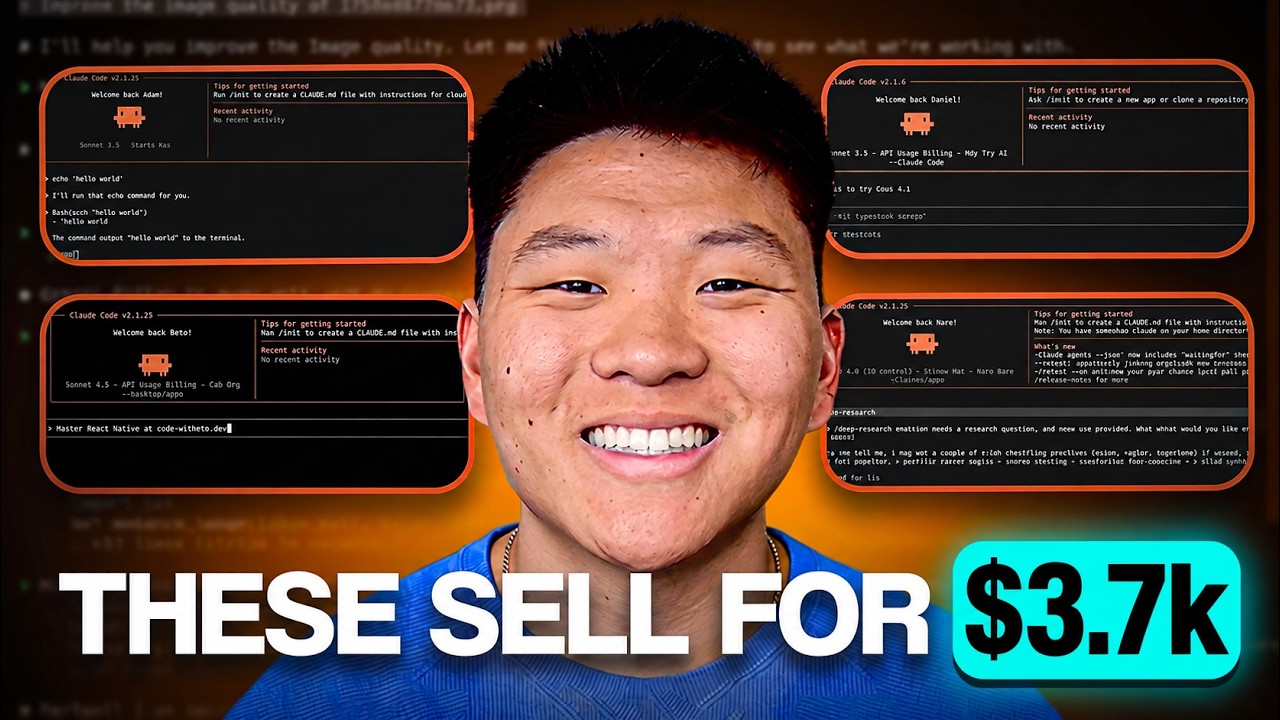
So, these four cloud systems can be sold for around $3,700. And they're all things that anyone who knows the basics of cloud can build and sell. Now, I know this because these
four systems were built and sold by members of my own community. So, I know that anyone can do the same. That's why today I'm going to show you what each system is, why people will pay for them,
and how you can sell them yourself. Now, make sure you stick to the end of the video because the last one that I go through sold for the most money, and I think that it has the highest demand
right now. All right, so the first system is a voice note to document system, and it's the simplest one to build. Basically, someone in the field sends a voice note, and it comes back as
a finished branded document. Jodie built this for a construction company. Their foremen basically have to fill out site registers, risk assessments, and plant registers, but nobody wants to actually
type all of that stuff up after a long day on site. So, the paperwork was always just days behind. But now, after the system has been implemented, the foreman just sends a voice note on
WhatsApp, and then it gets transcribed, it gets matched to the job record for that project, and it gets turned into a branded PDF that's saved automatically to the company's SharePoint, and sent to
whoever needs it. Now, everything obviously here starts with the draft, so a person still reviews and signs it off, but Jodie was able to charge £4,500 for this, which is around $6,000. When you
want to pitch something like this, you have to lead with the time and the risk. You ask the owner how many hours a week their foremen are spending on paperwork. If five foremen each spend five hours,
that's 25 paid hours a week that's going into typing that can be automated, and you can put a real dollar figure on that number. And then you can also point out that the paperwork just sitting days
behind the work is a real safety and compliance risk. Now, against those two things, £4,500 or $6,000 is very easy to justify for a business owner. And nobody has to learn anything new in the process
because everyone already knows how to send a voice note, and everyone already knows the content that would go into one of these branded documents. Because when you're communicating this type of stuff
to a stakeholder or business owner, you have to think about the hidden costs. Meaning, the cost of business isn't just how much they have to pay. There's also things to think about like time cost,
the risk, change management, things like that that actually matter to a business owner. So, to sell something like this, pick a trade where people aren't sitting at a desk all day. Something like
construction or plumbing or electrical. Ask the owner which document their team hates filling out the most, and you can build the automation for just that one. Once it works for that one, then maybe
add in the next document and keep automating a lot of this repetitive manual work. Okay, so system two is an intake and follow-up funnel. It basically takes a lead from a social
post to a paid booked call without the owner having to chase anyone down. So, this one kind of has two parts. The first one writes social posts from multiple platforms every week in the
owner's voice. The second one then kicks in when someone fills out an interest form from one of those posts. So, you're kind of helping them generate the lead and then turn that lead into a booked
appointment. So, they go into the CRM and they get a text and an email with a payment link. Once they pay, the intake form and the waivers go out with reminders until they're actually signed,
and then they get a booking link with a Zoom confirmation and of course follow-up reminders. So, Luis from my community built this for a semi-retired doctor who didn't want to hire a
marketing team or a whole front desk staff. So, he charged $2,200 for this, and it saved the client about 15 hours a week, and the client hired him again for another $6,000. Now, this is one of the
easiest to pitch because it ties directly to revenue. You know, ask how many people filled out a form last month and how many people actually paid. If 40 people filled it out, but only 10 people
paid, then this system can go after, you know, the other 30. And the few extra clients a month can cover that entire fee that they paid up front for this project. Now, this video right here
isn't a deep dive into pricing. It's more about the systems that people are selling and the positioning. If you guys want to check out a full video where I break down the way that I do value-based
pricing, then I'll tag that right up here so you can check that out. But anyways, for something like this, for this type of system, I would look for three things when I'm looking to find a
buyer. The first one is I would look for a business that runs on bookings. The second one is I would look for a business where their leads come in through a form or a phone call, and then
they just kind of sit there and there's not a lot of follow-up. And then the third thing is that the owner is actually chasing people manually right now, or someone on the team is manually
chasing people. And if all three of those things are true, then they probably need an automation like this. So, then what you would do is you would map their flow from first contact to
booked call >> [music] >> on one page, and then you would mark which steps inside of that process need a human, and then you can automate the
rest in between. And then you can basically just record a short demo and send it out. Now, Upwork is a really good place to look for work and to find clients, and that is where Lewis found
this client in this example. By the way, guys, I've got this completely free SOP for you about getting your first AI automation client. It's going to go over the exact steps that has been proven for
hundreds of our AI S+ members to get their first paid gigs. It goes over the one-sentence service pitch that can get you started today, why your first client should cost you money, the five-minute
video that answers can this person actually deliver before you've actually received any money, what to do when you have zero case studies. There's so many good things in here that are going to
help you out. Even if you already do have clients, I would recommend grabbing this because like I said, it's yours completely free. So, if you want to grab this, there's a link for it down in the
description. Let's get back to the video. All right. Now, system number three is pretty cool. It's a creator OS. It's kind of similar to that first piece of system two that we just talked about.
So, this one makes content in the creator's own voice and likeness, and it's one that can easily, very easily turn into monthly recurring revenue. Charles, another member of my community,
built this for a woman who teaches women in their 50s digital and affiliate marketing. She was making all of the content by hand, but she just couldn't keep up. So, her system that she got
uses her cloned voice and her likeness to make narrated videos and on-brand images without her filming or writing basically anything. Charles also came in here, over-delivered, built her a
six-page site, a print-on-demand store, a 101-page guide that she sells for about 200 bucks. Also, a nine-email nurture sequence, SEO for 12 pages, and a lead capture quiz. So, he definitely
over-delivered here. He charged about $3,600 for this project, and then she asked basically for him to get on a monthly retainer before he even offered one. So, he gets 197 bucks a month on
top. So, the way that I would pitch this one would be on growth. You know, all of these were obviously looking to pitch some sort of business outcome, not the functionality or the technical
requirements of the build. Creators and business owners already know that more content typically means more attention, which typically means more leads, and more leads means more sales, and that
obviously is what businesses want. So, show them how much more they could put out, and then do the math on their actual product or service. So, for example, with a $197 guide, she only
needs about 19 extra sales on those guides to cover the $3,600 fee that she paid up front. And since she needs new content every single week, the monthly fee is easy to justify, as well,
especially if it's actually working. So, to sell something like this, pick a creator or a coach who already sells something and already has [music] a back-end that is proven. Take 20 to 30
of their posts, build a voice profile, write three pieces in their voice, and then send them over something like, "Hey, you know, I built this for you. It's kind of a creator OS. Here are
three pieces that it wrote. Tell me what you think." If they like it, then offer to run one platform for a month, and then sell them the full build and a monthly fee. All right, so system number
four is a company brain. Super cool. And like I said at the start, these automations, at least in this bunch, are selling for the most money and has >> [music]
>> insanely high demand. It's an AI that knows everything that a business knows. It's kind of like your own personal AI OS, but it's more for your business. It's for your company. Like their
documents, processes, client history. So, anyone on the team can ask it a question and get an accurate, real-time answer. So, you could have one that connects tons of different tools, like
Drive, Calendar, Gmail, Asana, HubSpot. It can send daily briefings. It can write project recaps. It can file every single meeting transcript into the right folder. It can organize that kind of
stuff. Every business has this problem, and it's just going to continue growing as every person on the team is building their own sort of like personal agents and personal AI OS's. Because answers
are so spread across people's heads, and things are lost in Slack channels, and there's a bunch of documents. So, when you pitch something like this, lead with the hours the team loses when they're
looking for things. Ask how much time people spend searching for information or waiting for someone else to answer. If a 20-person team each loses two hours a week, that's 40 hours a week of
payroll. And then you can also say that new hires that get brought into the system are going to get up to speed faster because of the system. And I actually saw this study where they said
about 50% of employees' times, especially as the organization size grows, is spent doing the scavenger hunt. Essentially, thinking, "Oh, you know, I remember someone sent me that
doc, but where is it?" Or oh, I remember someone said that to me, but is it was that an email or Slack or where was it? And this type of offer is very sticky because once a business actually learns
to efficiently rely on something like this, they're not going to be able to turn it off. But there is also one of the other costs that we talked about, hidden cost of change management. It
does kind of take a team a while to get up skilled into this and to be able to actually make that culture shift of reaching for this first rather than just doing it the old way, which is exactly
what it means to become AI native, which is what I talk about in my book, which is right up here. Anyways, on your end, you can build this once and then you can basically reuse that system for every
client because you figure out how to organize stuff. So, you can build one for yourself first so that you have a real demo and you can actually be your own living proof of the value of it. And
then you can pick one type of business. So, you can find their questions that their team asks every week and you can connect only the tools that they actually need where those answers live.
You could add in other things on top of this, right? Like a daily briefing or different Claude code routines or whatever it is, you can add things on top of it now that the context is
already there and it's real time. But anyways, two members of my community sell this in different ways. Janette charges $15,000 and has sold 17 of these on the same foundation. She then adds
role-based dashboards or document generators and tools that run on their own like a research brief for every new lead. And nine of those 17 clients stayed on a monthly plan after the
build. And then we also have Kieran who charges $2,000 and builds each one custom for clients in different countries. He's made around $137 since June and he just got hired to build 30
of these for one company. So, you guys can go high ticket with a template like Janette or you can go lower ticket and custom like Kieran and then from there the relationship just keeps on growing.
So, those are the four systems that you can sell with Claude. Every member that I've mentioned picked one system and got really good at it and found the businesses that needed it. I wouldn't
put too much pressure on that whole idea of niching down. Try things, get some data, but ultimately like to achieve true scale and to also be able to deliver the best possible results,
niching down is a good idea once you have enough data and once you have enough experience to make a confident decision. And then when you pitch any of them, obviously lead with the business
outcome. There has to be a big enough business reason for them to put money and risk on you. So, think of yourself as a business growth person who happens to use AI when AI is the right fit. And
then you have to obviously prove that you can drive real business results. Now, a lot of these systems that I mentioned today are a great foot in the door. They also make good portfolio
projects. But, the way to have the biggest impact and earn [music] the most trust inside a business is to just go after their constraints, which is exactly what we did when I was still
running the agency day-to-day. We weren't just picking one solution and sort of like productizing it. We were helping the business grow. We were tackling their constraints. And that
means at the highest level, you figure out if they are demand constrained or supply constrained. A demand constrained business needs more customers. So, something like the content system or the
intake funnel actually grows it. But, a supply constrained business already has more work than they can handle. So, sending them more leads doesn't really grow anything. It just adds more stress
and it makes the whole process even less efficient. So, you have to actually think about the scenario that the business is in before you can sort of like prescribe the right solution to
actually grow their business. So, for example, that supply constrained company, you know, they need more capacity. They need the voice note system or they need the company brain
that gives their team time back. And in the description of this video, I've linked our community where you can meet other entrepreneurs and business owners who are building AI agencies and using
AI to run their own businesses and selling systems like what we talked about here. So, it's a great place to connect. But, anyways, that is going to do it for this one. If you guys enjoyed
and learned something new, please give me a like. It helps me out a ton. And as always, I appreciate you guys making it to the end of the video. And I'll see you on the next one.
Thanks, everyone.