Enjoying this issue?
Get tomorrow's AI & engineering digest in your inbox — hand-picked, summarized, and always spam-free.
TLDR
Runway's video models have advanced to the point where they are indistinguishable from real video and can now serve as interactive world models that simulate physics and respond to user actions in real time, without any underlying 3D engine. The company's 'Continuum' concept extends this to an operating system where any on-screen content becomes a live, interactive video portal, with plans to release these capabilities within the next year.
Key points
Runway's video models are now indistinguishable from real video, passing the Turing test for video.
Next-frame prediction at scale enables models to learn physics, object permanence, and gravity without explicit programming.
Runway's world action models allow real-time interaction with generated video, with no underlying 3D engine.
The Continuum concept turns any on-screen content into interactive, real-time video portals.
Runway aims to release these interactive video capabilities within the next 8 to 12 months.
Tools mentioned
Techniques
- next-frame prediction
- diffusion models
- world models
- world action model
- visual thinking
Stop scrolling. Start reading smarter.
Receive the day's most important AI & engineering updates in one concise email. No spam.
Transcript (captions)
[music] >> Hey guys. Very very excited to be here. Thank you for staying for the last talk. Welcome to my talk about the Matrix and
how we're living through it. >> [laughter] >> Um So, you know what? I've been working on Runway for almost a decade now. Started
here in New York, actually, maybe around 10 years ago. And I want to walk you through some of the learnings we've seen through, you know,
building the company, building this research lab here in New York. And where do we see a lot of the work that we do in video, in pixel generation, really moving forward? And so, I don't kind of
exaggerate and I joke that this is might be a simulation or not. Um and and so, for maybe for perspective, I'll walk you through a piece of history. This is like watching
prehistoric ancient ruins. Uh this is our first AI film that was done in 2019. It's called the orange because as you can tell very
clearly, it's an orange that falls from the tree and walks through different parts of the world. Um this is done this is a video model and image model that we had
back then that was creating pixels in 128 pixels by 128 pixels that we then forcedly up sample to to this kind of resolution. I think of this as art now. This is this
is like looking at a film from the 1900s, you know? It's it's beautiful. There's a lot of history behind it. But this is 2019. Uh we started the company in 2018, 2017. And so, we were
trying to figure out if this had any lags. Uh we're trying to convince ourselves that if you scale this, it will naturally improve to the point where we
can get somewhere close to this. This is state-of-the-art video today. This is all generated. None of these characters are
real. None of those locations are real. I'm sure you You've probably here you know this um, by now. you've probably have seen this online on Twitter.
Um, the models are just incredibly good. And the most interesting thing is that when I look at stuff like this, um, I still believe this will look like the orange in just a couple more years.
Um, and so I want to walk you through, you know, how we're thinking not only through what we're doing at Runway today, but also in the next couple of years and the research that's shaping
that. Um, we are a company that's at the intersection of both both art and science. Uh, we have uh, deep roots in artistic and creative communities and we
have some of the best researchers in the world working on diffusion models and large video models. Um, and I like that combination because it allows us to, you know, bring the best of both worlds.
Uh, we're we're a team of scientists and artists thinking about the problem of scaling video and world models. Um, but in a way that the core idea of the company was already discovered by
cinema and by moving pictures 120, 130 years ago, which is, if you think about video, and maybe you remember this from, uh, from high school, video is an optical
illusion. Video is the illusion of movement. That if you do if you stitch frames fast enough, you will create movement. You will create the illusion of movement. You create
motion pictures. And so at Runway we're doing kind of something very similar. We're taking that idea really to the next level. How do we do next frame prediction fast enough, scale enough, at
in in in in such a way that we can hopefully do more than just pretty pretty and nice creative videos. And so all of this all of this uh, is powered by, of course, scaling laws. I think we
believe in scaling laws uh, not only apply for for language models, but also for for video. And this has been true. We're now really ramping up the amount of compute that we put
behind the the models that you already have seen. And and I think the the interesting thing about, you know, seeing the model scale over time is the emerging properties that appear, the
intelligence that appears when you start taking this very simple idea that cinema found itself uh, figuring out 120 years ago, um, which is next frame prediction, and
taking next frame prediction really to the next level, right? So, if I take an image like this, which is not real, those two people are not real, and I just keep on predicting what the next
frame will look like based on the previous frames, and if I do it fast enough, and if I do it with a network that's big enough, I'll get movement. I'll get the illusion of movement. I'll
get something that looks so real to us that we we humans can distinguish. I I look at that video and it's I've been doing this for 10 years. I can't tell you if that's real or not.
Um and we measure that. We've actually measured tried to quantify um if people can distinguish between real and generated videos, and I think that that Turing test we already passed.
Uh people are not able to distinguish. But, the more interesting thing is here is that really what's happening as you predict next frames is you're learning a
lot more than just pretty frames. You're learning about physics, you're learning about object permanence, you're learning about gravity, you're learning about occlusion, you're learning about
movements, you're learning about how the objects work in the real world, and you're doing that all through just video, through images, through through next frame prediction. So, if you look
at a complex thing like this, um a good video model for it to understand how to make this a consistent video will need to naturally understand uh what all these objects are, how each
of them relate to one another, how a camel might probably uh stand on a ball like that, what water in a container looks like, and if I do all of that together, and I do it fast
enough, I'll get, hopefully, a consistent video that looks real to us. So, a lot of the uh benchmarks that we use to evaluate our video models are not only creative,
it's creative basically means do you like it or do you don't, are actually based on uh on physics, on geometries, on how objects behave in the real world, and
how those objects should behave, uh and also simulator or video worlds. So, you take that idea of next frame prediction, and you do it fast enough, and you get, of course, now something that looks more
like what we should expect from a video application or a game application. Again, this is just just video, right? And you take you take that idea to the next level. What happens if we start
this idea of next frame prediction, but do it in the context of through the environment or something that looks similar to a game, you can start actually getting closer to a physics
engine, a simulation system. But the simulation system has no physics laws that we didn't describe what the behavior of the object should be, the model just knows how to do that
by pure force of of of scale. And this kind of gets gets kind of interesting because you can only think about playing worlds. This is not GTA, this is someone playing someone else
in a environment and a software that doesn't exist. It's all simulation of a simulation, which which gets really meta, right? So, I'm not kidding when I said welcome
to my matrix simulation. Um But the most interesting thing for me is that everything you saw before was not real-time. Meaning that it took a couple
minutes or seconds for those videos to be made. Um a lot of what we're seeing right now, when we think about, you know, the next three, four years of video models and
world models, is to deeply think about what happens when you start not only scaling the models and making them much much much bigger with much more emerging
properties, but also what happens when you start making them interactive, right? So, take the same idea of next frame prediction, you take a frame, you predict the next frame, the next, the
next, the next, but then I can act at any point in time in that frame prediction, which means I can simulate any possible divergence or action in that world. So, in this world, I could
play the video, but I can also come and touch every part any aspect of that image and make it interactive to affect the consequences of of that world. And it works.
And of course, this is incredibly useful for a variety of different use cases, as you can imagine. We're now seeing an entire robotics lab in Runway. So, if you come to our office in New York, half
of it is what looks like a Hollywood studio. Half of it is a bunch of robots walking through and moving through the office. And so we're able to make these models
or start making these models the brains of how autonomous and embodiment systems walk and reason about the world. Um but there's a couple of more interesting use cases that I think go
beyond the two obvious one, which is video and robotics, which is what happens when you think about anything anything any pixel on a screen as a video model.
Um here's a good example. This is a video model. What do you see right now? Well, this is an image first of all. That image could be real or not, but I could run one of
our video models in real time and make this an interactive application. So, let's say I want to, you know, turn the lights of the car. Maybe I want to like turn the car around. Um I can
just click through it. I can turn it around again. Maybe open the hood and see what's inside the car. Now, everything you just saw here has no physical 3D representation. There's no
Unity. There's no Unreal. There's no Blender. It's just a video model. A video model has been trained to understand actions and clicks in an interface. We call this
a world action model. >> [snorts] >> Um sorry, um a world interface model. And the world interface model, well, I I feel like you guys understand now. It's
It's It's an interface and it's a world model. World interface model. Um allows you to very cool stuff like this. And so here's another application another um example of of how you could
think about using a model like this in real time. Um I can take an image a representation, move objects around, and expect them to move as I was if you if as I was
actually in that room. Again, remember there's no 3D representation of this. There This environment might not actually be have having modeled before. It's just an image and the model that
understands how objects look moving in a space because of this very simple idea that next frame prediction scale well enough can become a world model or a simulation engine.
Um so with the 8 minutes I have left, I want to show you this idea taken to another extreme.
We're we're thinking not only about what happens if you can control the school applications and the school interfaces, but what happens if you keep extrapolating and I think by the way
extrapolating may be one of the most important skills these days in in AI in in company building. What happens over the next 6 months, 12 months, 18 months may be one of the most important things
to to try to predict and understand. And so we ask ourselves that question a lot at Runway. What happens? What will happen if we keep scaling the models? If we keep adding more data, if we keep
making them better simulation systems. If we make them universal simulation systems that can predict anything on a screen. Literally anything on a screen. So we've been working on this idea that
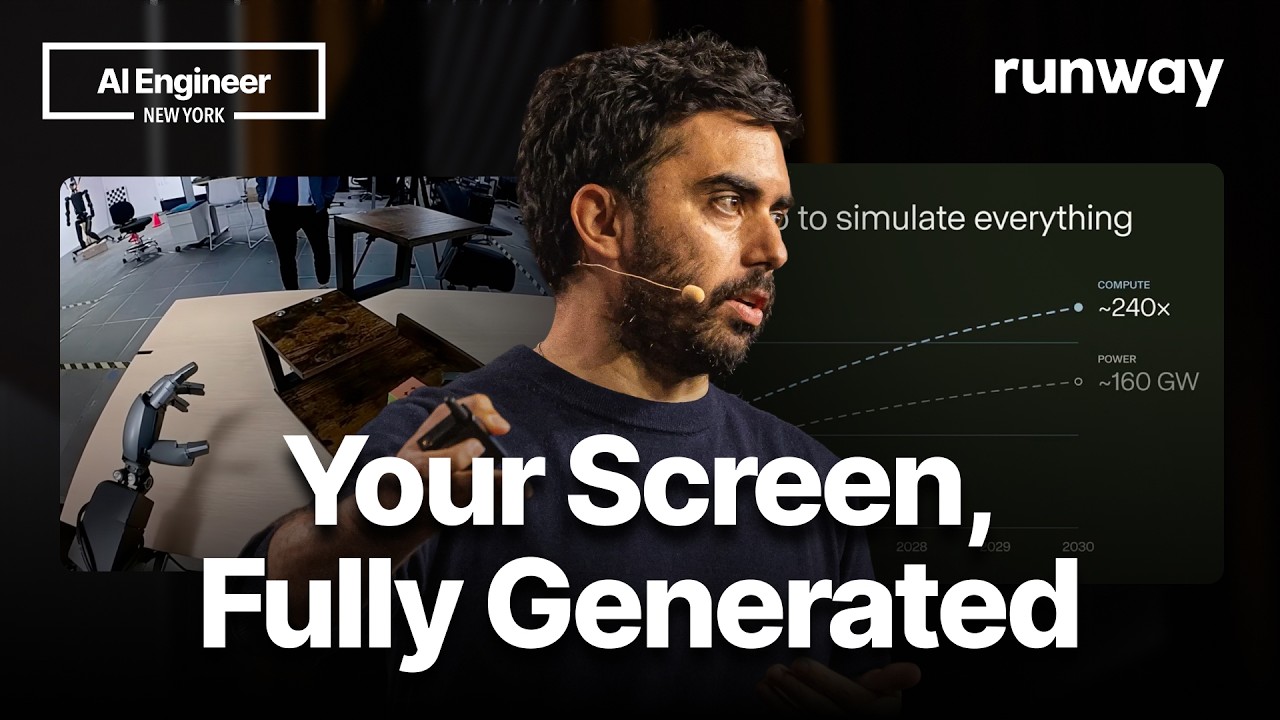
we call continuum. And continuum is the the idea of real-time video models or world models taken really to the next the next degree. This is an operating
system. The idea here is that you might open your computer at some point in the near future and what you see streaming to your screen may be coming from a video model.
So I'll show you next specific how this idea could could shape. This is still very early research, but I want to show you this idea of combining video models
as part of your operating system, as part of your daily work. So here's an example. I was researching, you know, San Francisco and the fog in San Francisco.
I wanted to learn more about when and how it happens. This is structural data. This is actually a website. This is something you can take from from the internet and
now continuum has this idea that I can select any part of content in that website and make it a portal. We call this a portal. And the portal is a real-time video. It's fully interactive
and fully based on the content you're experiencing reading through. I probably won't read through all of that text. It's too much text for me. So I just want to get a video and I can
make a video that's represented by by the text you see there. These portals can be 3D illustrations. It can be any content that you're watching or interacting with. On the
right you can have all the visualizations and portals you've you've experienced before, anything you've been trying to learn. Basically it's a it's a memory. So, it's
the disk of the imaginations or the visual sensations you've seen before. So, here I was researching about batteries, and so I can go back to the portal I had around batteries
before. And since they're real-time interactive applications, I can click them anywhere. I can move them around. I can start asking questions and the videos and and the content itself will
change based on based on my interactions and the way I'm I'm managing through it. Here's another very cool example that when I the first time I saw it when the team showed it to me, it was like blew
my mind. Since it's a real-time video, you can make it fully interactive with anything. Not only with clicks, but like resizing the applications would also change the
behavior. Right? So, I can resize. I'm I'm learning about photosynthesis here. If I resize the application, I get a different experience. And since it's again fully interactive
applications, I can click through it, navigate through parts of the cell or how photosynthesis work to get a better understanding of what I'm trying to learn and do.
Again, the one thing that still feels to me kind of uncertain about this is I don't know how to call this. I don't know if this is doesn't feel like a
visualization. It doesn't feel like a video. It doesn't feel like a game. It's something in between, and I think we need to do the collective work of figuring out how we call these kind of
interactions in the first place. And I'm sure [snorts] you hear kind of the other thing is that you can change the structure of the prompt or what's actually creating that interaction in
the first place. Here is another example. I'm going to type something. And this is one of the ones that I feel has been the most underexplored yet.
This is we call this visual thinking. So, we've connected Continuum to a coding agent. And what the coding agent can do is it can use Continuum to visualize through a problem.
So, imagine you ask your coding agent to create a 3D model for your bike. And instead of the model trying to just think through that via code, the the can spin a version of Continuum to think
through the problem visually. So, if you ever think about someone or I'm sure you have friends or maybe some a lot of people here maybe visual thinkers. What a visual thinker is is it
thinks through problems and through ideas visually first. And that helps you ground and project some of the best things you want to do. And this is somehow very similar.
Agents have the ability to do visual thinking. Agents can spin up a sort of imagination that you can tap and and interact with. So, not only the agent can interact with it, I can also
see it myself. And I can guide the agent in much better ways that I might have able to guide it just via text alone. Which is for us a very powerful idea. It's a
completely new paradigm. And we call this this this idea uh visual visual thinking. Um The last example I have
is how you think about taking, you know, Continuum to become much more than just uh using or navigating interactive structural
content in in the way I've showed you before, but actually making them fully live experiences that are reactive. So, in this case I was searching for Mars. Um and as as Continuum understands the
intention of what I'm trying to search from, it also suggests interfaces that are specifically designed in real time just for that. So, here it created for me this Mars outpost that's actually
should be uh accurate with the data about the actual like robots that are in Mars right now uh or the ones that are projected maybe in 2030. Um and since this is fully
interactive, I can interact with it. I can go to places. I can move around in the same way that I might move around, you know, in a 3D system or in a 3D Continuum. Um
And it works. Just fascinating. Um So, when I say everything will be simulated, um
I'm really trying to understand or help not really our team, but the world get to the point where a lot of what we'll see today will sound obvious, hopefully in a few more years or months.
We'll look back at Continuum and it will might feel very close to the video of the orange that we just showed you. Continuum and a lot of the things we're doing in in video and in Runway when it
comes to simulation are still in very early days, but we're getting to a point where it actually it actually works and it really scales. So, what we're really excited about is that for the next 8 to
12 months we're releasing most of what I showed here for everyone to use. Thank you, guys. >> [applause]