Enjoying this issue?
Get tomorrow's AI & engineering digest in your inbox — hand-picked, summarized, and always spam-free.
TLDR
Seedance 2.5's new 4K mode on Higgsfield delivers genuine native 4K detail, not upscaled 1080p, which fixes text rendering errors and improves close-ups. A credit-saving workflow drafts at 480p (3 credits/sec) and upscales only the selected take to 4K (28 credits/sec), cutting costs by 64%. The 4K mode is worth it for text-heavy or detail-critical shots but overkill for quick phone clips.
Key points
Seedance 2.5 on Higgsfield now offers a native 4K mode at 28 credits per second.
The 4K mode provides real additional detail, confirmed by a difference map test.
The 4K mode correctly rendered the number '70' in a text prompt, often wrong at 480p.
A recommended workflow drafts at 480p and upscales only the chosen take to 4K, saving 64% of credits.
The 4K option is not available in the United States at the time of the video.
Tools mentioned
Techniques
- Draft at 480p then upscale to 4K
- One beat per shot in prompts
- Put desired state in reference picture
- Keep changing labels out of the prompt
Stop scrolling. Start reading smarter.
Receive the day's most important AI & engineering updates in one concise email. No spam.
Transcript (captions)
16 gigs of VRAM doesn't fit. 24 still doesn't fit. [sighs] 48 now it fits with room left over for context.
And the giant models want 512. I'm broke. Every frame of that is AI rendered in 4K by one model and the hardest thing in it to get right was a single number on a
screen. The model is Sea Dance 2.5 which just got a 4K mode and I made all of it on Higgsfield. This video is sponsored by Higgsfield. Right now you can get the top AI video and image models with up to
60% off because Higgsfield just launched its Black Friday sale. It ends soon so click the link in the description. By the end you'll have the workflow that keeps 4K from eating your credits, four
tests of what the extra pixels buy, and the three prompt mistakes that cost me the most. 4K cost almost twice as much per second as 1080p so the fair question is what the extra credits actually buy.
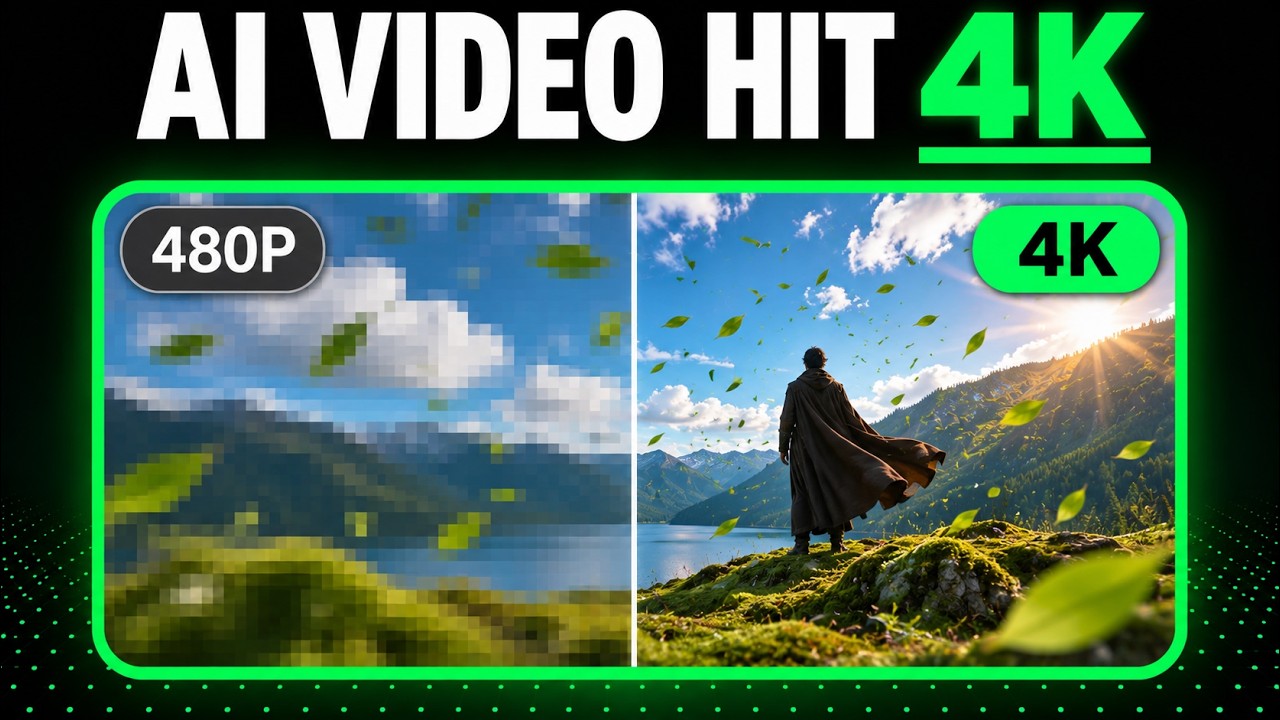
Higgsfield's first answer is that it's native. Sea Dance makes the picture in 4K from the start instead of stretching a 1080p clip and a 4K frame holds four times the pixels. Second, close-ups hold
up. According to Higgsfield, ByteDance who makes Sea Dance trained the 4K version on faces, small movements, and fine detail so skin, hair, and fabric stop looking like plastic. Third, small
text on packaging, posters, and signs comes out cleaner and colors stay closer to your reference pictures. And fourth, all those pixels give you room to crop so one 4K shot can become several sharp
1080p shots. Those are Higgsfield's claims and Higgsfield's demo clips. I wanted to test them on a problem this channel lives with. The story in that film is real by the way. A 70 billion
parameter model squeezed down to four bits still needs about 40 gigabytes so a 16 or 24 gig card can't hold it and 48 fits a few gigs to spare for context. The biggest open models need around 400
gigs even at four bits, which is why people buy 512 gig machines and why the moth. Every shot in it also hits a weak spot of AI video. Text on a screen, fast fan blades, fine fabric, and a tiny
moth's wings. Everything happens on the Higgsfield website, and it works best in a desktop browser. Higgsfield doesn't have mobile apps, so the ones you'll find on the App Store or Play Store
aren't theirs. I open Create Video and choose Seedance 2.5, and the quality menu now goes all the way up to 4K. One catch, if you're in the United States, the 4K option isn't available there yet.
4K costs 28 credits a second, and most takes never make the final cut, so I don't start in 4K. I switch to Seedance 2.5 draft, which renders at 480p for three credits a second. I add one
reference picture, which I made beforehand with GPT image 2.6 on Higgsfield with the red error already on the screen. The prompt is two shots, a slow push in on the error, then him
dropping his head onto his arms. 8 seconds, 16 by 9, four takes, and 96 credits for all four. While those render, I set up the other two shots straight in 4K because my tests had
already shown those prompts work. Seedance 2.5, quality set to 4K, 8 seconds, and the button says 224 credits. The wallet shot is 6 seconds, so it's 168, and each 4K shot comes back
in a few minutes. Back to the drafts. The rule is to judge the action and the camera and ignore sharpness for now. All four got the story right. Three of them also turned my 70 into a 78. In a film
about a 70 billion parameter model, that matters. So I open the one that says 70 and click generate in 4K. Generate in 4K renders the whole take again at full quality, so small details can change,
which is why you compare it with the draft afterwards. So here's the bill. Four drafts cost 96 credits, and the 4K version 224 so 320 for the finished shot. The same four takes straight in 4K
would have cost 896 which is a lot of credits to learn that C dance can't count to 70. That's 64% saved. Find the take at 480p and pay for 4K once. The 4K file is 3840 by 2160 but a
stretched 1080p clip can have that size too. So the first test checks whether the detail is real. I shrink a frame to 1080p and blow it back up. If C dance were only stretching 1080p nothing would
change. Everything that lights up in this difference map is detail that only exists at 4K. The rain on the glass, the fins on the graphics card and the text on the screen. The second test is text
and this one surprised me. One of the drafts that said 78 also went to generate in 4K and the 4K renderer wrote 70. At 480p a character on that screen is only a few pixels tall so the model
guesses. At 4K it draws the line again with enough pixels to get it right. Same on the shop page. 512 gigs and $12,000 stay sharp and spelled right for the whole shot. Test three is the close-ups
the 4K claim is about. Dust on the fan fins, the knit of the hoodie, the hairs on his hands and the moth wings and test four is room to crop. One 4K frame holds three sharp 1080p shots. The air, the
lamp in the rain and the machine. So the extra pixels are real and the best thing they bought me was a number I could trust. Getting to those shots still took three versions of the prompt. My first
prompt put the whole story into one 15 second shot. Fail, fail again, then success. C dance mixed it up. In one take the 488 gig card was the one that failed and a glowing sign saying kernel
panic appeared in the middle of the PC. Another take typed out a command with a typo of its own. Fix number one, one beat per shot. C dance handles one change of state well and three badly.
The second problem was the failure itself. Asked for a red error, SeaDance kept loading the model successfully, which makes it the most optimistic thing about local AI I've ever seen. Fix
number two, put the state you need into the reference picture. the error was already on the screen in my picture, four drafts kept it. And fix number
three, keep changing labels out of the prompt. Asking for cards printed 16, 24 and 48 confused it, so those numbers went into the edit instead. Here's the whole film in 4K with its own sound.
So is 4K worth it? For anything with text, close-ups or a big screen, yes, as long as you draft first. For a quick phone clip with none of that, 1080p at 16 credits a second is plenty. And if
your model doesn't fit either, tell me which card you're stuck on. Higgfield's plans are on its pricing page here logged out with the Black Friday prices, basic, plus and ultra. For this kind of
work, I'd pick ultra. It includes access to all models and 3,000 credits a month, which is about 13 of these 8-second 4K shots or 125 drafts. Right now you can get the top AI video and image models
with up to 60% off because Higgfield just launched its Black Friday sale. It ends soon, so click the link in the description. And if you make something with it, Higgfield just started its
talent contest, a community contest with a $1 million prize pool. 20 places win. First place gets $200,000. There are no categories and your video can be any length. You can make it with SeaDance
2.5 and 4K or mix your own camera footage with AI shots. Entries are open until November 26th and the winners are announced on December 3rd.