Enjoying this issue?
Get tomorrow's AI & engineering digest in your inbox — hand-picked, summarized, and always spam-free.
TLDR
100 billion tokens of DeepSeek 41 Flash in a month is enough to process 30 years of personal email into a searchable contact database with facts, promises, and recommendations. The experience convinced Jesse that per-token pricing is unsustainable and that the future will involve a mix of high-end frontier models for hard questions and cheap or local open-weight models for routine work.
Key points
Jesse consumed 100 billion tokens of DeepSeek 41 Flash in a single month.
He processed 30 years of personal email to build a searchable contact database with life events and preferences.
Modern models are so good at finding bugs that code reviews often fail to converge, requiring manual intervention.
Qwen 38 27B runs on a 64GB MacBook at 30+ tokens per second with intelligence comparable to Opus 45.
A new product will offer AI colleagues with defined roles (PM, dev, ops) that collaborate autonomously.
Techniques
- compaction tool
- proving it works with a movie
- sub-agent task list with effort levels
- audio chirp pairing
- agent school
Stop scrolling. Start reading smarter.
Receive the day's most important AI & engineering updates in one concise email. No spam.
Transcript (captions)
We're we're we're going straight into this from [clears throat] the beginning. >> Tell me what is this, dude? >> So, this is a Playdate. Um, it's a tiny little game console by a company called
Panic in Portland, designed by Teenage Engineering. It's got I think it's a Sharp memory LCD. It's an STM32. It has a crank. >> Yeah. For the
>> like for like fishing games and like it's a it's for games. Oh, no way. >> Um, but my friend Harper Reed uh was he's like, "I'm going to put a coding, you know, coding agent UI on my
Playdate." Like, that that was cool. I kind of want that. >> He says, "Uh, actually, I got distracted." And, um, I did a really nice fractal visualizer, which is like a
great project. >> Also cool. Yeah. >> That too. >> So, I have this bespoke coding agent called Evener that we've been that's
open source and has been open source since the beginning. We just haven't announced it. >> It's like it's there if you find it. And another one which I found last time that
we chatted clearance I'm a heavy user of. >> Excellent. Yeah, clearance is the um is my markdown browser. So it's for like reading. I mean that what's nice is
everybody else has finally figured this out. So all the desktop coding agents now have nice markdown readers. >> I noticed I know it's so funny also with the a few different UI things that I
always wanted. Yeah. >> But anyway. >> Yeah. All right. And so I'm like you know what? Um, hey Astra, let's build let's build a playd date client for
Evener. And it starts grinding and like an hour later it's using the RPC protocol. It's I can see messages rendering. >> Wow.
>> All right. I need to be able to do input. >> Yeah. >> Oh, I'm not going to I'm not going to use the
>> there's no there's no keyboard. >> I'm not going to use the D-pad and the crank to, you know, to type, which you can do for like >> imagine. Yeah. The crank going through
all of the different letters >> for uh like for Wi-Fi passwords. That's how they do it. It's like, you know, either D-pad or crank and then a a >> cumbersome, dude.
>> But I was like, so for input, why don't we just use OpenAI's uh speech recognition stuff >> smart >> and it, you know, tries it and it's a
little laggy. It's okay. Well, we can, you know, we can drop the bit rate and whatever. And then suddenly I can, you know, hold down a dictate, it transcribes it, and it sends the message
to the coding agent. >> Wow. >> And okay, well, I want to be able to demo this to people, which means I got to take it out of the house, which means
it needs to vent tail scale. >> Uhhuh. So, hey, let's get this out. This is an STDM32. I think it's an STDM32. It is a microcontroller. >> Wow.
>> Um, I was a little shocked that it actually like tail scale turns out to have like IoT device support. So, it does the stuff. It opens up the tail scale control panel and says, "Hey, you
really got to click that approve button. I I won't click that." >> Yeah. >> Um, >> and it does it and it hardcodes the keys
in the build. I'm like >> as it does. And like that's fine, but if we're going to distribute this, it really should be a proper tail scale enrollment. Yeah.
>> Says, "Oh, great. I'll uh I'll do the proper QR code enrollment system." So it shows a QR code that you scan with your phone and it onboard, you know. >> Wow.
>> And it works. It works great. >> But so >> I want to buy one of these just for this. >> But then I mean it is not actually a
wonderful device for this. It's but it's a great demo. >> Yeah. Exactly. But but the next thing I get to is to talk to the hub, I need to give it the hub address and a
cryptographic key. >> Um I'm not going to type like 200 characters of line noise into here. >> Like what could we do instead? Um
initially it says well you could >> there's no copy paste. Huh? >> I mean it's it's a remote noise. like you it's you know you could drop a file on it or if you use the um
>> the um iPhone client that that you've got for even you could do the QR code scan trick. I'm like I don't want somebody you have to have a phone client paired to do the
>> um how about an audio chirp? It says >> like an audio chirp. Sure, let's do that. That'll work. Um, so you go to the web app and you have the button and it gives you a choice of like pair with QR
code or pair with audio chirp. And audio chirp is >> Oh, it's the audio stamp that >> Well, it's like it's like modem noise. It is it is encoding a bunch of data.
It's the audio equivalent of a QR code. >> Uhhuh. >> And it works. That's so cool. >> It's so wild. >> The future. I mean, this was an evening.
This was an evening. >> Wow. >> Um, and I was doing four other things. >> Yeah. Yeah. Of course, as you should be. Yeah.
>> Oh my god. Well, dude, since we chatted last, for everybody that hasn't seen our first conversation, you talked about superpowers. You talked about the >> the inspiration that you had behind it.
>> I loved that conversation. And I think that when we got done with that conversation, you were saying like, "So, what should I be what should I be thinking about? What's cool that you've
heard about?" And then I asked you the same thing. And we kind of came to this point where we were like, it feels like uh everybody's building orchestrators. There's so many orchestrators out there.
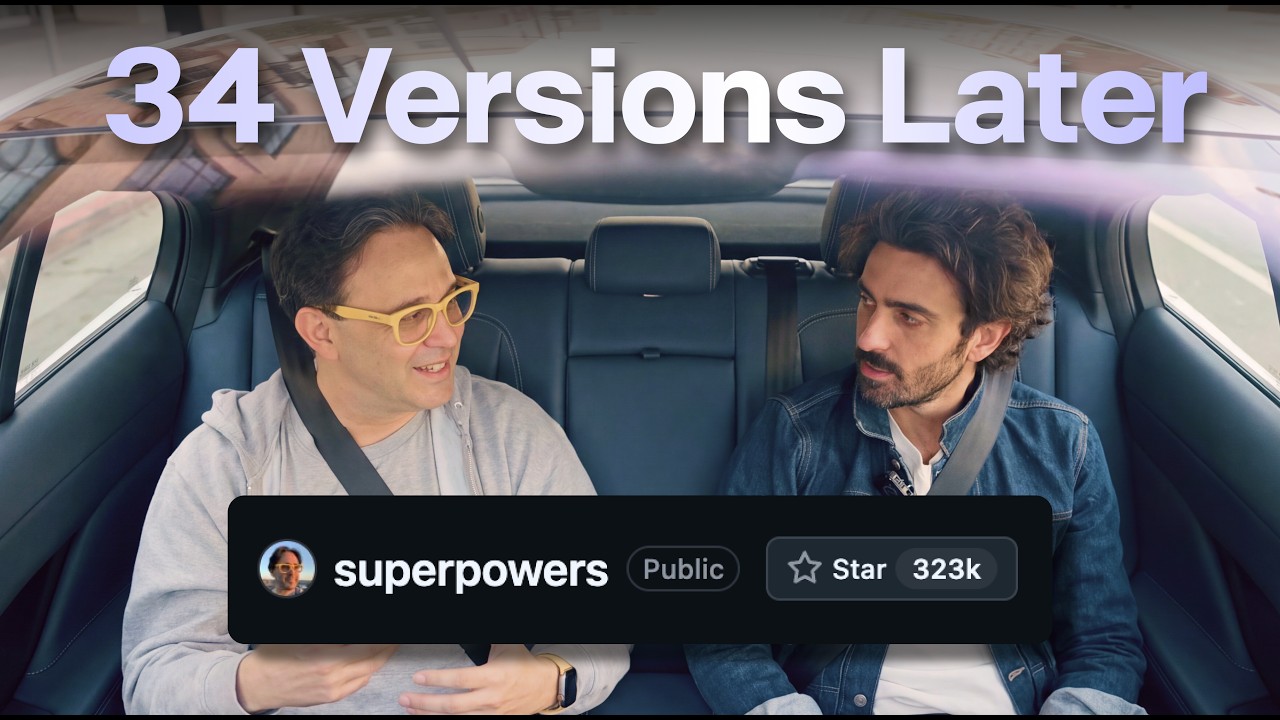
And oh, before I forget, I wanted to mention huge congrats because I saw Superpowers hit like 300,000 stars. >> 300,000 stars. It is, I think, the 12th project ever to do that, dude.
>> Which is insane. >> So wild. And I think it is very very warranted because I still use superpowers even though every coding agent and every harness has tried to
incorporate everything that superpowers has into their harness. Yep. >> I still find it is better using superpowers. >> So I've honestly I I had assumed that
when I first made superpowers I was going to have like three months and then everything you know and then everything we trained in the models the harnesses would have all
the things. Um CL when cla code came out with plan mode. I'm like well that's it. Um and but their plan mode conflated two things. It conflated help the human figure out their intent and the exact
set of technical tasks to uh to be implemented and those are two very like in traditional management those are two very different processes and they don't work as well when you do them as one.
>> Yeah. Um and so you know it's it is absolutely the case that mo that modern models and harnesses are much better at oneshotting things and superpowers is it is way more expensive to use the s full
superpowers flow than it is to just let the model yolo it >> and every time we run the eval to be like can we delete all of this it's oh yeah it's more expensive but also it is
much more it is much closer to bug free its and so we've done a bunch of work to help to help superpowers >> let you pair back how much involvement it has.
>> So um somewhere in the six series it went to this looks like a bounded change. This looks like a development spike. This looks like a quick fix. Do you want to skip? And now in Superhower
7, we when we gutted and redid brainstormings, um, which I wanted to ask you about that, but my favorite skill, >> the first thing it does is,
>> you know, hey, this looks like a thing where we should go through the superpower slow. Do you want to? >> And it's like it just is straight up like
you don't have to. is like super members auto triggers and we put a lot of effort into making sure that skills trigger proactively and automatically because you shouldn't have to be saying oh use
this skill that skill >> the goal is to have these tools help you >> and you know while I you know I have an engineering an engineering background or was I got a Russian studies degree and
I've been coding since I was a kid so that passes for an engineering background um but I you know and I hear from a lot a lot of engineers use superpowers. I you know inside I know of
at least three of the fang that have their own internal super you know superpowers in their internal plug plug-in repos >> and I love that it helps engineers but
the ones that really blow me away are the people say well so you know I'm not a programmer but I just shipped this thing with superpowers. >> Um an old friend of mine who's like he's
a recovering CIS admin and he's like I can string shell scripts together but I don't code. He was looking at two chest X-rays from a couple years apart and trying to figure them out. And he's
like, you know, I know I'm doing it wrong, but I just I realized that superpowers was there. And I'm like, hey, could you help me build a visualizer?
>> And it built him, you know, a health, you know, a health visualizer that was like that gave him the understanding of what he was seeing so that when he went in to talk to his doctor,
>> he was already that much further ahead. >> He had good questions. >> Um, and so it's that stuff that really like excites me. everybody should be able to build.
>> Um, >> you know, it encodes my 30 years of engine of engineering and engineering management experience so that you don't have to have it.
>> Yeah. >> Um, >> dude, what did you do to make it trigger so easily because that's one of my gripes with the skills that I'll build,
>> right? >> And even after saying multiple times like, hey, this skill is called this. I use keywords and sometimes it still doesn't trigger and it's so frustrating.
>> So there are a couple things going on. So when superpowers first shipped, I accidentally front ran anthropic. I superpowers was like was a skills system for cloud code. I didn't know they were
putting skills into cloud code. I had found skills on cloud.ai. They were using them for office docs. And so I had to build everything. So I had to build the system prop pieces, the triggering
pieces, uh the the you know the skill structures and I had done something pretty different. So they the standard front matter for a skill is a name and a description.
>> Mh. >> And in my version of it before there was a standard there was name, description and when to use >> and when to use was a separate line that
didn't say anything about what the skill did. Just here are the situations in which you should trigger the skill. And the model never saw the skill description. It only saw a name and when
to use >> and that worked really well. >> And when Anthropic came out with their skill system um so they you know they reached out to me
and they're like so you know these are the docs we're going to ship next week and you know what do you think? And I like sent back this sort of litany of like should do this should do this
should do this. Um I think you should name skills in um you know in active voice like writing code. Mhm. >> You know, the skill is writing code. The skill is not code writer.
>> Um, and I was so gratified that in the 3 days between when they sent me the draft docs and when they published the docs, they adopted like a dozen of the things where I'm like, you should do it this
way. >> Um, but most but most skill guidance is the description should say what it is and when to use it. And especially with the newer models, what I've been seeing
is when they can read the description and think, "Oh, I know how to do a code review. I won't I won't pollute my context window." >> And so they skip the skill.
>> They skip the they don't they don't bother to load it. But >> and if they had loaded it, you'd be fine because in the context window. >> Yeah.
>> But if the but if the description is just use this skill anytime you're about to do a code review, it doesn't know what's inside. It has to go look. And so the superpowers writing skills guidance,
you see that, you know, phrasing there, um tells tells the um the model that the that the description should only ever include when to use. We also have a bootstrap that loads in most harnesses.
That's you know, if there's only if there's a 1% chance that a skill might apply, you should read it and check. >> And so we put a ton of effort into triggering. What was wild is right
around when was either Fable or Opus 5, some of the stuff we had in the trigger in the triggering like extremely important in you know all
caps XM fake XML. Um Claude started freaking out. I was like this looks like a prompt injection attack and no I mean they they trained it so that all of the techniques that you would use to get a
model to pay attention. >> Yeah. the attention became too much like prompt injection, >> right? Um those super sensitive people, >> they put a ton of effort into trying to
defend against prompt injection. To to their credit, it works much better. It is much harder to trick the model, >> but it mean you know it's it's a constant game of
>> evolution. Yeah. >> And it's we also >> we don't want superpowers only to work in the highest highest end frontier models. It should work for everybody. It
should work for folks running local models. It should work for folks running a generation back because that's what they got. >> Well, this is a fascinating piece is
that you really have to almost like >> either build something that you know is going to be kind of universal and you're not going to get as deep as possible for certain models. Yep.
>> Or have evals and pinned skills for pinned models. >> Yeah. And we have tried really hard to avoid having to do a build step where different providers get different
versions of the skills >> superpowers. >> Yeah. Or it's like in the you know in this you know for you know for Astra you need to have this paragraph for for soul
you need you need to not have that paragraph. >> Yeah. And we've we've managed to avoid it. There's I'm not convinced that we'll be able to do that forever. Um there is
a single uh when it loads the superpowers bootstrap there's a single like if you're in this harness read this the this harnessd >> um because originally the skills were
all for claude and so we had translation tables >> because that very first time that um codeex loaded up superpowers and the skills said you know use your to-do
right tool to keep track of work it freaked out. It's like I don't know what to do. >> What is a to-do? I got to go build a to-do right tool.
>> Well, well, it's like, is there one in the current directory? Is there one anywhere on disk? Let me search the web to find out what to do. Write it. It's your to-do list.
>> Oh, yeah. >> Your to-do list. >> Yeah, it's so simple. But again, it's these things that you think you don't realize it until you encounter the
problem and you're like, ah, yeah. Yeah, I forgot that. So now you're more focusing on how can you have a harness level type of thing that will help the model and the harness understand how to
best use superpowers without having to bespoke create superpowers every time. >> Yeah, it it Yeah. And so it's it works pretty well. There's constant tuning. Um, one of the things that we've run
into over time is as the models have gotten better at finding issues, things stop things stop converging. >> So, for my entire career, I've often
repeated this phrase that all software is made of bugs. >> Sometimes the bugs combined in a way that you got the functionality you wanted.
>> Um, >> all software is is bugs. >> All software is is bugs. Yeah. But what what we're what we're seeing is as the models get better at fi at finding bugs
when you say, "Hey, go review this code and if there are bugs, fix them or like list off the bugs and then have the other guy fix the other agent fix them and then review it again."
>> And it used to be that you get two or three rounds in and it would find all the serious things and be done. >> Yeah. >> And now the models are very good at
finding bugs. The OpenAI models are obsessed with edge cases. >> Um, the number of times that it is like, oh, there's a time of check time of use
bug here where somebody could replace the SIM link underneath you on this shell script that's going to run only on your local machine and and hack your and hack you.
>> Yeah, you're screwed. >> Um, it's the judgment they don't seem to have is how much code is worth writing to fix a bug. the this 50 millisecond visual
glitch. Is it worth 10,000 lines of additional machinery? I don't know. I mean, I know it's not. >> Well, that's I was just talking to my buddy Pep about this and he was saying
you can spend that extra 10K a month, but how do you make sure that that 10K is actually worth the 10K worth of tokens? >> Yeah. Um, so I've been spending a lot of
my time with Deepseek 41 Flash. M >> so a friend of mine has an inference provider startup where their whole their whole thing is instead of uh billing you per token they're billing you per uh how
many concurrent requests you want >> so last month I did a 100red billion tokens of Deepseek 41 flash >> Wow >> yeah um
>> Wow >> and it's I mean it's only going >> billion >> 100 billion um >> it's like do you remember Austin Powers
when they were like $1 million and then it was like no that doesn't actually mean anything >> 100 billion billion tokens. [clears throat] Um
and and it's I mean it's really interesting when you go from super metered watching your you know watching your 5 hour window watching your oneweek window to I can just do things.
>> So one of the things I did was >> go through all my email go through my 30 years of personal email. So there was a bunch of filtering to only get >> correspondence with people who like
wrote me and I wrote back to them at least once. So, not spam. >> Um, not spam, not commercial messages, not and pull out all the facts, all the promises, all the recommendations,
um, all the favors. >> Dude, I did this recently with my um my LinkedIn. Yeah. >> And it was the same kind of thing. Like, who have I had two-way conversations
with and then let's go and let's um throw an embedding model and now I want to search it because I want to know who do I know in New York that's working on GPU optimization.
>> Yeah. Yeah. Yeah. Um, so the thing I had it do is it it basically wrote me Wikipedia style articles for all my contacts where it's like, you know, here's all the stuff that you
recommended to each other. Here are all their major life events. You know, it's like the CRM the CRM data you really want. Um, like here's what their kids named.
>> Yeah. >> Um, no way. >> But, you know, by the way, they're you know, they're allergic to night shades. >> Um,
>> yeah. Don't don't make that when you have a dinner party and invite them over. Um, so >> or you can even ask it things like, "Hey, I'm having a dinner party. Who
should I invite over that I haven't talked to in a while?" >> Yeah. No, it's there is amazing stuff that you can do. Um, and it's and it's just getting easier and easier.
>> Oh, man. That is so cool. And especially when you're looking at it. Somebody was just telling me >> I feel like we're in the, you know, 1990 eras of how we're paying for tokens.
Like the per token cost structure. >> Yeah. Are we sure we want to go with that in five years? Do you still see us paying per token or is it going to be something like this like concurrent us?
>> So I mean five years out is really hard to predict let's say I mean like you know it's like I I talked to VCs and they're like so what you know how do you where do you see the industry in in 18
months and I'm like >> I'm having trouble with six weeks these days. >> Um >> which is another testament to the fact
that superpowers is still around. >> Yeah. Yeah. And you came out with it like a year ago. Yeah, I just want to make that very clear. That's what like super hat
>> tip. Thank you. It's it's what like I had a I had a friend at one of the Frontier Labs who um was like, "So, yeah, no, I know you did superpowers. It was totally six weeks ahead of us." Um
and then four months later, he's like, "So, my guys didn't pull off a thing and I was decided to show them how it's done on a weekend and I finally tried superpowers and you know, you're still
ahead of our state-of-the-art, our internal state of the art." I'm like I I am humbled and gratified by that and also somewhat appalled because >> I would hope they have like the magic
like in the severed floor in the lab. I I want to believe that they have >> behind the key card where you got to fob in and you got to Yeah. It's the secret store where everybody's wearing the
gloves that you can't get any fingerprints on anything when you touch it. And >> no, you know, no phones, no AirPods, no, you know,
>> total airlock. Yeah. Um but yeah um no it's it's pretty wild. So the um the other thing that I've been realizing is I've been spending a lot of time with the open weights models is they're get
you know they Quen 3827B which is the >> I've been told it is it's like the most downloaded model on hugging face now >> on a 64 gig MacBook you can run it and
get like >> 30 plus TPS >> and at it has the intellig an intelligence level that's around um opus 45.
>> Wow. And what's interesting is Opus45 is what we had last December when everybody discovered that it was good. >> Freaked out. Yeah. >> Um and so now that's a thing you can
have on your laptop and not pay for. >> Yeah. >> I mean, you pay in electricity and and like burning your lap, but >> So in your eyes, it's like well, if
we're going to go that way, there's it's going to be really hard to do pay per token. So, what I think I mean the future I kind of expect we're going to end up with is you have a couple of
calls to a really high-end Frontier model >> that you you ask the hard questions and then all of the work a day stuff is either, you know, hosted hosted open
weights models or local local open weights models. And you don't have to pay anywhere near the same for that. And you probably are going to get to a place where that's
just a separate machine that you have on your desk >> and it's like a desktop >> computer. So I mean that's I mean that's certainly you know Microsoft partnering
with Nvidia to ship these RTX Surface machines. >> Um you know that's pretty or sorry DJ DGX Surface machines that's like pretty clear where they're going. Um, it is
Apple has done some really interesting stuff around their ondevice models having the same and >> I've never I'm embarrassed to say I've never trained a model so I don't really
understand like they apparently the ondevice models have the same vector shapes as their cloud models and so it is possible to start a process on the local model and push it to the cloud
when you need more oomph without having to reprocess everything. in this is a thing where you should you should absolutely get people who know what they're talking about this to talk about
this >> explain that part but it's >> I like I I mean it's a lot of this stuff commoditizes >> and another thing that I'm finding is
that I don't always want Astra or Fable writing the code I've noticed that too >> it's do you want a triple PhD do you know writing your crappy React Yeah, >> you want somebody who's like it's not
going to strain them, but there it's like it's that's what they do. >> Well, it goes back to your point on we are having these open AI models that just go through and they find all these
edge cases and you're like, I don't really care that much for that edge case. I just want the app working right now. >> Right.
>> And there's never a place that it knows when to stop because if if you just let it loop, it's gonna find something every time. >> Yeah. So, um, I use a, uh, for my code
review, I've increasingly been using a tool called Robo Rev by my friend Wes McKini. >> Oh, nice. >> Um, it's good, it's good stuff.
>> Wes who created he he was pandas back in the day, >> legend the data world. >> So, he he um he's got a tiny AI startup and disclosure, I'm an adviser to them.
So, when I puff them up, it's it is not entirely because just because I'm an adviser, I actually use the tools. So, he's got the like the the things that he's got that I I see a lot of folks
using. Now there's Katada which is his local first issue tracker for design for your agents. >> Um which is an it I have a I mean I spent the first 20 years of my career on
ticketing systems. I have a lot of fields there. >> Nice. >> Um so he's got agents view which knows how to siphon all of your transcripts
from all of your harnesses on all of your machines and lets you get really nice visualizations, lets you search them. Um I think it now is an embedding model. Um, he's got a thing called
Message Vault, which is siphon your all your Gmails, all of your WhatsApp, all of your iMessage, all of your Slack into a readonly database that your agents can query.
>> Um, and and then he's got this thing called Robo Rev, which is his take on the agent code review tool. It's got nice um post commit git hooks that you can install. It's got a set of skills to
do like review or refine and but it used to be this thing where running it I would get five you know five turns and it would converge >> and no it never did
>> and well and now like I've had things go to 80 and so I've been working through well how do you sol you know how do I solve this for me some of it is if it's been seven turns and it didn't converge
some the uh the piece of work is too big decompose And so like >> Oh, nice. >> That and so that works pretty well. The
other is if you you know if you get far enough that all it's finding are low severity issues, write out a list of them, merge and fast follow. >> Uhhuh.
>> Um >> so you can figure that out later. >> And it's like Yeah. And it's like because all software is made of bugs, the harder you look, the more you'll
see. >> Yeah. Yeah. >> Yeah. >> Oh man, there's so many places that I want to go on that one. But yeah,
>> what I would love as you're talking about that, >> Yeah. >> it would be so cool to see almost like now maybe it's not so much what you know
how we used to nerd out on like what's your rig? >> Yeah. >> Now it's almost like what is your harness setup for your agents as you're
coding because I imagine you're using different agents with different harnesses in different parts of the life cycle. So harness-wise um because of how anthropic does subscriptions my cloud
usage is still in cloud code. Um when I am doing desktop software on the Mac I still often use codecs but most of my coding is in Evener which is this coding agent that I've been working on. Um, it
originally was a design just for non-interactive for run for running it inside a factory style thing. >> And I started realizing that, >> well, it'd be kind of nice to have, you
know, my own >> TUI. Actually, it'd be kind of nice to have my own guey. >> Um, I think everybody's doing multiplexers wrong because I, what I
don't want is to multiplex different harnesses. I want to multiplex different models. Uh >> and so even is inherently provider agnostic. So you know you can use your
codec sub, you can use tokens from pretty much anybody. Uh you can dispatch uh to sub aents across provider. >> Um nice. >> Yeah. Which is real nice.
>> Um and so you know it's a lot of it I'm doing from my phone now. >> Yeah. Um >> or the game boy >> or Yeah. Or Yeah. Or um but like here
are my open sessions. >> Oh nice. >> Yeah. Oh my god. >> Yeah. So, >> just churning away.
>> Just turning away. And it's >> we chat. >> Yeah. >> All right. We're gonna refresh the, you know, it has all the standard stuff, but
it's >> Yeah. >> It's a harness that you've built, you've customized to your liking. >> It's so Well, it's I mean, I've built it
from pretty much from scr. The very very core of it was an implementation of StrongDm, part of StrongDm's um software factory stuff back in the back eight months ago. It was like they had put put
together this natural language spec for what the core of an agent looks like with standard standard sets of tools for file edit for each of the providers. And then I it is wildly different than it
was um because I have a lot of like strong weird feelings. >> And so it is a it is fully open but it is also super opinionated. It is not >> it is not pi style where everything is a
plugin. >> Yeah. It's very light harness. You're like, "No, I know exactly what I want." >> Well, I mean, so developing tools that people use in pi is huge pain in the ass
because every every instance of pi is a beautiful and unique snowflake with a different sub aent tool tool set, different compaction, uh different task
lists and so even is how I think it should be done. It supports, you know, cloud code and codeex plugins. It supports cloud code and uh marketplaces, which means that I can literally just
add marketplaces and add plugins and they just work. You know, I've got impeccable design installed. I've got superpowers installed. >> Um I have a version of uh Anthropic
Simplify Code plugin which is amazing. >> Nice. >> Um >> you know, and it's like I feel a little a little weird about that one because
it's it is straight up an Ursat's version. Like I'm not that is a private plugin because it is it's pretty much a copy of the thing they do because what they do is really good.
>> Yeah. Wait, so do you have with with this harness and >> doing it, >> do you try to create like different >> parts of the cycle or different loops
that will specifically use a different harness just to get you out of your kind of like way that you're doing it or >> so I feel like we have not as a as an engineering culture and community
explored the problem face of harnesses very well at all And one of it is either one of my superpowers or one of my catastrophic
flaws that I am very bad at looking at competitor products. >> Um I have always assumed that my competitor's products are the platonic ideal.
>> And so when I am competing with the competing product, what's in my head is the best thing it could possibly be. >> Yeah. And so, and I found that building for me and listening to users is way way
better than chasing competitors. >> Um, so like a couple of things that evener does that I haven't seen a lot of elsewhere. When you dispatch to a sub agent, you don't just give it a prompt.
You it the main agent can give it a list of tasks. The t and so that goes straight into the sub agent's task list. Um, each of those tasks can contain an effort level for the model. it contain
contains the prompt that should get injected there. When a task is done, it automatically makes the nest task live. Um, and that seems to work pretty well. Um, a thing that we're that is currently
chunking 3D valves is does it make more sense to when you launch that sub agent show it the first task or to give it a preview of here's everything in the task list, do the first one first.
>> It's ready. >> Yeah. It's like does it which one helps plan better? Yeah. >> Um, another thing that is not absolutely unique to us but is desperately uncommon
everywhere else is how compaction works. >> Um, we gave >> the bane of my existence. >> We gave the model a compaction tool. >> Uhhuh.
>> And it's and so it can choose to compact when it wants to. when there's um when it finishes a task and it and the context window is more than I think like 60% full, it says, "Hey, maybe now is a
good time to compact, but it's your choice." And the compaction tool includes a feature that is write yourself a letter of of all the important stuff you want to remember
after. >> And that seems to work really well. >> So, it's not just like summarize the summarize the history. like here is you know you have all of your encrypted
thinking blocks we can't see you have all of the transcript you know project state what should you know after you get your you know after you get mind wiped >> you've been doing this and you've been
on to this for a while now cuz I remember you telling me after particularly hard coding sessions you would ask the agent >> what do you wish you had that you didn't
have that would have made your life easier >> before going into this session >> yeah no like we've been doing a whole lot of like I mean it's a one of my
patterns is like go try you know go try your tools how do the tools feel what would you know what would have been easier um and you know we built the doctor into into the harness and that
the doctor is not hey user figure out why the harness is broken it's hey agent go you know go debug this session go debug the harness go look you know what tool calls have failed in the last week
how could you know why did they fail what could we improve Is it the prompting? Is it the, you know, is it the the structure of the thing? >> Well, I'm just thinking you you
mentioned Wes's uh rocket. >> Uh there's Ro, there was Robo Rev and there's Agents. >> Robo Rev. That's it. And >> I was just thinking about how
>> there's probably a subset of us that are using you've got your harness that you're using on a lot of the life cycle, but are you plugging in Robo Rev into what you're doing? So Robo Rev ships
skills. >> Yeah. >> And so the way that I mean so the way that it you use it in pretty much any harness is
>> either Robo Rev has done uh review per commit or it does branch review or you have it set up as a git as a GitHub reviewer. >> Okay.
>> And you just tell your harness, hey, you should go check the robo rev reviews. So, a pattern that seems to work pretty well is have Robo Rev in the background as a as a postcommit hook. Do code
review on every commit. Don't look at them till you get to the end of the branch >> and then handle them all at once. >> And that seems to work pretty well.
>> Okay. Are there other ones that you're seeing? Like if these it's almost like a a little branch of a subtree of one of the cycles that you have the main harness that is the one that ultimately
decides what to incorporate or what to focus on. >> However, you do have these little spin-offs that are happening around. >> Yeah. Um I'm trying to think like Robo
Rev is probably the you know the most serious one. >> How are you doing like uh verification and quality assurance? >> So all right. So there's unit tests.
There's end to end tests and there's proving it works. >> Yeah. >> And so we actually have a skill that we that was almost ready to ship in
superpowers and then we looked at it and decided it was actually there was too there was too much slop code. >> Um and it is called proving it works with a movie.
>> And so this started off with there was something I was doing in codeex. I'm like I need to go to bed. >> When I wake up I want to see a movie proving to me that the whole thing
works. I wake up >> and there and screen record >> and and I'm like, "Hey, Codex, where's that movie?" And it says, "Oh, it's d-v34.mpp4
in your Dropbox." I'm like, "V34?" Well, well, the first 33 times I ran through the, you know, the proof life cycle, I ran into bugs, so I had to fix those. Do you want me to make videos for
all the failed turns, too? >> No, it's okay. Very nice of you. But no. Um, and so that's a pattern that seems to work really well is because what you I mean what I cared about as as a
manager was was not the line by line is this the most beautiful code I've ever seen. >> I've worked in an industry. I've seen what enterprise code looks like. It is
not you open source code is the best like shy of NASA is the highest quality code on the planet u because there are so many eyes on it and people >> have opinions.
>> People have opinions and people are driven by embarrassment. Yeah. like you don't want to ship slop, you know, even in the pre-AII era, we didn't want to ship slop.
>> Yeah. >> Um, >> unit tests matter. Yeah. Um, end to end test matter. Fuzzing has gotten easy. >> Um, and so you can I mean you can just
>> get 100% buzzer coverage. You can get 100% code quality like uh unit test coverage. And for even at one point I t I had tasked um it was probably GPT6 soul or
maybe it was 56 soul we want 100% unit test coverage >> and it there's grinding grinding and finally it's like you know I'm at like 99.46
but there are these these assertions that we can never touch great and then I realized that it had built a test suite for the test suite. >> It was mocking the compiler. It was
mocking the shell. it was mocking make. Um, one of the things that it had tested was uh it made sure that you couldn't accidentally run rm-rf home and then Opus 5 broke the tests
>> and I lost the home on that machine. >> I mean, so it's a machine where I had hourly backups. It was designed for this, but it was was a I mean, it was more than a year in when I finally lost
a home and it was because Soul overbuilt and then Opus screwed up. [laughter] Um, and I was not su I like that was a case where I wasn't supervising tightly enough. A lot of what we've been doing
for the past year is sort of the spiritual evolution of what superpowers looks like at large. So we've been spending a lot of time on AI colleagues that have jobs and identities and their
own accounts not just roles. So like the PM that manages the de the dev the op now multiple devs the ops engineer the tech writer and go to market that are a little a little more early but I the PM
and the dev use a brow uh an AI browser tool that I built a while ago for superpowers Chrome in the past month three times they've run into places where they could get at uh API keys that
they shouldn't have been able to and they're like this is bad. they rol and so they rolled the rolled security releases and released them and I didn't find out till after. Wow.
>> Like I mean they did all the right work and there was a case where um they were collaborating with my cloud code instance and I said hey don't ship that in Slack.
>> I didn't realize the cloud code instance wasn't in the channel where I said that it shipped it and the PM ran a blameless postmortem on on its own. They work together on a chronology.
>> But what is this? It it just means that you're giving a really in-depth system prompt or >> No, this is so it's a bespoke it's a full bespoke harness um designed for
designed for long horizon colleagues that like >> um like multiplayer. So it's like team collaborating with with each other and with us. This is the like the
superpowers product that we're going to start selling. >> Nice. >> So it's like >> Oh, cool. I'm excited for that. So like
starting with probably starting with the PM. Yeah. Um >> so individual roles that have superpowers leverage for that specific role,
>> right? So it's like it's everything that I learned doing superpowers and everything we've learned in the years since about how to get higher quality outcomes. And so now focused a lot more
on non-engineering roles on teams working together. So it's not one person, one one agent. it is all the all the humans on the team, all of the AIs on the team
collaborating with each other. Um the PM started off pretty junior at one point we had a team meeting. I'm like, "Hey, Cadence, your job is not just to track, you know, to keep linear up to date, but
linear is cleaner than it's ever been. Your job job is to drive outcomes. That means assigning work to people, assigning work to uh to models uh or to agents and AI colleagues."
and Cadence stepped up their game. But also the next morning, Ada, the first AI dev, joins the PM channel and says, "Hey, what's my slice for today?" Because we had a team meeting. And every
workday since 9:00 a.m. That's when it, you know, Ada pings Cadence and says, "Hey, what what's on top for me today?" >> And on the back end, of course, ADA set itself a cron job that has a prompt
self- injection. >> But the way it happened was we had a team meeting about priorities. Wow. >> So that is the future. >> When I think about that, I'm just like
the more that you're able to create those kind of loops because those are loops, but they're loops for >> other almost. Yeah. >> Not like people, but uh yeah, it's like
tasks. >> It's well like but it's more than tasks. It's jobs. It's roles. It's outcomes. >> Yeah. And so it's they're thinking through
>> what you know what the higher level goal like they're loyal to the organization and so it's not just >> ship this piece of code. It's how you know how do we get to what we're all
supposed to be doing. Yeah. >> And it is it is mindblowing how good it how good it is. Um it is of course better. This is stuff where the frontier models are a lot better. But as they
built, you know, we've been doing this thing where we build skills in in thing we call agent school where it's what would it take to get a a >> a competent human from zero to expert in
18 months >> and then turning that into knowledge, turning that into skills. It's it's a fun future to be living in. >> Dude, I'm so excited for you to launch
this. I will be your first user. I want to try it. Okay, >> Jesse, thanks for coming. >> Thanks so much for having me. This has been fun.
>> This has been so awesome.