Transcript (captions)
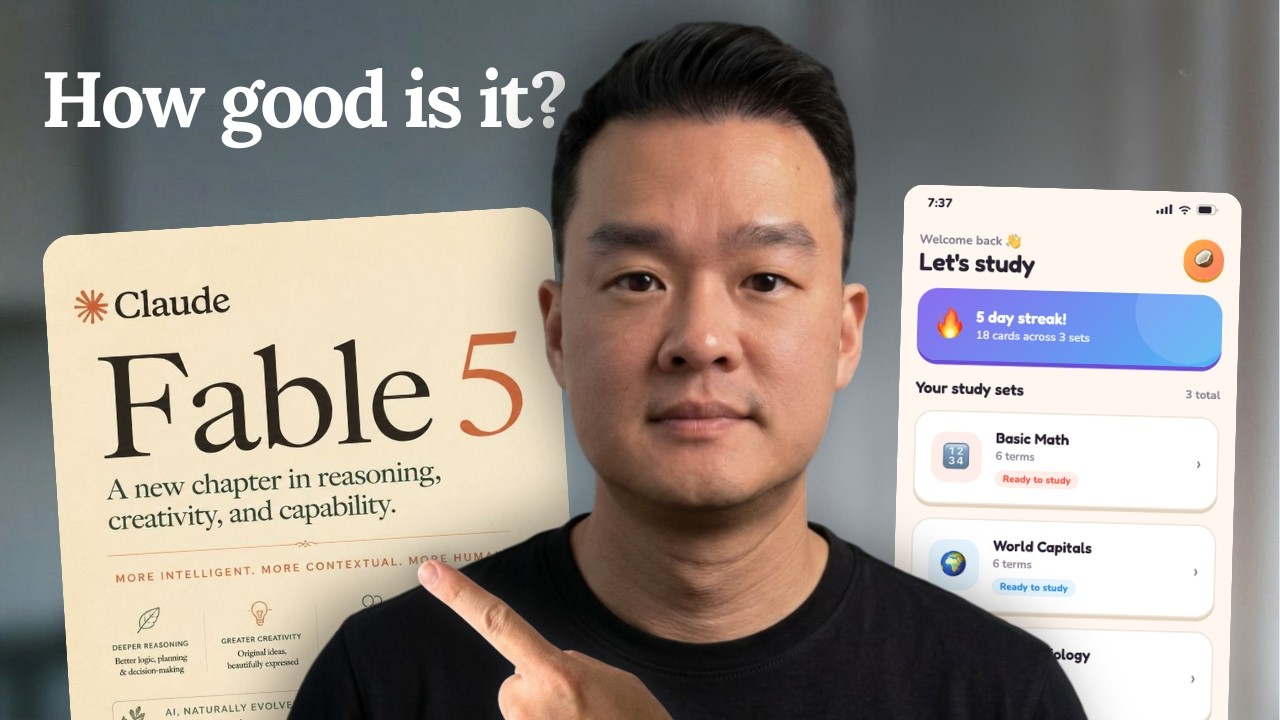
Cloud just released a brand new super intelligent model called Fable 5. It's been trending everywhere and I've been testing it for the past 24 hours and in this video we're going to see if it actually lives up to the hype. But instead of just showing you some benchmarks, I want to show you some practical use cases. I'm going to show you some of the things that I actually built. Some of it was okay, but but some actually genuinely blew my mind.
Now, there's one thing to note, Fable 5 is now available to use in your monthly Cloud subscription, but only until June 22nd and after that it moves to credit only. Meaning you'll pay per use on top of your plan. And it also costs twice as much as Opus, so by the end of this video you'll know whether this is all worth it, where it actually falls short when you're building apps, and exactly when to use it versus when to stick with cheaper models. But before I show you the apps that I built, I want to explain what this model actually is because there's a bit of backstory that makes it quite interesting. Now, just about a day ago Anthropic actually released two models at the same time, Fable 5 and also Mythos 5.
If you've been following Cloud over the past few weeks, you've probably heard the rumors about a super intelligent model that they're working on called Mythos. There was a lot of speculation around it and Anthropic even came out and said it could be dangerous in the wrong hands. So, instead of releasing Mythos to everyone, they built a safer version called Fable 5. So, basically the same model underneath, but they added some guardrails that block all the dangerous stuff, right? So, Fable 5 is essentially Mythos with some safety layers on.
Now, if you've been using Cloud for a while, I want to show you where Fable 5 sits compared to the other models. So, you've got Haiku, which is the smallest and the fastest, and then you got Sonnet, which is the everyday model. And Opus 4.8 was until recently the most powerful model, but now Fable 5 sits above all of them. And it's not just the best Cloud model, but right now Fable 5 beats every model from Gemini, ChatGPT 5.5, and Grok 4 across pretty much everything. But here's the thing, it is capable, but it also costs twice as much as Opus, which means that you want to know when to use it and when not to use it.
And this is actually how Anthropic intends for you to use it. So, they describe Fable 5 as a model built for ambitious and long-running work, meaning it's not really designed for simple one-off tasks, but it's designed for long-running projects. So, the way to think about it is that you want to use Opus or Sonnet for simple tasks, but use Fable 5 when you're doing some advanced planning for an app that has tons of features, something that would normally take you like 20 prompts to get through. Give it the full problem, let it run, and it will think through the whole thing on its own. All right, so let's get right to the demos, the apps that I was able to build with Fable 5.
So, I had the chance to build four different apps with Fable 5. A mobile application, a web application, a SaaS landing page, and also a simulation game to really stress test the model. And the way that I built these apps is that I ran the same exact prompt and built it using Fable 5 and also Opus 4.8 just to compare the results. And I'm going to show you both results so you guys can tell me which one you think is the best. Now, one thing to flag before I show you these demos, when you select the model Fable 5 here, you can actually select the effort level as well.
And I actually put it in high effort, not extended thinking or max. The reason is that if I put it in max or extra high, a single prompt can just run for hours, and it's just going to obliterate your tokens very, very quickly. So, I found that high effort is kind of the sweet spot. So, I kept it at high effort here, and I also used the same setting when building the app with Opus. Now, normally when I build any app with AI, I always start by asking it to plan out the features first.
That is a habit that I would recommend because it keeps the output focused, and it prevents you from getting AI slob. But, we're going to do something different today cuz the whole point of this test today is to give Fable 5 just enough information just to see how well it reasons and think through the gaps on its own, right? How far can it think ahead without being guided? So, that's what we're testing today. All right, so the first app that I tried to build is this mobile app for iOS.
This is basically like a quiz app with flashcards and study notes. Apparently, it's making around $3 million a month. So, I'm going to try to get Fable 5 to one-shot this app. So, here's the prompt that I gave it. So, build a mobile iOS style application called Coco Quiz, a flashcard quiz similar to Quizlet, including the color palette and typography and the layout as well.
And I just gave it a bit more context about the features that I wanted. I also told it to pre-populate the app with some dummy data so we can see if the app is working or not. And I also asked it to build the whole thing in HTML so I can easily preview it on my Chrome browser. And I gave the same exact prompt to Opus as well to make it a fair comparison, right? Now, if you notice, I didn't give it detail here.
It's just a very short prompt with just the basic features and a reference app that I want to copy cuz the point of this test is to see how far it will go in building out the features and whether it's going to get it correctly. So, here's what I got. So, the one on the left is built with Opus and one on the right is built by Fable. So, at first glance, I think both of these look quite good. One obvious thing that I noticed is that Opus actually gave me this iPhone frame while this one does not, but I can easily ask it to do that as well.
But, let me see if these are all clickable. So, these filters are just dummy data, but let me see if I can click on this. Okay, so this one works. So, if I click on flashcards, and let me see if this flips. Yep.
So, the answer is behind this flashcard. So, the animation works and if I go to the next one, that works as well. And let's see if I want to go to quiz. Okay, so there's a dummy quiz that I can do. All right, so I do like the animation and if I go to cards, maybe I go to home and then can I add a new one?
Okay, let's do coding. Coding. Let me see if it actually works. Maybe do advanced coding. And then let's hit create.
All right, so the functionality works here, which is nice. And let's see what we have here. I think both of these they look equally good. They look very similar in terms of design, but this one they added uh the icon here cuz I asked it to name of app Coco Quiz. So, added this icon here.
Let's study. There's a fire animation here that is glowing. So, I I added that. And if I click on this, yeah, it's very similar to that one. And there's a flash card as well, which works.
I feel like the animation is a bit better here. So, it went a bit further in terms of the animation. So, let's click on Okay, so it added a feature that this one didn't have, which is matching the matching game here. So, if I go back, yeah, this one only has flash cards and quiz, but Fable was able to create a third feature, which is this matching game here. So, you can drag and drop all of this, right?
And it has a timer as well. Nice. So, I didn't even ask it to do this, but I think this is really, really good. Now, can Opus create this feature as well? Of course, if you ask it to do it, but the fact that it did it without me asking, just to think about the features that I might miss, I think that's something impressive.
And I think design-wise, both of these are very similar. But if I had to pick one, I'd probably pick this one because the animation is better. But again, all these things you can actually prompt it to add whatever animation you want, but what we're testing today is how far it's able to go with just one prompt. All right, so the second app that I built was this web application, basically a booking app like Calendly. I wanted to see if I can just one-shot the app as well with one single prompt.
So, here's the prompt that I gave it. Build a fully responsive single-page web application called Calendar with two Rs, a scheduling tool similar to Calendly. So, I gave it a reference as well, but I asked it to come up with its own design direction, and also gave it a couple of features that I think is pretty basic for a calendar booking app like this, like a booking page where users can select a date from calendar, and then also a dashboard where the host can manage the bookings, and maybe reschedule, things like this, right? And again, very short prompt, and I gave the same exact prompt for Opus as well. And this is the result that I got.
So, on the left here is the one that's built by Opus and on the right is from Fable 5. Now, I think that looking at the design here, they both are okay, but the only thing that I don't like about the left one here is the fact that it's using the purple theme here, which screams 5 coded app, right? So, I don't like that. But to be fair, I did not give it any design direction. I didn't specify the color that I wanted.
But with Fable, it was able to be a bit more creative and used a different theme, which I personally think that it's a lot better than this one. Now, with Opus, there's also a bit of design errors here. So, I think the 8 here is a little bit too close to the 2.5. But in terms of the functionality, if I click on the reschedule here, okay, so that works. I can pick another time.
If I click on two, confirm new time. Yep, so that actually changed as well. And let's say if I toggle Monday off and save it. And then if I go to book a time, this is the page where people can book a time slot with me. Yeah, so that works and I can see that I can book a time, right?
Okay, so I obviously I can't book a time yet cuz it's just dummy data, but functionality-wise, it works. Yep, 45 minutes. This is changed. Yeah, to be fair, there's also I think these are too close together, but can easily be fixed as well. Okay, so yeah, I think I just like this color better than this one.
And then if I go to this one, yeah, I can cancel it. I can reschedule as well. Yeah, so I think this is good from just one prompt. I wouldn't say that Fable is better than Opus for this particular app cuz I'm sure that I can build a much better of this if I give it a more detailed prompt. So, I don't think it's worth the double token usage if you want to build something like this.
Now, the third thing that I wanted to build was just a simple landing page for a software product like WhisperFlow here. So, if I was building a voice dictation tool like this, I will probably need a website like this to showcase the app. So, here is my prompt for Cloud. So, build a fully responsive single-page landing page for Voice Flow, a voice dictation software that lets users speak and have their words instantly transcribed anywhere on the computer. And again, I ask it to come up with its own design direction, and I ask it to add some basic sections like the hero section, testimonial section, a pricing sections with two plans and a footer.
So, very, very basic. And And then I said the page should have smooth scrolling and at least one solid animation. So, that's it. And this is what we got. All right.
So, on the left again is the one from Opus, and on the right is the one from Fable. Now, looking at the left one first, I think it's quite impressive what it's able to build with just like a one-paragraph prompt. It was able to build all this animation here, and it understood the software or the app that I'm trying to build and created this animation to match the app that I'm building, right? So, if I scroll down here, it's got the feature section, and then the testimonials, and also the pricing that I mentioned that I wanted. And then the footer section here.
Now, the only thing that I don't like about this is obviously the purple color, which is a dead giveaway that it's a Vibe Coded website. But with Fable, it was able to avoid giving me this color and and added some creativity here, and I think this looks a lot better. Although, we do have the same kind of similar animation here. But if you notice here, the top is kind of messed up here. Maybe it's the divider here.
Yeah, so if I open it up a little bit more, I think it works perfectly. Yeah, so this one is also the same case. But let's scroll down here and see if it's any different from Opus. So, I think this is a little bit more thought out design-wise. I definitely will pick this one over the one that Opus created.
And let me scroll a bit more. Okay, so the testimonial section is a lot nicer as well. And then FAQ as well. If I go to the just the top navigation bar here, 1 2 3 4 5, we've got five sections and Opus only gave me three. So, he added more sections here, which might or might not be a good thing depending on the software that you're building, but it's just nice to see more options here and then I can decide whether I want to keep it or I want to remove it.
But, I think for this one, I would give it to Fable in terms of the design. But, to be honest with you, if I were to design just a landing page like this with no back-end functionality, I'm not going to pick Fable because it's going to burn through my tokens a lot quicker. I can give it more design direction to Opus and probably achieve the same thing. All right, so the next thing that I built here was a game, right? It's a It's a simulation game and similar to like a SimCity if you guys are familiar with that.
And I wanted to do this because I want to stress test the model to see how detailed it can get. Cuz what I'm trying to build here is basically a city simulation where there's going to be buildings, going to be houses, there's going to be parks, trees, and cars, and people as well. And I want this to be as real as possible, meaning like I want the traffic lights to work, I want traffic jam, and I want it to mimic a real city as close as possible. So, I gave this prompt to both Fable and Opus and this is what we got. So, on the left here you have Opus and on the right is Fable.
So, let's take a look at what Opus built first. So, at a glance, I think both of them look very similar, but when you zoom into the details here, you can see that all the buildings look really good, right? Um we've got cars here, we've got people walking. Uh the cars are actually boxes here, but with names, right? And then And you can also adjust the time here.
So, you can make it faster, you can make it slower, and you can also zoom in and out here. And if you notice here, when it turns to night time, it will actually turn on the lights in the building. So, that is something clever. Now, if you zoom in here, actually the traffic lights are here. So, if it's a green light, the cars will actually go and then if it's red, they will stop and create a traffic jam here and people can cross.
So, that's really good. But, now if you compare this to the one that Fable built, right? So, I'm going to make this bigger. You'll see that this is more elaborate, right? Not only that it built a similar city, but actually built a better one.
So, you can see all the buildings here like a financial district in the middle. And you can see houses here. Whereas, if you look at the one that was built by Opus, they're basically all the same buildings, right? So, I would give that to Fable here. And if I zoom in and look at the details here, the cars actually look like cars.
And they're not just boxes like the one in Opus. And people look like people as well. And you can actually hover on the people here, and it will actually say that, "Okay, this guy's out on a stroll. This guy walking off from a long meeting." So, it's very detailed, and this is actually fun to watch, right? And I also noticed that the traffic lights, they work as well.
And when it's green light, the cars will go. And if it's a red light, it will create a traffic jam as well. Very similar to what Opus built and left here. But I feel like this is a lot better, a lot more interesting to watch than this one. And the city feels a lot more lively than the one here.
It's definitely a lot busier. And one more detail that I noticed is that you can see the sun actually moving here on top, and there's some clouds here. While this one actually does not, right? So, I think that's an interesting detail that it added. So, I think from this example alone, we can see how far or or how many extra layers Fable was able to think through when building something like this.
But here's my personal take on when to actually use Fable, right? Cuz if you're building something simple like a landing page or a basic website with just some text and buttons, I think Opus 4.8 will give you basically the same result. There's no real reason to like spend twice as much. But when you're building something with a lot of moving parts, like maybe a Mac desktop app which is quite complex build, or a CRM, I think that Fable is the right choice. It thinks a couple of layers deeper, and I think that actually matters when things get really complicated.
Now, for me personally, I'll still be using Opus for most of my projects. I think the only time when I'll be using Fable is probably when I'm planning something or when I'm mapping out how an app should be structured. That's when I'm going to use it. And once everything is planned out, I'll probably hand off the build to cheaper models. Now, I think the other way that I might be using Fable for is to help me catch things that I might miss security-wise when I'm building something.
So, did I accidentally expose my API keys or is my database secure? Is there any security gaps that I should know about, right? So, this is the kind of thing that a model like Fable is really good at flagging. And I would use this like sort of like a final check before I launch anything. So, tell me in the comments if you guys have been using this and what you think about it.
I'm definitely going to do more testing and build more apps using Fable. So, make sure you subscribe if you're not already so you don't miss these videos when they come out. But, thanks again for watching and I will see you in the next video.