Transcript (captions)
[music] Uh, okay. So, I'm Suba. I head AI engineering at ZS. Uh, >> I'm Ablash. I'm director of AI engineering at CS.
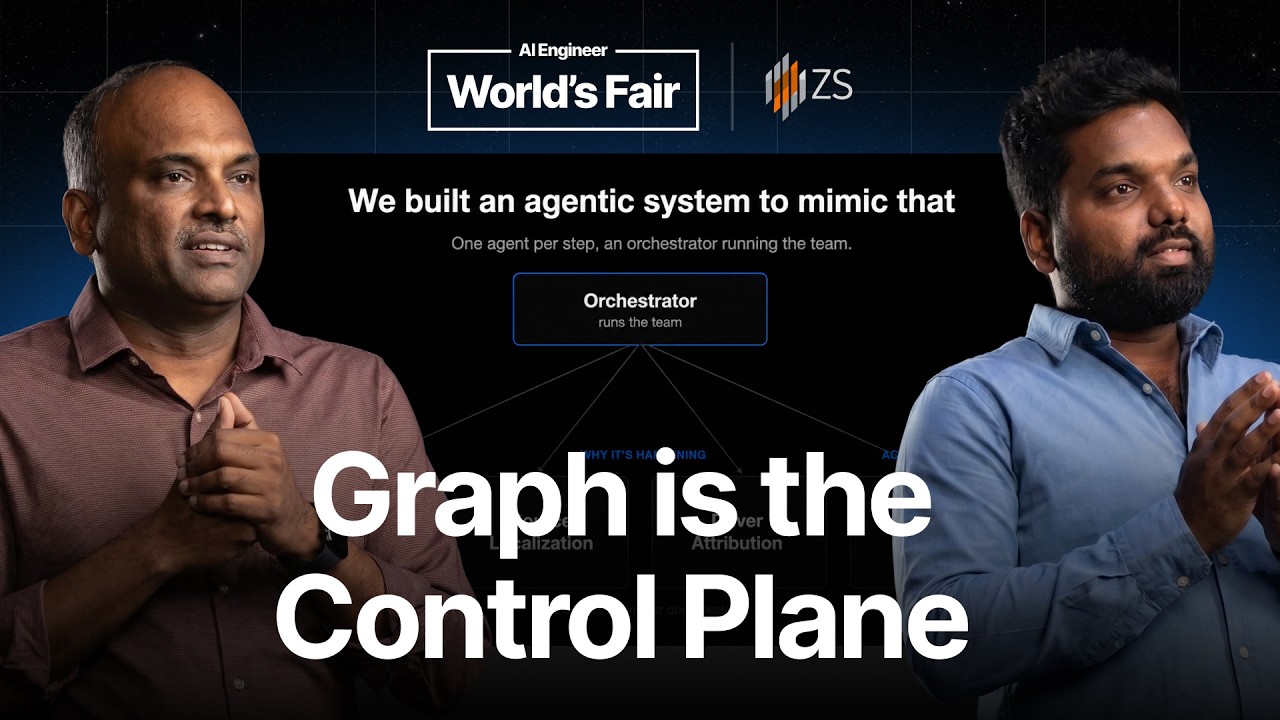
>> So, ZS, we are a tech firm. We work with many of the top companies in the world, including a lot of the top farmers actually. Um so today's talk I think we wanted to as I think already introduced right we wanted to talk from our experience right building multi-agent pipelines uh what are the mistakes we did right and what did we learn and how did we fix them so um so I'm going to orient it more on pharma commercial domain and for people in the room probably who are not aware quickly u pharma has two main functions one is R&D right the drug discovery right uh and the clinical trials part and then there's a commercial how do you take a drug to a patient basically and and Within commercial there are different functions like once you create a drug right um what is the performance of a brand how is the drug performing in different markets right uh then there are things right your field force your reps how effectively are they engaging uh right with everyone there are things around patient journey how a patients are adopting a drug right I think if there is any therapy switch which is happening so as you can think about there is a lot of analytics which really happens in a commercial domain and how do typically analysts So there are four steps right what analysts do right so first there is always something called a signal detection right so signal can be something like okay the prescription is what a doctor is writing maybe is there is there a drop in the prescription so that's a signal so once you got a signal the second thing what an analyst does is why is this signal really failing what is the reason for it so is it like there is a competitor drug which has come in because of that is it is it reducing is it is it because maybe a payer coverage for the drug has reduced or maybe the the reps on the ground there's no proper uh they're actually not taking the benefits to the doctors and once you arrive at the reason the next step becomes okay what is the action do you take so if reps suppose if reps the coverage is not good in a particular region should do we have to increase that and once you do that what is the what is the outlook right is my brand is my sales performance is is it going to improve right so these are the four things which happens now for some of the top farmers what we have done is how do we in an agentic way right I think how do we actually mimic this this analytics work so what we did we built agents for every step right signal detection we said okay we'll have an agent for signal detection it'll identify identify the signals for me second what are the root cause right for the signals right so in this case we have two agents one we call it a source localization so for example if my sales is dropping at a national level is it because it's dropping at say a particular region or is it dropping for a payer So we need to understand that we we are trying to identify the source of it and then once we understand what is the real reason right I think the the sales performance has gone down that's another agent the driver attribution agent and then the last step is your synthesis right so depending on the cause now what is action you have to take and what is outlook like typically how an analyst used to do and all of this we used to have an orchestrator agent which connects all these agents together so now what happened once we had the system what did it generate right It generates something an information packet like this, right? It clearly tells you the signal, right? So, first it says maybe my brand's prescriptions have dropped 18% in some territory, right?
In some time frame, maybe four weeks. It then tells you the reason why did it why did it drop, right? The reason it says because a payer actually, right, the coverage for this drug has actually they moved it to a lower tier. So, for patients, it's expensive actually to to buy this drug. the action it says okay because doctors are writing less prescriptions maybe send more sales reps to talk to doctors right and increase the number of prescriptions which you're writing and then if you take this action maybe your outlook your sales performance is going to increase so all of this looks good high level but then if you if you look at at it closely it's not very coherent right the cause is right it identified the right cause right because patients can't afford the d drug right but the action it said it didn't really focus is on the payer part, the insurance part of it, right?
It just said reps, right? Focus more reps actually, right? And then the outlook because the action is wrong, the outlook is not going to match. So at each level, if you see it is actually derived the right fact, but then there is no single agent which is owning which understands the end to-end picture basically. So why did this happen?
Like why did it fail, right? So obviously it's not the LLM which failed, right? It's the way how we split the work, right? because we tried mimicking the analyst behavior and we did it. The first first key issue is like a language model is actually determining your signals.
So signals like things like your sales drop is a simple information which you can use statistical methods to actually go and fetch this information. You don't need a language model actually right to fetch this information. Second is as your multi- aents there's a lot of context handoff which is happening and context is actually getting lost at each of these handoffs. So for example, the driver attribution agent is actually determining the right cost. But then the next agent, the synthesis agent is actually is not able to understand why is that right the the payers are finding the drug to be expensive.
It's not understanding the weightage of an insurance coverage going going down. So that is a key information right which is getting lost. And the last big piece is there's no shared understanding of the business domain knowledge for all these agents. All these agents don't understand metrics right so things like TRX the number of transa number of prescriptions which a doctor writes right what are the relationships between them why does it go up or down so those are the the reasons so then what did we do uh so I called Abilash to come and solve for this okay uh thank you SA so we had like three problems uh so we thinking how are we going to solve this uh our first instinct was we'll go back to the drawing board we'll start designing it again. So maybe the topology was wrong, the skills were wrong, the tools were wrong, or maybe the maybe we have to define a better handoff, design a better handoff or a better schema between agents.
But we took a step back. We didn't do any of that. We like all of us, we went back to cloud code. So we opened a very plain empty directory. I rent cloud code then give it just bash and the database then give it an actual signal which we identified then started observing what it is doing.
So while we look at what code does, we are able to figure out fix for all the three issues we discussed the first the first part. So what was happening is the agent was looking at data and deciding on a signal. Sometimes it's applied some statistical methods. Sometimes it's barely look at the data and say this is a signal. Sometimes it's actually a signal.
Sometimes it's a noise. This is something we don't want an agent to do. This is a completely deterministic workflow. So we separated it out from the agentic system. So we built a pure deterministic workflow with different statistical methods.
We put guard rails, we put thresholds, we put prioritization. Everything happened before the agent even kickstarts. So we run an automated pipeline which scans through the data identify signals for each of the KPA. Is anything happening with that? any anomalies which is happening any trend which is very uh any trend which is baking based on that we identified a signal we put it on a queue the moment a signal comes to the queue the agent wakes up so the agent's dope is to investigate not to identify the second part so mainly the issue which we previously what sub was mentioning there is no coherence in the output which the agents produced so we started consolidating we Look at how cloud code operates.
It's able to do a lot of operations. So we started designing around that. So it's repeatedly writing a function and querying database. So we give it a tool for that. So this consolidated the entire process into a single agent.
That doesn't mean that we didn't do parallelism. We still do parallelism. What we removed is do we need distributed reasoning? We didn't by the judgment to be distributed between agents that we wanted to consolidate to a single agent. So that what exactly what we did.
Then occasionally we observed cloud code it's launching sub aents dynamically for a very particular focused task. So we did the same thing because if suppose you want to understand if rep activity in a particular region that's an investigation which you need to run that you can still delegate to a sub agent you can get back the uh results back not the reasoning or the judgment that is still controlled by the by the main agent but the investigation part of it we did we're delegating it to a sub agent. So these are some of the things we kept based on observing what code was do cloud code was doing. So that give us a more lighter architecture than what was initially there. But still it doesn't solve the problem.
That's why you see a knowledge graph in the diagram. So it still doesn't have the business context. It still doesn't understand all the entities, the domain, the KPIs, how do they relate to each other. So that's something we wanted to solve for because the agent was looking at data looking at tables then trying to infer the relationship that which was not scalable and it often produce relationship which is which is not actually exist in the data. So what we did so we've been in this working in this field for a lot whole lot of years.
So we've been doing this for our clients. So we had a lot of domain experts who understand the farmer domain very well. We're doing commercial analytics for the clients. So we start sat with them start building a knowledge graph. We start trying to map out the domain.
So we are able to build a knowledge graph. We are able to identify different entities their relationship between that. So if you see there are like geographic entities, there are payers. How how geographic is connect to a payer or an account? How does this connect to a brand?
Then from B brand or payer, how does it go to a KPI? How does a KPI relate to like a uh secondary KPI, tertiary KPI? How does one KPI drives another KPI? So, we started mapping out all of this information and then creating our our knowledge graph. Once you have the knowledge graph, then we wanted to let the agent to navigate the knowledge graph.
So, the knowledge graph is not just something the agent looks up for data. It is a control plane for the agent. So, what do I mean by that? So the knowledge graphs dictates what the agent can look into, what path it can take, what investigation hypothesis uh it can evaluate. So for example, if you when you do this analysis, the root of the problem say something like your TRX is declining at a national level.
This could be when you do source localization. So that's our uh contract for how to find the bear. It might happen within a region. It could be concentrated in a territory. it would be concentrated in a combination of a territory or a payer or an account.
So there are whole lot of dimensions which the agent needs to evaluate. Now it's a lot of permission permutation combination. So the knowledge graphs gauge the agent on how to find where this is concentrated. >> Then the why why part of it why it is happening. When you figure out that okay something is concentrated at say the decline is concentrated at a particular region.
Now you need to figure out the why. This is where where the uh KPS and the relations comes in. Once the agent is able to narrow down the where then it's able to go and figure out the u figure out the why part of it, which KPS is driving what graph acts as the control surface. So agent every edge is a hypothesis. So the agent can go and evaluate that hypothes hypothesis.
Uh it doesn't go outside of this. So that gives a more bounded surface for the agent to investigate. So like everyone was mentioning about loop. So we also build a loop. So what the agent does?
So the agent first start with an entity. It goes to the graph. It looks at the neighborhood of the graph. Then it it figures out the edges. So it's got some hypothesis.
It will go it'll go back to the original data. evaluate that hypothesis. Look at the actual numbers. Then reason over it. Then it will it will either find it find it contradicting or it finding supporting the the evidence supporting the hypothesis.
If it's supporting it, it started traversing through the graph. So this repeats this until it ran out of all the hypothesis or it's able to figure out the root cause. So this this concludes this run. this runs and it'll be able to figure out the uh root cause of the problem. So once we build this so maybe like after like 50 plus turns a whole lot of tokens it's able to produce something an analyst uh was able to produce maybe in three or four weeks in like maybe 20 30 minutes.
Thank you. So just to wrap it up um key takeaways first thing is I think we should not be introducing human constraints or design constraints into architecture. I think let the architecture be derived actually number one. Second I think any complex workflows will have deterministic parts and agentic parts. Don't let agents actually run the deterministic part.
Right? So I think we need to break break that off. The third you need to have one agent right which owns the reasoning end to end right this agent can actually take the call to use sub agents tools skills to actually spawn off other other tasks basically right but you need one agent to own the the reasoning and the last probably the most important I think graph cannot be treated just as a lookup player I think graph has to be treated as a control plane which the agent uses to navigate and takes the next decisions basically okay with that I I think thank you. Thanks. Thanks for telling me this.
[applause] >> [music]