Transcript (captions)
[music] >> Okay. Oh, yeah. Thanks everyone for coming. And I know this is the last session before lunch. So, thanks for staying here.
Let's make it smooth and with good vibes. Just as that said. And thanks that for introduction. And for inviting me. So, yeah.
My name is Rustam. I'm leading AI platform team uh at Snorkel. And uh today I want to tell you how to turn agent traces into agent simulations and why this uh becomes the next stage for agent evaluations. So, three main things that I want you to take away from my talk is uh every company needs a benchmark. It's the only way to reliably evaluate, release, and improve your agents.
It has to be as close to production as possible. Uh it has to mimic your real tools, real API services, policies, and workflows. And finally, it has to be part of your agentic life cycle. It's not a static benchmark. It's a constantly populated data set from your production traces.
So, why is Snorkel AI giving this talk? We are uh data as a service company and we uh basically selling uh benchmarks. And we're producing benchmarks at scale. And for us, benchmark construction is an engineering discipline. We run millions of agent simulations per month.
And uh we learned how to do like uh environment built at scale. Working using both agents uh and subject matter experts to build reliable benchmarks that are close to production and uh specific domains. So, a lot of the time when people say about agent evaluation, they're focused on traces. And traces are very useful. The usual traces like you can see an example on the screen.
It basically shows, "Okay, here is the input prompt. Here are the actions that agent took, and here is the agent output." And then relation can analyze it and and say, "Okay, was agent successful or not? Was there any edge case?" Uh so, it is useful to find failures in production, but it's hard to test different variants. You can run AB testing, and that's one way of checking different agent configurations, but it's hard to make sure that everything is repeatable because you will get different database state, different tool versions, and so on. So, never fully compare apples to apples.
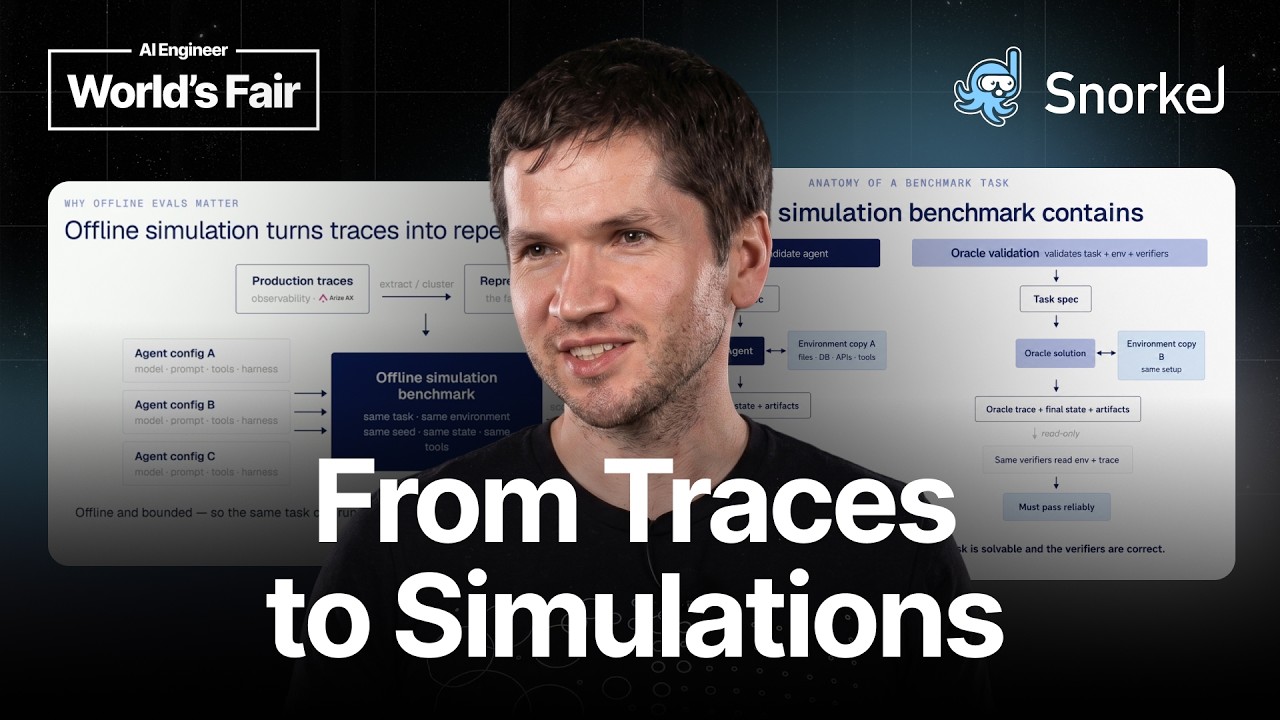
Offline simulation turns traces into repeatable experiments. Now you take production traces, you construct tasks, and then you can run simulation benchmark um with different agent configuration offline. And you can compare agents using different metrics, not just success rate, but cost, latency, and retries. And you can run those in parallel. But you can ask, "Okay, but why do we need it?
Like we already have public benchmarks." The challenge with public benchmarks is that usually they are focused on a very specific domains. For example, SweepBench is focused on like uh fixing GitHub issues, TerminalBench will focus on agent running in terminal, and Co- Bench will focus on computer use agent. In your case, you want your benchmark to be focused on your company's domain both from perspective of use cases and in terms of tooling that your agent has, whether it follows the policies that your company uses, and whether you get full production environment. Basically, public benchmark is useful to orient and build your prior, but your private benchmark is useful to ship. And a lot of the time public benchmarks they're specifically focused on pass rate.
Every time you see new model release, you see performance like pass rate on different benchmarks. Which makes sense because it tells us like about the frontier of how good is the like new model. But when you release agent to production, you also care about more metrics. You care about cost for solving the task. You care about latency.
You care about number of retries. And by running evaluation offline with in simulations, you can effectively compare apples to apples and and iterate on agent. In this case, you can test the full stack of your agent. You're not just checking, okay, is model one is one model performs better than the other model. You check even like thinking talk like thinking level.
You can change the prompt. You can tune the full hardness and skills tools available to agent because in your production, you don't care about the model, you care about the full system. And here you can configure and test the full system while keeping environment and evaluators the same between runs. And that raise the point about like what benchmark is in this case. Because first of all, you can use it to first release the agent.
You can make sure that it works. You can handle edge cases well. You can select the optimal model, and you can debug the traces. That's how you make sure that it works. Next, you can make it right.
You can put it as a release gate for your agent and verify that any change to agent stack in didn't reduce regression suddenly. And iterate on hardness. And finally, you can optimize it. You can tune it for better cost or latency. Or you can use the traces to even do error training.
Uh later I will say I will share link to our website where we have example how we used simulation environments to fine-tune small plan model to match performance of large plan model for specific tasks. Here effectively, that becomes like trifecta of use cases. Like for you, benchmark becomes part part of agent evaluation, becomes part of integration test for agent for release, and it becomes also training set for agent to improve it. So, I hope I explained why you need benchmark. So, now let's take a look like how can you actually construct it at scale for your company?
Like what is the anatomy of the benchmark task? If you take a step back, like what is the sequence of running the benchmark? It's straightforward. Agent gets input prompt, it interacts with environment trying to solve the task with APIs, MCP tools, database, files. Then it produces the output, trace, final state of the environment, and artifacts, basically output files.
Then we run verifiers, and we can produce the metrics how was agent able to solve the task, how well did it do, and so on. The important second part of the task is Oracle. When Oracle solution runs, it runs through the whole sequence, but just instead of running the real agent, it runs Oracle, and it and when we construct Oracle ourselves to make sure that task is solvable in the first place. Because if it's not solvable, agent won't be able to solve it. So, Oracle is important part of the task.
If we look at the anatomy of the like of the benchmark task, how it looks in terms of files, we can look at one of the most popular formats nowadays, Harbor format, which was done by the same team who uh maintains Terminal Bench. In this case, basically, it's just three set of files. So, basically, what agent sees and interacts with, instruction.md, classic markdown file, environment, which you can see Dockerfile, could be Docker Compose in case you have multiple Docker containers. You have something that agent doesn't see, which are which is Oracle solution and verifiers. And finally, you have some metadata.
It may uh look very straightforward. Yeah, I'm saying like, "Okay, simulation environment is just Dockerfile and a bunch of stuff." But, it is useful because now you have repeatable way of running experiments in agent simulation. So, now let's dive deeper into main parts of benchmark. First is environment. The main challenge with the environment is that effectively it has to be mini production, but you don't want to run full production for every experiment.
So, you want to make sure that uh your database, API service, tools, and files match production, just as like previous speaker mentioned like that you don't want your agent to know that it's running within simulation. So, it has to be real. One thing, though, you cannot put real user in your simulation task. So, you can simulate the user. In this case, that becomes effectively LLM with its own prompt, which with additional context that can mimic human behavior and interaction with your system.
So, in the port system that all these things exist in the environment, and verifiers just interact with the environment afterwards. There are certain patterns to make sure that you can organize environment this way. And think about it as like how you construct integration tests. Basically, how you give effectively diff environment to your agent. You don't run the full production database.
You have a certain snapshot. You can run side containers sidecars in this case. So, your uh agent runs in one main uh environment, but there are other containers which contain API services, databases, MCP tools, and so on, available to your agent. You don't need to have like full production API services, you can mock them. I already mentioned simulated users.
Uh and uh one important piece here is multi-step to handle long horizon task, if your agent needs to handle task that span hours. You want to ensure that you have intermediate like steps, and for each step you have separate prompt, separate verifiers, and uh you can uh finish simulation early if you see agent failing. And basically that enables you to simulate long-running horizon tasks. So, next part is verifiers. Like in traditional sense, usually when people speak about verifiers, you just verify the output.
You get agent output, you verify it, that's it. That's why, let's say, how coding works. It's like we just verify the output code. We test, and so on. Here it's more complex.
The way agent interacts with the simulation, we get a lot of different data. We get the world, basically how environment changed in the final environment state. What is your database state? What are the API responses? What were user replies?
And so on. And your verifier analyzes final state, trace, and artifacts. So, how can you analyze it? Effectively, there are multiple ways to do it. You can have deterministic checks.
Basically, uh and that can work really well for things like final output or tool calls, where like it's very easy to check whether it was correct or not. It Sometimes you can use LLM as a judge, or even harness as a judge, or agent as a judge to evaluate basically whether the uh trace quality was successful, whether um planning of the agent was correct, and so on. In this case, it really depends on the use case. So, you can use one or another or both depending on what's what works better. And finally, it's important to keep in mind that you can use sub- uh subject matter expert to review some of the traces, some of the outputs.
Not for everything, but for cases where you see discrepancy in agent behavior and where you want human involvement. So, final piece, how can we kind of organize everything together as part of agent release and agent improvement process? So, can we just start? Not just yet. Can something go wrong with benchmark task?
100%. Agent can try to reward hack simulation environment because it can understand that it's in simulation and it can hack it. Task could be too simple and like our verifiers could be too broad and in this case agent will always pass even if it does something incorrectly. It could be that agent always fail because verifiers are incorrect. Or it could be that agents not perform in a stable way and like you have high variation of agent success.
So, all of these are effectively edge cases that you need to catch during your benchmark development because benchmark development is an art on its own. We saw already like hundreds of benchmarks appear over the course of last years, but this is something that the card culture and engineering discipline that needs to be built in each uh engineering team that needs to ship AI agents to production. Because as you saw, effectively benchmark is software. It's code. It's files.
You need to treat it as such. You need to have a separate CI pipeline for it. E- And you can check pretty obvious things like for example, making sure that all dependencies are pinned or like your base image is correct or you don't have any missing fixtures, then you can run Oracle uh solution and make sure that it passes. Or like if you don't run Oracle that verifies fail, you can run several agent runs uh on the task and verify that okay, it is solvable and it is hard for agent. You can tag the task whether it's simple, medium, or hard depending on how much time how many times the agent is successful.
And finally, you can approve it to make it part of your benchmark. In this case, the process for improving agent becomes straightforward. You establish baseline in like on your benchmark, you run evaluation data set, you see the failures where it doesn't perform well, you change one thing, you rerun experiment and where you can use something like Arize to record your experiments. And then once you fix it, you rerun the full experimentation again. And then you can finally release to production.
What it unlocks is to make sure that you fix issues correctly. There is a bit of an anti-pattern in the industry where like folks try to fix things in the prompt. And they populate the prompt with things like, "Never do this or only do that. Never output this critical that." Which is one way of handling it for sure, but with simulation, you control the full stack. You can evaluate the full stack.
And you can make sure that fix lives in the correct place. You don't push everything to the prompt. You fix hardness if you want if you have context overload. Or you can if there is a missing procedure, you put it into skill. Or like if you need to have specific output schema, you put it as part of structured output.
So, once agent is in production, effectively, you will have two loops. One loop for benchmark expansion. You take uh, observability traces uh, traces from observability basically using something like a rise. You record failures and use failures to build your benchmark further. Then you have simulation runner that will run experiments on your on extended benchmark on a new or on new agent config.
Uh, we'll record these experiments. Then you can use it for as a release gate whether, uh, agent performs significantly well and finally release it to production. Uh, in this case it's important that you have system like it's important to under- to make sure that your observability piece and experimentation piece are connected. Because they're part they're two sides of the same coin. Um, so yeah, to summarize my talk, everyone needs every company needs a benchmark.
Traces are useful for like the finding edge cases in production, but simulation helps to, uh, test what would happen. And finally, uh, you want, uh, your, um, benchmark to be part of your, uh, agent ops, uh, loop. Thank you very much for for your time and, uh, I think maybe I will have answer for one question, but will be happy to answer any questions outside and please check our booth, uh, if you have any questions about benchmarks. >> [applause] >> All right. A couple questions.
All right. >> A great talk. I have a question about structuring the benchmark. How many examples you should include ideally? And do you split them into, uh, like a train test split?
If so, like how do you recommend structuring examples, um, across those two splits? >> Great question. So, uh, the question was basically how can we structure to for training and validation? And just as previous speakers uh shared, basically they also had a pattern of like having train validation split. This is very close to traditional machine learning where we want to have standalone data set that agent didn't see.
But basically where we can verify agent config. I think the classic approach applies when like you want to have 80/20%. Always depends on the use case. But uh you do want to have a standout data set that agent didn't see through the experimentation process. >> Awesome.
Next question. >> Um so when you create the benchmarks, um what data do you include in the benchmark? Do you include production runs that you've handpicked into the benchmark? Or if your agent is not yet in production, do you create uh data sets or problems to solve for the agent in the benchmark? And if you're if you're like handpicking problems for the agent to solve, um how do you make sure you have like enough coverage uh similar to what you'd see in production?
>> Great question. So the question is how to ensure coverage and distribution of benchmark is a very important piece. So effectively you want to keep keep make sure like you have both. You have bread and butter use cases, basically covering all main use cases that work, but also making sure you have edge cases. Basically how you can make sure like your agent can handle edge case when tools fail or if like there is problem with database and so on.
So you want to have both uh it basically think about it as integration test. You you have happy path, but you also have edge cases. >> Would you simulate agent with LLMs or would you create hand-crafted business? >> Yeah, uh great question. Basically similar to us handcrafting, uh I think basically I mean people use agents to write code.
So a lot of things here can be automated. So the what is handcrafted kind of changes. Like the the most important piece that you can provide is like the build environment once and then build the context uh for basically that mimics your production. >> Um you mentioned sometimes you use LLM or sometimes use human expert to build verifiers. Can you elaborate on that?
What's the best practice over there? >> Great question. So, in our case basically, we have a lot of subject matter experts, so we do things at scale. So, the important piece here is to you don't need subject matter experts to review everything, but you specifically want to find cases where there's disagreement between agent and different verifiers. If you you think that basically task was supposed to be solved, but agent somehow marks it as like not solved correctly or like it marks that trace wasn't optimal enough.
And this is where you want to have subject matter expert that can basically tune the agent that does the review. >> [music]