Transcript (captions)
Excellent. I will say that um I might speed run through this. Feel free if you don't disag- agree with something to yell out. It's way more fun for me if things get interactive. Um otherwise, I will go through this.
Uh first, can I have like a vague show of hands of who knows what RLHF is? Oh, excellent. I might be able to skip through that part quickly and get into the interactive stuff. So, my name's Tiago Almeida. I'm talking about what's next after RLHF.
More accurately, I think this should be called what's next after the chat GPT era that I think we're all in. And my hint for you guys is it is not the Claude code era. I will justify this later on, but I actually believe them to be part of the same era. Why should you listen to me? I was co-authored to what what is basically OpenAI's greatest hits, at least published hits.
Co-authored to GPT-4, chat GPT, RLHF {slash} instruct GPT. Um the team I was part of basically invented post-training as a concept. So, um very qualified on a lot of this stuff. But what makes me somewhat unique here is that I'm one of the few people at OpenAI who actually hates on chat GPT. Uh thank you.
Uh I don't hate chat GPT as a product, to be clear. I think chat GPT is a world-changing product that will probably stay with us for the rest of time unless something better comes up. But I also acknowledge its limitations and I I I think a lot of what's happened in the state of the field can be traced back to minor decisions we made in making the algorithms behind chat GPT. Um I feel like the question that's relevant to everyone in AI right now is what's actually going on. Um there's a lot of like differing opinions, and I think it's really useful to like map out the spectrum and figure out how can smart people have like such different opinions.
There's cult one. Um, AI is not just going well, it's going insanely well. Every single benchmark we surpass human level, and as far as we can measure, we are continuously surpassing human performance. You know, like basically every new benchmark, and it's only getting faster and accelerating. You have uh, you know, every Can I see my mouse?
Excellent. Basically every like NLP benchmark is getting crushed, and not only that, allegedly the time that LLMs can operate autonomously is growing exponentially. On the other hand, you have AI is not just going poorly, it's going like insanely poorly. AI is a bubble, it's basically generating no value, it's just circular financing deals, etc., etc. And, you know, if AI is so great, why is why is everything just like a chat app right now?
Or like a cloud go thing? Um, and a a lot of the people have actually kind of given up on what was the old guard's terminology of a transformative AI revolution. People aren't really talking about that anymore. They're talking about it being like massively valuable like B2B SaaS. So, the only thing that everyone agrees on is like there's just a these extreme points of view and like nothing in between.
And everyone basically thinks AI is insane, but like for different reasons. And what I would want to talk about is what is the sane view of AI? Let's take all the evidence of like cult one, it's going super well. Take all the evidence of cult two, it's going super poorly. Like, uh, you know, map them out and try to explain what what what explains that divide.
Like, what is the simplest possible explanation of why some things are too good to be true, and some things are not just bad, they are so bad that we would still employ human workers to do like, you know, like kind of like dumb tasks. Um, no offense to any of them. A lot of these tasks on the right seem way, way, way easier than the stuff on the left. Like, how can we be solving like, you know, unsolved math problems, but still customer service requires like humans in the loop in order to actually like make decisions? This I think is like a kind of like a wild state of affairs.
And in my opinion, anyone who works adjacent to AI should have an answer to this because this is like the evidence in the field right now. Um, I would normally pause and ask people if they want to like yell out their thoughts in this, but uh, that I don't think we have time for that and I've been told to not take Q&A until after. Um, but I'll just give you my answer to this, which is, in my opinion, the simplest explanation. All the stuff on the left is not just a task that happens to have a human in the loop. In the left, the task The goal of it is to please the human in the loop.
These tasks are intrinsically human in the loop tasks. The like Claude code's job is not to just make code work. Um, the the the the way it converses would be totally different. The goal is to please the human in it. And on the other side, all of these tasks that seem way more basic, the goal is to not have remove the human loop.
Ideally, it would be running in the background in a server that you never even look at and ideally it eventually becomes like legacy software that you don't really worry about. So, and this is the divide between assistance and automation. Um, lesson one for my talk is that today's AI, everything inherited from our LHF, is incredible at the human in the loop stuff, but not for automation tasks. Tasks. This is a longer side, but the lesson basically every business has learned is do not use AI for decisions with stakes to your business.
Um, a common pattern is make sure that all of the costs are to the user and not to your business. So, um, it's oh, totally okay to throw the user at infinite docs in customer service, but it is not okay to make it make expensive decisions. Horrible pattern, but that is the state of AI right now. Uh I can I can blitz through the what is RLHF part cuz you all seem to know what it what it is. Um it's the algorithm behind not just ChatGPT, but basically every LLM today.
As far as I can tell by usage, 100% roughly of LLMs are trained with RLHF. And we have this we as in we the OpenAI team had this great blog post on how it worked. Um I will not get into that because you all know it, and this is super boring. Um the summary of this is it is just collect human preferences, optimize for human preferences. Um and if you want to see like an annotated version of this, you can see which parts are collecting human preferences, which ones are optimizing for them.
And [snorts] this, I think, provides a really clear answer to everyone in the field asking, "Why do all LLMs require a human in the loop?" The And the simple answer is we literally put them in the loop. The goal of the loop is to optimize for human preference. It is not to run software autonomously. It's kind of super obvious. Thank you, my man at the back.
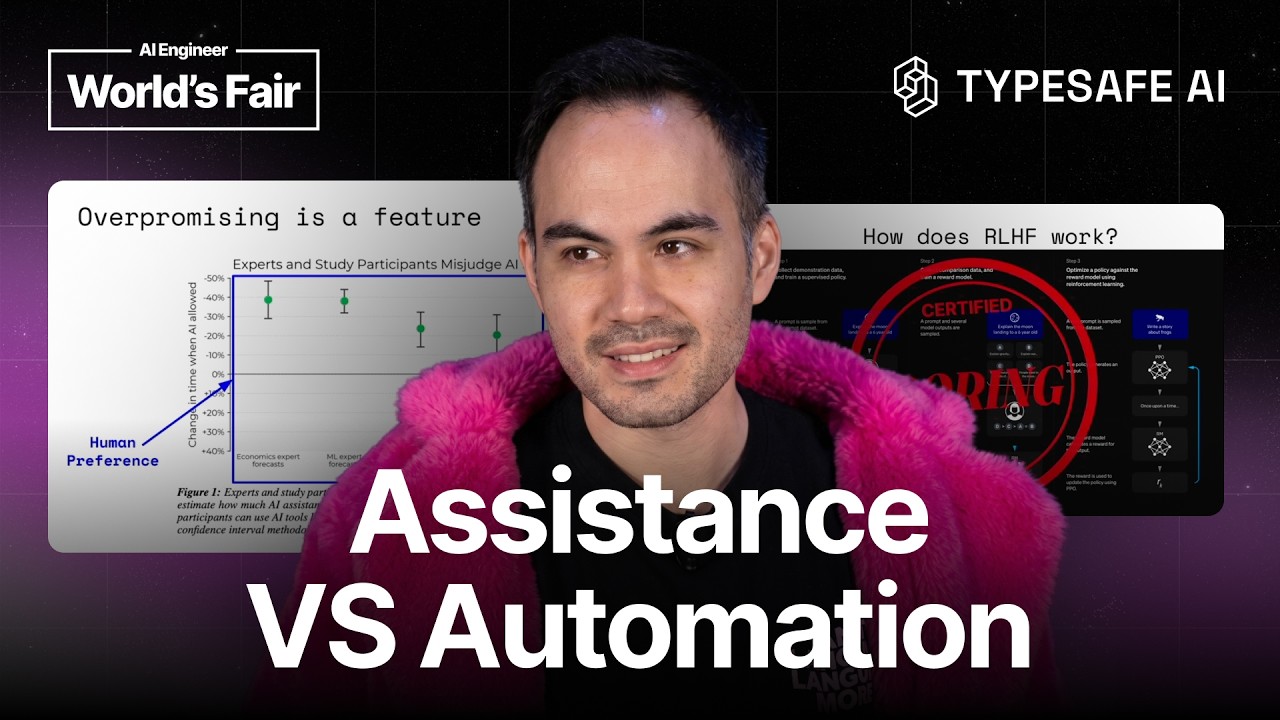
The Yeah. I I I love that you're laughing at this. Um and because of that, overpromising is a feature. This is by design. This is an old meta study.
Um and the the numbers probably have changed, but by construction, every RLHF model will always have a big difference between human preference and results, even if the results are good, because the main objective you're optimizing for is for human preference. This is just like natural to how LLMs work. Um I love this tweet of um uh sending ChatGPT an audio file of fart sound effects and asking like what What do you think of the music I made? Here's a straight honest reaction. It's a very eerie vibe atmosphere piece.
And this is just how RLHF works. If it doesn't know, it will err on the side of doing what it thinks is best for human preference. And this makes total sense if you are a user in the loop because like the end game for all RLHF models is optimizing for engagement. But what you really want if you want automation is for it to just like not give a about the humans and just do the task correctly in a calibrated way. Um Lesson number two is that today's AI was designed for assistance through optimizing for human preference.
This is like it's like in the name. This is not like a controversial take. And the consequences are maybe more controversial, but it's like very obvious if you think about what we really are optimizing for, which is no matter how wrong the models are, they will look right because of the asymmetry within the reward model in RLHF. Um and this is where a lot of like the dilemma in the field stems from because people really want automation to happen. Cool.
So, back to the original question. I'm over halfway done with the talk and I haven't even answered it. I was just talking about what's RLHF. But this was a framing to talk about what RLHF is to talk about what's next. And I would say the real question is what's next after AI's assistance era, which I think that we are like very firmly in right now.
And back to the original clue of why it's not Claude code. It's actually a super fun nuanced discussion, but it's not Claude code because Claude code is still part of that assistance era. Claude code is still RLHF and it'll it would look very very different if it was purely This is a little advanced, but if it was purely RLVR, it would look very very different. And this is why you get like this dilemma with models where sometimes it gets really good at agentic stuff, but it stops following what you actually want. This This like the trade-off in optimization space that keeps dancing, but both of these trade-offs in optimization space do not add to the automation component.
And like that leads to what I think the the logical answer of what's next after assistance is real automation. Um to talk about a little bit about the automation and how that would work, I want to talk about software. Um maybe this is a little bit philosophical for you guys, but I think it's when it clicks and hopefully it clicks if I do a good job. It it I I hopefully it'll be like really clear, which is I'm a lover of software. I assume everyone here loves software.
Software is like super valuable. See all the SaaS. And kind of like the craziest part of software in my opinion is that all of the SaaS basically has not changed since 2019. Like SaaS is not really changed in the LLM era, except sometimes a chatbot is like latched on, which is like kind of insane if you think about like the progress made in AI, but is actually very predictable when you think that AI is assistance native, right? Like AI is made for assistance.
What can you do in SaaS? Just provide an assistant on the side. And this is not what early AI pioneers used to think would happen. Like when you see like the early wording in opening eyes uh charter, it's about like doing like tons of work, not about like making profit or anything like that. And we used to think that software would get a lot smarter, not just cheaper to write, which is kind of the direction we're going down right now.
And I actually really like this phrasing from Garry Tan. Um I think he means this as a compliment to what's going on right now. We're entering the golden age of just-in-time software, but I actually think that this is like a like a double-edged sword. Like I don't just want just-in-time software, which is cool. I I love cloud code, to be clear, just like I love ChatGPT.
I would keep using it. But like what I want is smarter software. Why can't like B2B Why can't software just be more expressive? Like why are the like the building blocks of software actually still the same? And um I think this is a question that the whole AI industry should ask itself.
And basically every time you're thinking about we want to do automation, it is not about like, you know, an amalgamation of like automating a person's work. It's about like, "Hey, there's this extremely rote work. It's so simple that we can like communicate to someone else that this thing should be done." And ideally it's like it it's so basic that it could be done repeatedly for basically free. Um or it could be done by computers. And that's really not happening right now.
What we're doing is we're just automating the writing of the software. But then it its expressibility is the same. And that's That to me is like tragic in the state of the world. Um Cool. Oh, lesson three.
Um This is something that I believe strongly in. I believe that like eventually the field will write the I wouldn't say Arlatech is a wrong, but it was like a weird detour and one that we didn't expect. Tomorrow's AI, I believe, will be for automation. And we will eventually have a world with smarter software. Like there will start to be actual work that is automated, which I, you know, right now it's a rounding error despite LLM's intelligence.
And that is what we are working on at TypeSafe. We are still kind of stealthy. Like I'm willing to give these talks, but these are like some of the early ones. Um Our core question is what if the AI stack was redesigned for reliability and automation? Like how would that all change?
What what would you do? And actually there's a lot It's a It's a very interesting fork in the road for what's go you know, like from basically every LLM that's built today. And I think it's one of the most satisfying things I've worked on, and I've worked on some pretty cool stuff. We are releasing soon. So, um if you want to work with us or you want to like you know, be the first one of the first to build smart software, please sign up on either our mating mailing list or careers page.
And I am trying to start a Twitter. So, follow me and I will post really spicy things. I actually will post something later today that I guarantee will be very spicy. Uh the hint is that the original scaling laws were incorrect. Cool.
Um that uh that's it for my prepared stuff. I would love Do I have time for for people yelling out questions? I would love questions, feedback, disagreements, strong stuff. I can repeat the question. You don't have to worry about the mic.
Hell yeah. Uh cool. Uh the question was roughly what if you trained like a classifier head with pre-training as well? Uh roughly uh like Yoshua Bengio is suggesting. Um I will say that that's complicated.
And I actually think I don't have the time to answer that particular question. I will give like my simplified view on this. And it the answer is I actually don't think that pre-training is the problem. I think pre-training is uh phenomenal. Like the fact that we compress the knowledge of the internet into like this core of intelligence that then can be utilized is incredible.
And the pre-trained models are incredibly intelligent. Uh and I believe that the problem is like how we unearth it. And hallucination [clears throat] to me is intrinsic to um optimizing for human preference. Like there's an asymmetry in the reward model kind of like a GANs have. Oh, I really should not get This is a very advanced topic.
But there's an asymmetry in the reward model like what GANs have that allow for um that encourage the models to drop modes and be confident because it's very easy to see when the model is not confident and to punish that from a reward model perspective. It's very complicated, but uh I'm happy to chat afterwards if you want to jam. Cool. Oops. Um I have other slides from other talks as well that I could go into more about that.
I have a minute left. Hell yeah. Say it again. It is definitely not RLVR. So, it is a new thing.
Every single optimization stack I will actually go into an old presentation that I have because I think this is super important. Um in terms of like to me what the like Sutton's bitter lesson is that algorithms matter more than compute. This is true in games, but not true in reality. I actually think that the full stack is that data matters more than compute and doing the right task matters way more than data. And basically every single branch of LLM post-training if you want to call it has its own North Star of what it's optimizing for.
So, RLHF is optimizing for human preference. RLVR is optimizing for like log error rates of pure correctness, but we are doing a third thing that is optimized for calibrated decision-making and like basically mainlining the intelligence of pre-trained models into like being actually useful for software, which I think is like quite different. Uh could you say that again? Uh they're asking if the the reward is injected through the whole process. I will actually say that even the shape of the API is different because the shape of the API for RLHF is different from RLVR, which is different from what we are doing.
So, we are like thinking about it from scratch just like no one thought about instruction following before we made instruction following happen. Um usually when there's a big branch in new ways to post-train, like it it it just looks like totally alien, and then in hindsight becomes super obvious. Cool. I believe I'm overtime cuz this red thing is is beeping, but please find me afterwards. I love questions.
I love the interactivity. Um and uh follow me on Twitter for spicy stuff. Heck, yeah. Oh, oh yeah, it's over here. Complete skeptic.
Um it's it's on brand for me. Cool. Heck, yeah. Thank you. >> [music]