Enjoying this issue?
Get tomorrow's AI & engineering digest in your inbox — hand-picked, summarized, and always spam-free.
TLDR
Deploying AI inside a bank lives or dies on governance decisions, not engineering or model quality: a document-review assistant in Gayle's example demos perfectly and still never ships because data owners, risk reviewers, and auditors were never consulted. His answer is a week-one discovery process built around naming the person behind each decision, scoping with shadow-draft-shrink, granting the system only the authority it needs, and producing a five-file evidence pack starting in sprint one. It is a practical playbook for anyone taking LLMs into regulated environments.
Key points
A bank document-exception assistant demoed successfully but still did not ship because governance questions went unanswered.
Gayle names four deployment dependencies: data, model risk, third-party risk, and audit.
Every data set has an owner who must approve each use before retrieval design begins.
Gayle's scoping method is shadow, draft, and shrink the smallest useful workflow.
The evidence pack has five components, and results should be reported by segment, leading with the weakest.
Techniques
- decision-owner discovery for data, model risk, third-party risk, and audit
- shadow-draft-shrink scoping
- autonomy ladder of suggest, draft, act with approval, and act
- five-file evidence pack
- segmented evaluation reporting by document type
- preserving reconstruction records of input prompts, model version, configuration, output, and reviewer action
Stop scrolling. Start reading smarter.
Receive the day's most important AI & engineering updates in one concise email. No spam.
Transcript (captions)
Hello and welcome. Today we will be talking about deploying AI inside of a bank and how it is not an engineering problem. Before we get into that, I want to introduce myself. My name is Payeyton
Gail. I worked across many different fields. So I started off at consulting at Accenture. Before moving over to Bloomberg as a software engineer where I worked on a trade infrastructure team
and a data platform team. Then afterwards I would be at Google working on security and deployment. And right now I am a founding FTE at a startup and writing the book on for deploy
engineering with O'Reilly. In this example, the system reviews client documents and drafts exceptions for an analyst. The demo shows the intended workflow and everybody can see
why it would be useful. Then security asks, okay, which environment will host it? The data owners ask who agreed to this use of documents and someone from risk asked who will review a wrong
exception before it reaches the next system. Those are reasonable questions, right? Each question can change what we are allowed to build. The team has already invested a design while several
people responsible for that design have never seen it. So in this case, the demo worked. The model was fine. However, it still did not ship. I want to now show you how to uncover those decisions in
week one so you can design a system with a credible route into production. These four labels represent decisions your deployments depend on. For each one, I want a person who can explain the
decision, the evidence they need, and the next step. So, let's start with data. Data, who owns the source, who can grant access, who can approve using this in the workflow. Those responsibilities
may belong to different people, but being able to query a data set does not settle every question about how the application may use it. For the model risk, find a person who can tell you
which review applies to the intended use. Ask what a previous submission looked like. Learn who will own the system after launch and what evidence that owner will need to maintain it. For
third party risk, draw the actual dependency chain. Include the model provider, the host arrangements, and your role in the operating service. Find out which relationships have already
been reviewed and which proposed changes require another decision. For audit, ask someone, right? For audit, ask what someone would need to reconstruct a consequential action.
Which input was used? Which configuration produced the output? What did the reviewer see? And who approved the action? Those are the questions that affect the records you need to capture
from from the beginning. Now imagine getting those answers after you built the whole entire system, a deployment boundary, a data path or action that may have to change. The useful move is to
bring these people in and bring them into the design early. Their responsibilities help us identify the system we can actually operate. And here discovery is the engineering.
So now we want to talk about what discovery is and who we need to really find out to understand what exactly we need to build. So you want to think every data set has
an owner. The work I did at Bloomberg on the data platform team made this concrete for me. So building infrastructure for for an LLM meant understanding which data sets could be
used and who could approve that use. The idea we want to get across is that every data set has an owner. My work at Bloomberg on the data platform team made this concrete for me. Building an
infrastructure for an LLM meant understanding which data sets can be used and who could approve that use. Carry that into each bank deployment. Honestly, any deployment. So before
designing retrieval, find the person accountable for each source. Confirm the allowed use and the environment where the processing can actually start to happen. If those answers change, your
design changes with them. Imagine the key on this slide stands for a real permission with a real owner. We should be able to name that owner to know where exactly this key needs to come from.
When starting to scope out an architecture, a lot of the questions you may have can be answered by looking at the or chart. Read the top row first. Documents go into the model and an
analyst reviews the output. You can probably sketch that system in a few minutes. Now read the row underneath it. The documents have a data owner. The model service needs a platform owner.
The analyst workflow needs someone who can confirm the relevant risk requirements. And the last name still has a question mark. That question mark is a dependency. We have designed a
workflow without finding the person who can tell us whether its intended use is acceptable and what evidence will be required. So I would walk through this diagram with a sponsor or someone you
trust and figure out, okay, who owns the documents? Have they heard about this use? Who can help us reach the appropriate reviewer? Then I would confirm the answers directly with those
people. The real map will have more relationships than this. A technical component may depend on several approvals. Some decisions span the entire system. The point is to make
those dependencies visible while the design is still easy to change. An unnamed owner becomes a specific task with a person responsible for resolving it. That is how discovery starts turning
uncertainty into an implementation plan. And given that you may start to ask yourself, okay, Peyton, what sort of question should I be asking? So here are some of the questions I would bring to a
discovery call. Where does the data live and who can approve reading it? Who has stopped it in a similar project before and why? Which existing controls could cover this workflow and who owns them?
Where will this production run and who are the administrators for that environment? Who signs the relevant risk review and what have they signed before? What obligation is the sponsor
personally worried about and who can explain it? Notice what I want to leave with. It's either names, decisions, or next conversations. If someone says security will be fine, ask will actually
review the design and when you can meet them. Then close the loop. Send each owner a short description of the proposed use and confirm what they need from you. By Friday, the people whose
decisions the deployment depends on should know the project exists. That gives scoping a much firmer starting point. And once all that is done and we know who owns the decisions, I can scope
the work. When the customer cannot write or give out the spec, I rely on these three things. Shadow, draft, and shrink. For example, at Bloomberg, I worked on a system that handled cash flows. That
work had to reconcile. That gave me a concrete place to start. So, it started with following. For example, at Bloomberg, I worked on a system that handled cash flows. The work had to
reconcile and that gave me a concrete place to start. Follow the flow and the people responsible for it. I use that approach when a sponsor wants AI for onboarding. Sit with an analyst, watch
which systems they open, where they make a judgment, and when they ask for permission, ask what happens when a document is missing. Write down the actual sequence. That is the beginning
of your specification. Now, imagine we are building the document exception assistant. This is a hypothetical example, but I would still put these three lines in front of the sponsor.
One, review the documents. Two, draft the exceptions. And three, analyst submits. Then I would make each line specific. Which documents can the analyst access? Is it access approved
for this processing? What should the model produce? And that'll be a highlighted passage, a draft form or both. And who checks the draft? And also who submits it? For first version,
suppose the output is a highlighted exception and a draft form. The analyst checks the source, edits the form and submits. That is the boundary someone can correct. I would also propose a
success criteria. So either less review time with no increases and misconceptions. We still need to agree on how to measure that against the current workflow because that again
right is the whole point. It is a proposal until we have an agreement. Take the draft to the sponsor and the control owners. They can cross out a document type. They can change the
reviewer or they could just, you know, flat out reject the output. Each correction gives a decision we can build around. So once the workflow is complete, scope
becomes a series of approval questions. So now let's grow our hypothetical system one step at a time. First, it summarizes a document that the analyst already has. We will still confirm
whether that existing access covers its use. Next, it reads from a second system. Now, there's another data path and somebody needs to approve it. Next, after that, it drafts a response that a
customer will see. Who checks the content and which will review the applies that we can use. Finally, it sends a response automatically. Who owns that action? What happens if it sends
something wrong? And how do we stop it and recover it? Those are the four different engineering scopes. The applicable reviews depend on the institution and the use case. So I would
confirm them with people who own those decisions. Then I ask which increment creates the useful value today. Could I draft inside the analyst's current workflow to solve
enough of the problem? If so, start there. Confirm that the existing control really fits and build the smallest useful version or the MVP with a credible path of approval.
That brings me to autonomy. I start with the least authority that the problem solved then ask what task can be proven as evidence to give the system more. So when working on cash flows at Bloomberg
I thought about automation a lot of the time. So every automated step needs a control and somebody owns a number. I carry that discipline into AI. So find the consequential action name its owner
decide what happens when the system is wrong. So for example in a hypothetical exception workflow the submission is that action. An analyst reviewing the draft needs the source evidence and
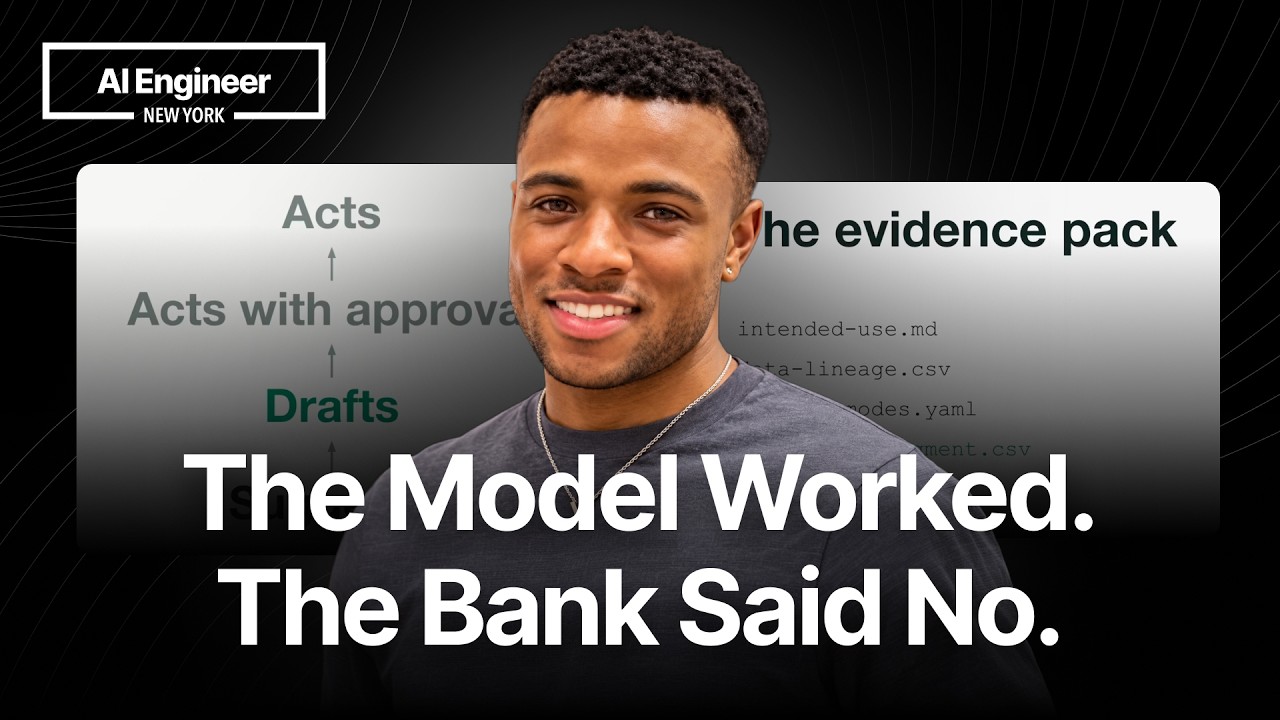
visible uncertainty to make a real judgment. A review button only helps if the person can actually check the work. So when thinking about autonomy, I want you to read the ladder from bottom up.
Suggest means the analyst receives a recommendation and chooses what to do with it. Draft means the system prepares something the analyst checks and submits. That is a highlighted step.
Acts with approval means a person authorizes each action before it happens. Acts means the system operates within limits that have already been approved. Each step changes the
consequences of an error. However, it also changes which controls must work and which reviewer needs to be convinced. I would start at the lowest step that creates value. Then collect
evidence from there. Are the reviews overriding the drafts? Which failures keep recurring? Can people recover when something breaks? Use those observations to make the next authority decision. A
model does not become more capable by itself. Answer how much authority this particular workflow should give it. So now let's make that concrete with the same hypothetical exception assistant.
Suppose the initial request is an agent that reads client documents, decides which ones fall outside of policy, and files exceptions automatically. In that design, the model's judgment can become
an operational action without an analyst checking each case. Now keep the model and change the action boundary. It highlights a likely exception, points to the relevant source, and prepares a
draft form. The analyst checks the evidence, corrects the form, and chooses whether to submit. Follow that sequence on the slide. Model, human, submit. I'll take that design to the people we found
during discovery. Can this use the analyst existing workflow? Does the approved data access cover the processing? Which controls apply? And what evidence do the reviewers need?
Human review does not guarantee approval and it does not determine a regulatory category on its own. We still have to confirm the intended use and the required reviews. The useful question is
whether this drafting version solves enough of the problems to ship first. If it does, we can collect evidence about errors, overrides, and recovery while operating within that boundary. The next
decision about authority can draw on what happened in real use. That makes the evaluation part of the operating plan. And that brings us to our fourth promise. An evaluation the risk team can
use for evidence, which really just means the ones they're responsible for managing. At Google, the question I needed answered was what happens when the system breaks, who notices, what
stops, who takes responsibility, how long will it take to bring back up. For an AI deployment, I want the same concrete account, right? The intended use, a threat model, the failure modes,
and a response plan. Show me the controls working when the model gets something wrong. Name the person who receives the alert and can stop the workflow. That gives a practical way to
evaluate our example. So going back to our lovely example, the hypothetical exception assistant. If it invents an exception, the analyst checks the source passage and rejects the draft. If
extraction produces unreadable text, stop and request a clean file. If it misses exceptions, targeted offline cases help expose that weakness. They do not detect every live miss. Keep
affected work under manual review. For each failure, name the detection path, the fallback, and its owner. Put those decisions in an evidence pack. These five files make the review complete.
Intended use, record users, boundaries and prohibited actions. Data lineage, records, each example source and use approval, failure modes, records detection and fallback, results by
segment, record coverage and errors controls, record reviews, thresholds, stopping rules and owners. So with all of this, we generate the evidence with each evaluation run. alongside it
preserve the input prompts model version configuration output reviewer action that lets us reconstruct the historical decision. Calling the model again later may produce a different answer. So we
preserve what actually happened. A reviewer can then expect that supporting record. So now we can take a look to see like what exactly is being used to organize that result which is in the
fourth file. For a hypothetical workflow, I would separate clean documents, scans, rare exceptions, and new document types. Measure the errors and control behaviors
in each group, then lead with the weakest result. An average can hide a serious gap in one segment. If a group has a little evidence, say so and restrict that use until you have enough.
This tells reviewers what the results support. And it also brings us back to our week one decisions. Now, just rounding everything up by Friday, I want five answers. Is the data owner engaged
and aware of this project? Are the production environment and its administrators named? Can the sponsor describe the workflow without saying AI? Can the smallest useful scope fit
existing controls confirmed with their owners? Do we know the risk signer and what happened to the person that signed last time? Use those answers as a planning heristic. Four or five yeses
suggest a credible path to ship. Three means unresolved decisions need owners and dates. Zero to two means resolve this decisions before committing to delivery, including possibly shrinking
scope or even redefining scope. This score does not predict approval, but it does tell us where to spend the next week. And here is what I would carry into these next conversations.
So to wrap this up, what I want people to walk away with is that discovery is the engineering. Draft the spec, then shrink it. Give the system only the authority it needs. Build the evidence
pack in sprint one. The demo worked. The model was fine. It still did not ship. So what do we do? We go find the people. Thank you for going through this presentation with me. My name is Peyton
Gail. I am a founding for deployed engineer writing the book on FTE for O'Reilly. And yeah, love to talk about FTE and everything related to it. If that's of interest, you can find me on
LinkedIn or my website painting.com has all of my information. Thank you again for watching today and yeah looking forward to