Enjoying this issue?
Get tomorrow's AI & engineering digest in your inbox — hand-picked, summarized, and always spam-free.
TLDR
Fable 5.2, a language model from Enthropic, scored 64.9% on the Robo Dojo robotics benchmark, outperforming other contemporary models by a significant margin. This is notable because robotics tasks have traditionally required specialized architectures rather than general-purpose LLMs. The result adds to evidence that LLMs are progressively improving at controlling robots through various methods.
Key points
Fable 5.2 achieved a 64.9% success rate on the Robo Dojo robotics benchmark.
Enthropic's experiment showed LLMs can control robots via direct commands, code writing, or pre-trained policies.
On ARC AGI 3, Fable 5.2 outperformed GPT6 Astra when using a standardized harness.
On Terminal Bench 4.0, Fable 5.2 ranked first among models with a standardized harness.
Fable 5.2 is 30% faster and cheaper than its predecessor Fable 5.1, but Enthropic models remain token inefficient.
Tools mentioned
Techniques
- direct low-level command control
- code-based robot control
- pre-trained policy coordination
Stop scrolling. Start reading smarter.
Receive the day's most important AI & engineering updates in one concise email. No spam.
Transcript (captions)
Wait, so Fable 5.2 scored this high on robotics? How is a language model performing this well on robotics benchmark? As we all know, robotics is inherently different like trying to
solve this Rubik's cube using robotic arms. Because the physical world is vastly unpredictable in nature, which is why researchers often use specialized architecture instead of LLMs to truly
understand the cause and effect that exists in the real world. You know, something that language models don't really have to contend with. But the fact that Feeble 5.2 can demonstrate
these capabilities using robotic arms and scoring almost 65% in average success rate on Robo Dojo benchmark is something that we should all pause and think about. Even going back a few
months ago, Enthropic made a post right here saying that LLMs are progressively getting better as you can see in interacting with robots. And within this very experiment, Enthropic tried to pair
an LLM with robot in different ways for the LLM to actually control the robot. An LLM can either directly control the motors by outputting low-level commands directly, or it could directly write
code that executes them, which then controls the robot, or use a pre-trained policy where the LM can send output commands to coordinate with the existing policy to control the robot. And looking
at the first case, we see this progression in language models ability to actually control the simulation by sending the commands directly. And same thing for LLM's writing code to control
the robot where newer models progressively get better at controlling them as newer flagship models are made available. And finally, LM interacting through an already pre-trained policy to
send commands to the policy to then interact with the goto robot on various tasks. This is showing better and better results as newer models become available. Pretty incredible for a
language model, right? Fast forward to Fable 5.2 model that was recently released. When we put this model into Robo Dojo simulation right here, you can see that they're asked to do various
tasks like stacking up objects vertically like this or even pouring water into the cup on a messy desk full of random objects. And all these are fairly complicated tasks. And Fable 5.2,
2, despite being a language model, was able to score 64.9% success rate in a simulated environment, which is significantly higher than contemporary models that we have at the
moment. As you can see, now this certainly doesn't mean that LMS will eventually subsume all other expressions of models and training methods that currently exist today. and vision
language action models and world action models still serve a really important role when it comes to specializing in different types of robotics that still knows how to best operate its own
equipment. But this really does make us think about how LLM could potentially be used on top of VAS to guide its actions if not entirely but definitely partly when we connect the dots from anthropics
experiment to the release of Fable 5.2. Now outside of how Fable 5.2 too pushed in robotics. The question is, what else is something worth noting about around the release of Fable 5.2? But first,
let's make sure that you have the right hardware at home for AI, which is why MicroEnter could be perfect sponsoring this video. November is here. And guess what? Mac Mini is still something you
can get from MicroEnter if you're looking for hardware to drive your AI needs. As you can see, MicroEnter is showing you deals on Mac Mini, gaming PC, a laptop, and monitors, or even this
3D printer. Especially those of you guys who are looking to train and build robots at home. You might need one of these soon. Personally, whether I'm actually shopping or not, I always like
to view deals on graphics cards because why not. And here I'm seeing that Nvidia RTX 5080 is on sale, as well as workstation grade GPUs are still on sale while the stock lasts. I just love
seeing all these hardware parts on sale. Anything from RAM to CPU, all of which I can keep an eye on for my next computer build. Also, MicroEnter's newest location in Austin is finally opening up
on November 13th, and as part of their grand opening, you can sign up to get a free 128 GB flash drive where you can redeem it in store when they open. So, if you're nearby, make sure that you
take advantage of this. I'll have the link in the description below. As I was reading through Feeble 5.2's model card, one thing that I found interesting was how OpenAI models always seems to lag
behind in benchmarks to enthropic models. In fact, there are even cases where even Opus and Sonnet outscore GPT6 Astra, which to me seems a little bit strange. Something that I noticed when
looking through Arc AGI 3 benchmark, for example, where the model interacts with the game simulation and makes different actions to solve different puzzles. As you can see, the disparity in score
between GPT6 Astra in Fable 5.2 is quite interesting. OpenAI clearly dominates when we use codecs in comparison to when Enthropic uses their own harness clot code. But as much as we look at this
standardized harness instead of vendor provided ones like clot code and codeex enthropic model as you can see specifically fable 5.2 completely dominates by a huge margin here. So
looking at ARCAGI3 benchmark, it's really showing how OpenAI can squeeze out more work when pairing Astra with codecs while enthropic models show stronger ability to actually perform
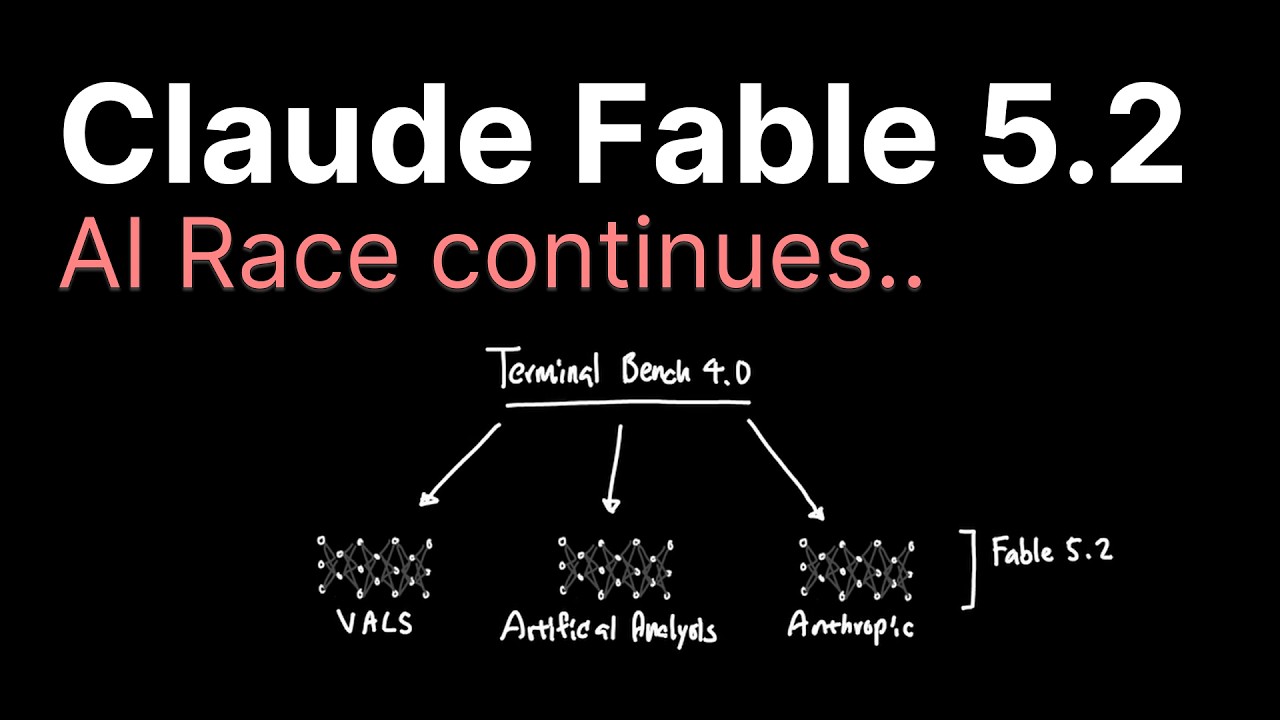
well on standardized harnesses like this. We can find a similar case here when we look at terminal bench 4.0 where as you can see the harness is standardized across all models and the
top three models here in this case are all claude models from enthropic fable 5.2, 2, Opus 5.5, and Sonnet 5.5, while GPT6 Astra is all the way down at the sixth place below Kim K 3.1 Pro and
Gemini 4 Carbon. And when we take the same benchmark and look at it from artificial analysis rendition of the Terminal Bench 4.0 that we just saw, in this case, Kim K 3.1 Pro scores first
place at 67.2% while GPT6 Astra is found all the way down at the sixth place. Again, this goes to show just how fragmented our industry currently is when it comes to
benchmarks. So, when you finally line up all these three, the same benchmark with different setup can give you anywhere from 67.6% to 65.15%
and 59.6%. Which all of this makes it really hard for us to get a good bearing on the model's true capabilities. Even looking at something like artificial analysis
composite score like this, even though it shows us what seems like raw intelligence of the model by diluting the harness layer by not using the vendor provided harness, but instead
using a standardized one to make it fair, harness is still the very much necessary counterpart to how we actually end up using these models into our workflow. And that's something for all
of us to keep in mind when we look at artificial anasis scoring here, which is that it doesn't really mirror the real downstream use case, but our expectation looking into this should be that its
scoring is based on specific conditions away from how it actually will be used downstream. Now, to be fair, Fable 5.2 outscored GPT6 Astra, even comparing them using their own preferred harness.
But separate from how useful it actually will be when we start factoring in the cost efficiency, token usage limits, and the harness. And the cost per frontier seems to show that Fable 5.2 broke a new
curve as it extended the highest score on the right as you can see. But anthropic models as a whole, including the new Fable 5.2 model, is still extremely token inefficient. It's also
worth noting that the cost of intelligence is dropping yet once again, as Fable 5.2 2 not only outscores the previous 5.1 model, but it comes at a cheaper API cost as you can see. And
based on their report, it produces output 30% faster than Fable 5.1.