Transcript (captions)
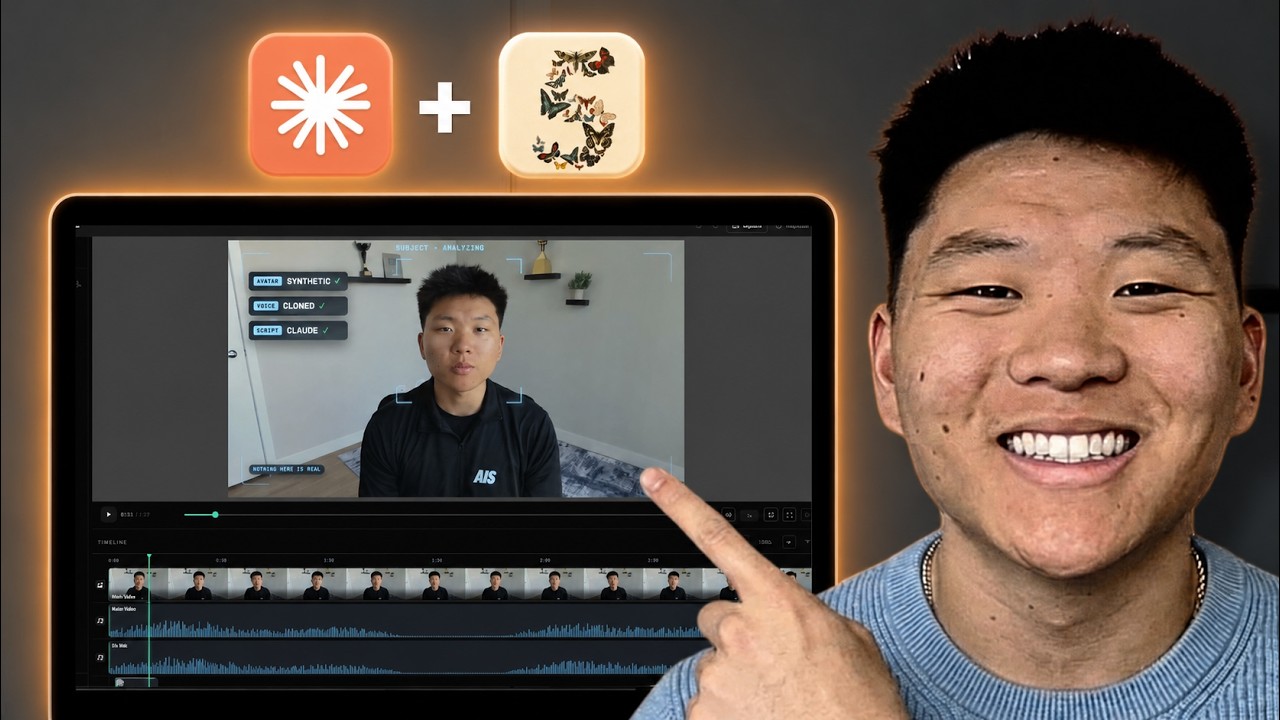
So, I literally just opened up Claude Fable, gave it this {slash} goal, went down to the gym, and came back to this. What you're watching right now was not filmed. This avatar is AI. The voice you're hearing is a clone of mine, and every single word of this script was written by Claude. I didn't write this, I didn't film it, I didn't edit it, and while it was being made, I never saw a single frame of it.
I just typed one prompt into Claude code and walked away. And everything else, the research, the script, the voice, the avatar, the motion graphics, all of it happened on its own. So, this week Anthropic released Claude Fable 5, and that's basically the only reason this video can exist. It's the first time a mythos class model, that's the tier above Opus, has been available to anyone on a paid plan. Until now, that tier was locked to vetted security partners.
And it's state-of-the-art on nearly every benchmark they tested. So, let me show you guys what this thing is actually good at, and then exactly how it made this video. So, the coding numbers first, because they're kind of nuts. Stripe said Fable 5 compressed months of engineering into days. And in the announcement, there's a 50 million line Ruby code base where it ran a full migration in a single day, a job that would have taken a whole team over 2 months by hand.
And vision took a big jump, too. It can rebuild a web app's source code just from screenshots. And it actually beat Pokémon Fire Red start to finish on raw screenshots alone. No maps, no navigation aids, where older Claude models needed a whole helper harness just to play. But the one that matters most for this video is long horizon focus.
This thing stays locked in across millions of tokens. Anthropic gave it a file-based memory. Like literally just files it could write notes to, and had it play Slay the Spire, and it reached the final act three times more often than Opus 4.8. Now, it's not cheap. 10 bucks per million input tokens, 50 on the output.
But you guys are about to see what that buys you. Okay, so real quick, how did this video actually get made? First, the script. Claude read Anthropic's full announcement, fact-checked every claim you just heard, and wrote this entire thing in my voice using a voice playbook built off my actual transcripts. Then the voice.
It sent that script over to 11 Labs where I've got a voice clone trained on my real videos. And the trick is you can't just generate like four straight minutes of audio because the longer a generation runs, the more the voice starts to drift. So Claude split the script into chunks just under a minute each and generated them separately. Then every chunk went to HeyGen to render on my avatar on the Avatar 5 model, their newest motion engine. And for a while you couldn't even select Avatar 5 through the API, so the workaround was Claude literally driving a browser with Playwright and flipping every video by hand.
Their new API finally exposes it, so this one went straight through. But at that point it's just a pile of raw avatar clips and nothing's been edited yet. And then the editing, which is usually the part that takes a human days. Claude stitched the avatar clips together with FFmpeg, ran a word-level transcription, and built every motion graphic in this video as actual code, HTML animated with GSAP inside hyperframes, timed to the exact words I'm saying. Then it checked its own work.
It rendered out frames from every scene and visually reviewed them, and anything that looked off got fixed and re-rendered until it all passed. So one prompt went in and a finished, fully edited YouTube video came out the other side. That's what a Mythos Class model does the same week it comes out. But anyways, that's going to do it for this one. So if you guys enjoyed the video or learned something new, please give it a like.
It definitely helps me out a ton. And as always, I appreciate you guys making it to the end of the video. I'll see you on the next one. Thanks everyone. I mean, isn't that amazing?
Even all those sound effects, everything in there, one shot by Claude Fable 5. Now two quick things to keep in mind. First of all, if you copy that exact same prompt, I'm not convinced you would get the exact same results because I've got a few different like hyperframe skills that are already in there. And then number two, I don't think you actually need Fable to do all this. I could definitely replicate this style.
Now that I've already built it out once, I could build a skill around it, but I think that I could replicate that style with probably even Sonnet. This is the actual session that I ran. This only took an hour as you can see, and I used {slash} goal. So, the goal was achieved in an hour. It took about 400,000 tokens, 380,000 tokens.
But, keep in mind, I did have it spin up a dynamic workflow at the end to verify everything. So, it had a bunch of agents taking screenshots and verifying everything, even those sound effects. All of the sound effects in that final render was built right in here with Claude Fable and Hyperframes. You'll also notice that I was on max. So, obviously there was a lot of energy being put into here.
But, when it spun up the sub-agents, all of those sub-agents in the workflow were not Fable. But, you do seriously have to be careful. This was obviously me doing an experiment, and I just wanted to see what it could do. This ate up about 40% of my $200 a month plan. So, in 1 hour, it ate up almost half of the plan.
So, obviously, be careful. You can see here it says done, the video is ready to upload. This is where it lives. This is how long it is. Here's what I built.
Here's how it was verified. And it has this weird thing where I'm trying to scroll up to show you guys the prompt, but it like cut off. So, let's see if I can recover that. Okay, so here is the exact goal prompt that I set. I'm not going to read this entire thing, but you guys can pause the video and and read it if you want.
You'll notice here at the end what I did is I I gave it context. I said, "You should only stop when you are 100% confident that this is a high-quality video. This will be going out to my YouTube channel, so if it doesn't look good, you know, it's high risk. It will damage my reputation." Now, obviously, like with {slash} goal, you want to do things that are pretty objective, but I have found that when I give it context, so it understands why we're doing something, it tends to understand a little bit better. I also said here, "Now, after you build it, verify it.
Use a dynamic workflow to visually verify and validate that the entire video is perfect. The motion graphics come in on time. There's nothing out of bounds. Everything is aesthetic, and everything fits within the goal of a completely finished and fully vetted and reviewed YouTube video." So, anyways, this was my Glido word vomit into Claude goal, and then that's what we got. So, that is going to do it for today.
You'll even notice that my HeyGen ended the video the exact same way I always do, which is, "If you enjoyed the video, or you learned something new, please give it a like. That really helps me a ton. And as always, I appreciate you guys making it to the end of the video. I'll see you on the next one. Thanks, guys.